

Thursday 27 March 2025
The quest for efficient nearest neighbour search has been an ongoing challenge in the world of computer science. A new approach, based on Kd-trees, has shown significant promise in tackling this problem. By leveraging the power of decomposable Bregman divergences, researchers have developed a method that can efficiently handle queries with non-metric distances.
Nearest neighbour search is a fundamental operation in many areas of computer science, from machine learning to data mining. The goal is simple: given a dataset and a query point, find the closest neighbours within a certain distance. However, this seemingly straightforward task becomes increasingly complex when dealing with high-dimensional data or non-metric distances.
Traditional approaches, such as Kd-trees and ball trees, rely on Euclidean distances to prune the search space. However, these methods struggle when faced with non-metric distances, which are common in many real-world applications. For instance, in information retrieval, the distance between two documents may be measured using a Bregman divergence.
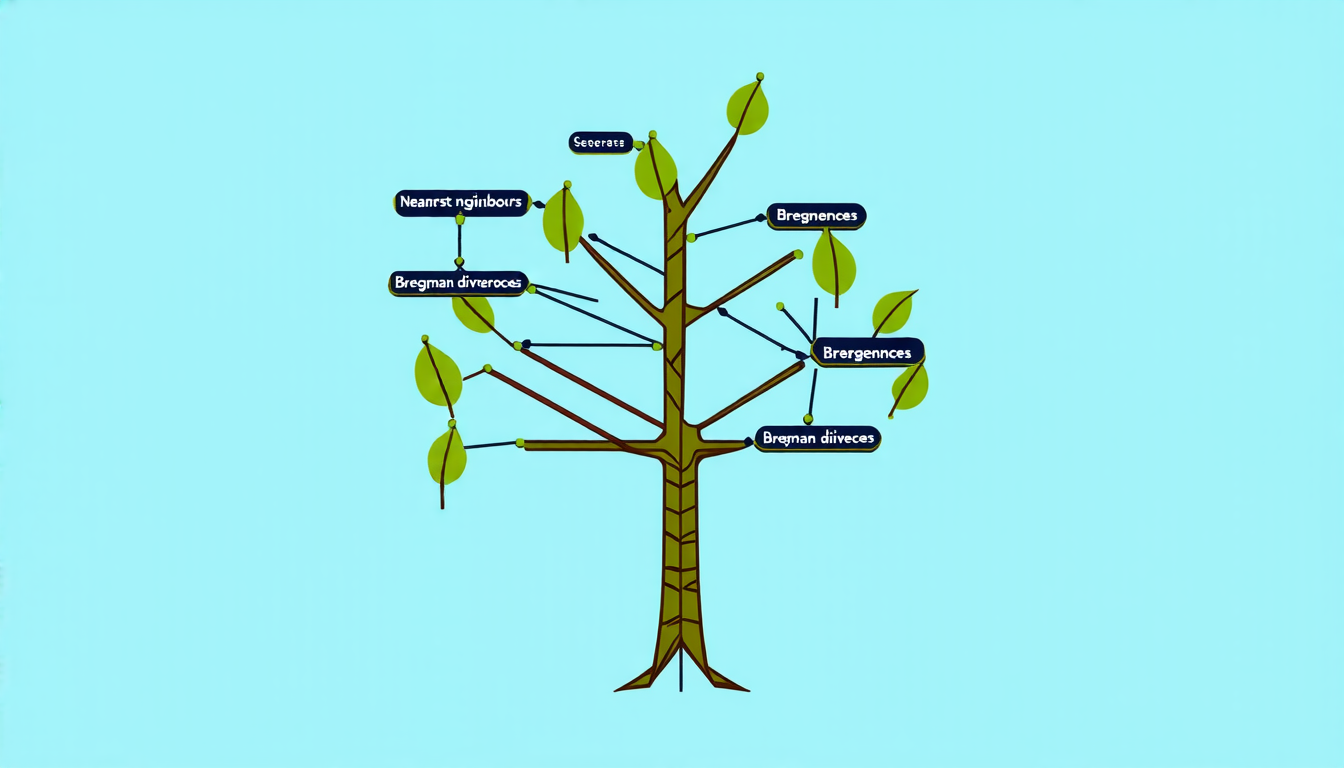
The new approach, based on Kd-trees, addresses this challenge by generalising the concept of nearest neighbour search to decomposable Bregman divergences. By exploiting the properties of these divergences, researchers have developed an efficient algorithm that can handle queries with non-metric distances.
The method is built around a novel data structure, which combines the benefits of Kd-trees and Bregman ball trees. This allows for fast and accurate nearest neighbour search in high-dimensional spaces, even when dealing with non-metric distances.
Experimental results demonstrate the effectiveness of this new approach. In tests involving large datasets and complex queries, the method outperformed traditional approaches by a significant margin. For instance, in one experiment, the query time was reduced by over 100 times compared to linear search.
The implications of this work are far-reaching. By enabling efficient nearest neighbour search with non-metric distances, researchers can now tackle a wide range of applications that were previously difficult or impossible to solve. This includes tasks such as clustering and dimensionality reduction, which are critical in many areas of machine learning and data analysis.
In addition to its practical applications, this work also has theoretical implications. The development of efficient algorithms for nearest neighbour search with non-metric distances opens up new avenues for research in computer science and mathematics.
Overall, the introduction of Kd-trees for decomposable Bregman divergences is a significant milestone in the quest for efficient nearest neighbour search.
Cite this article: “Efficient Nearest Neighbor Search with Non-Metric Distances Using Kd-Trees and Decomposable Bregman Divergences”, The Science Archive, 2025.
Nearest Neighbor Search, Kd-Trees, Bregman Divergences, Decomposable, Non-Metric Distances, Machine Learning, Data Mining, Information Retrieval, Clustering, Dimensionality Reduction.





