

Thursday 27 March 2025
The quest for a reliable and efficient way to store quantum information has reached another milestone, as researchers have successfully demonstrated an optical quantum memory that can store time-bin qubit states with high fidelity.
This achievement is significant because it paves the way for the development of more robust and practical quantum communication systems. Quantum communication relies on the ability to transmit and store quantum information securely over long distances, which requires a reliable method for storing and releasing quantum states.
The new optical quantum memory uses a unique approach that leverages the properties of light to store information in a time-bin qubit state. A time-bin qubit state is a type of quantum state that represents the duration between two pulses of light. By controlling the timing of these pulses, researchers can encode and decode quantum information.
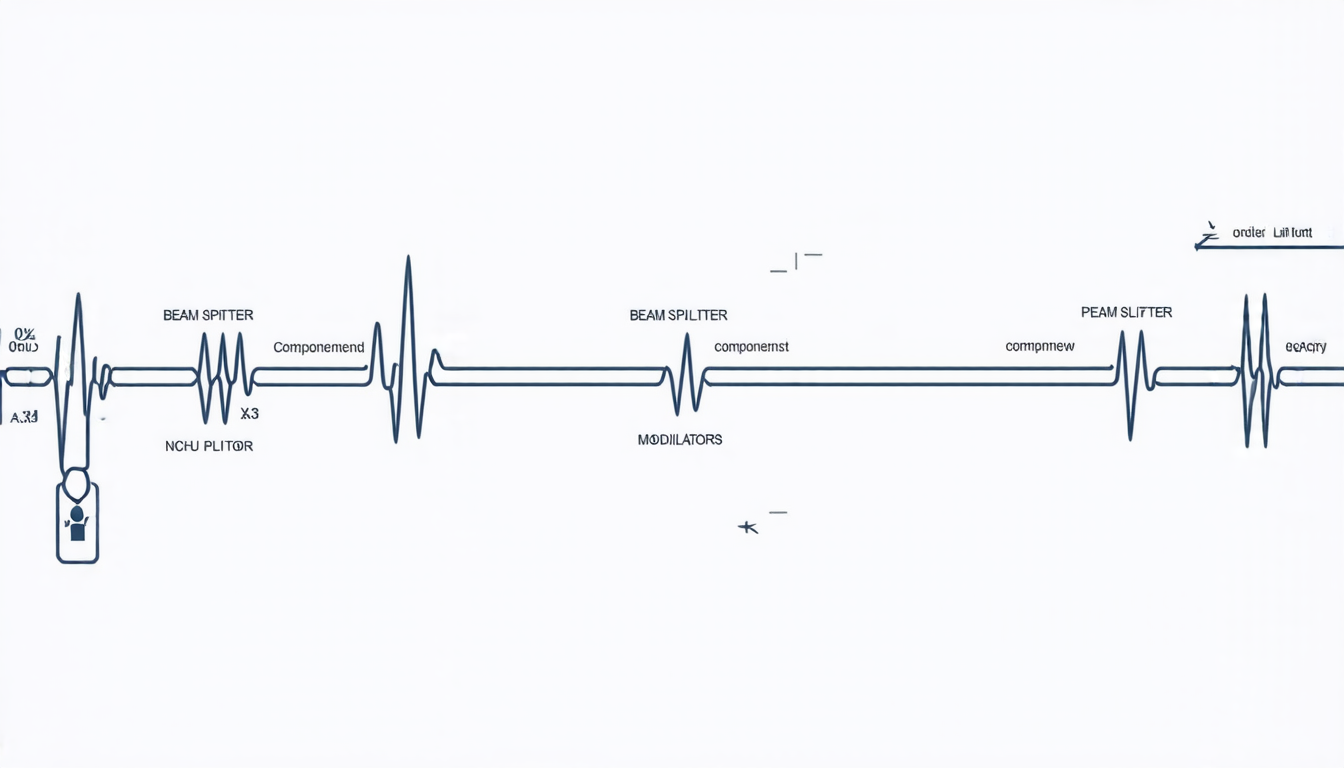
The memory is based on an all-optical setup that uses a combination of optical components to manipulate the light pulses. The setup includes a polarization beam splitter, which separates the light into its horizontal and vertical polarization components. A phase modulator is then used to encode the time-bin qubit state onto the light pulses.
The encoded information is stored in a cavity, where it remains until it is read out by applying a high-voltage signal to the pockels cell. The pockels cell is a type of optical component that changes the polarization of light when an electric field is applied.
The researchers demonstrated the memory’s ability to store time-bin qubit states with high fidelity by measuring the output state after storage for different numbers of rounds. They found that the average single-round efficiency was 95%, and the overall state fidelity exceeded 99.1%.
This achievement has significant implications for the development of quantum communication systems. The ability to store quantum information reliably over long distances will enable more secure and efficient transmission of data.
The researchers are now exploring ways to scale up the technology and integrate it into practical applications. They believe that this technology could be used in a variety of fields, including cryptography, telecommunications, and even space exploration.
In addition to its potential applications, the new optical quantum memory also provides insights into the fundamental physics of quantum information processing. The researchers’ approach has shed light on the behavior of quantum states under different conditions, which will help inform the development of future quantum technologies.
Overall, this achievement represents a significant step forward in the quest for reliable and efficient quantum communication systems.
Cite this article: “Breakthrough in Optical Quantum Memory Enables Secure Data Storage”, The Science Archive, 2025.
Quantum Information, Optical Memory, Time-Bin Qubit States, High Fidelity, Quantum Communication, All-Optical Setup, Polarization Beam Splitter, Phase Modulator, Pockels Cell, Single-Round Efficiency.





