

Thursday 27 March 2025
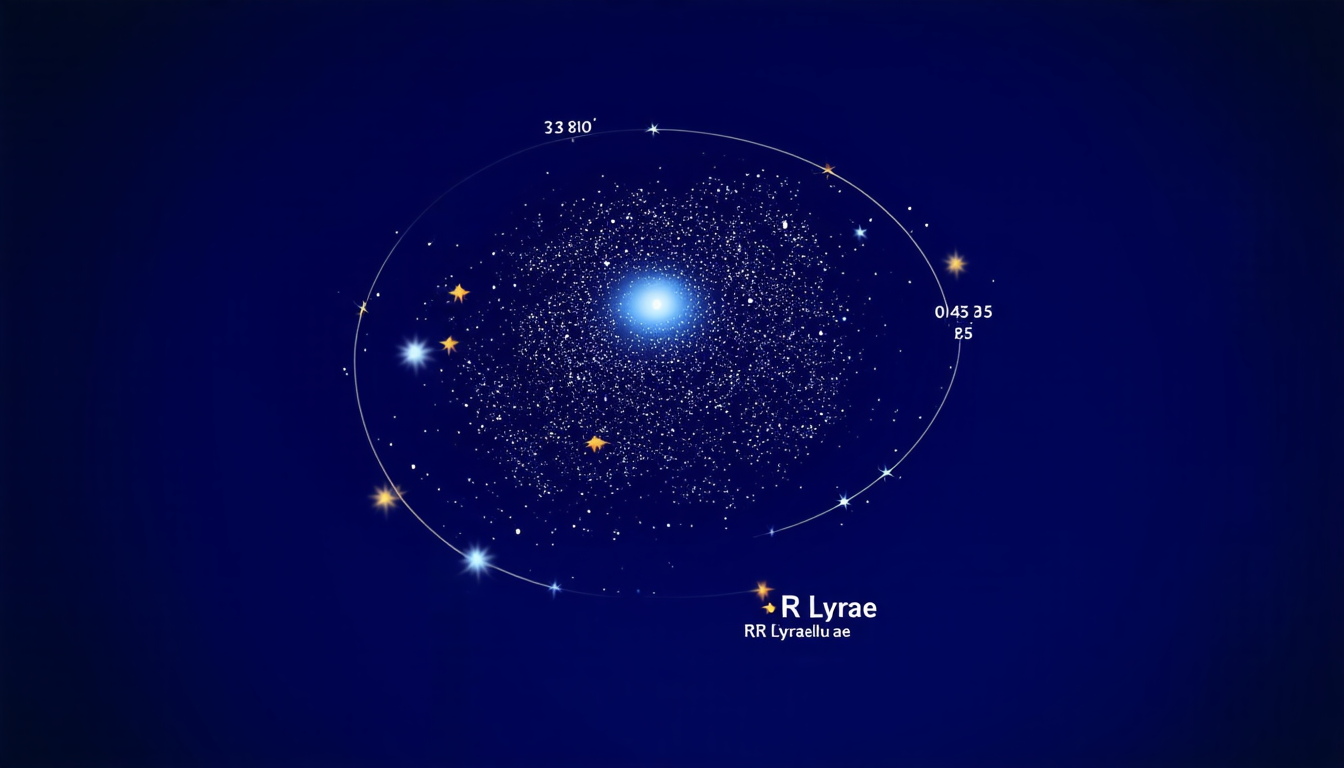
In a recent study, astronomers have been exploring the mysteries of RR Lyrae stars, which are a type of variable star that can be used as distance indicators in the universe. These stars are found in globular clusters and are known for their short periods and low metallicities.
The researchers used computer simulations to model the formation and evolution of these stars, taking into account various factors such as the initial mass of the stars, their orbital eccentricity, and the distribution of stars within the globular cluster. They then compared their results with observations of RR Lyrae stars in our own galaxy, the Milky Way.
One of the key findings was that the majority of RR Lyrae stars in the Milky Way are not part of globular clusters at all, but rather have originated from orbitally decayed globular clusters. This suggests that many of these stars may have once been part of a larger cluster that has since dissolved or been disrupted.
The study also found that the distribution of RR Lyrae stars within the galaxy is influenced by their initial orbital eccentricity and the distribution of stars within the cluster. In particular, stars with higher eccentricities tend to be more concentrated towards the center of the galaxy, while those with lower eccentricities are more spread out.
These results have important implications for our understanding of the structure and evolution of galaxies like the Milky Way. By studying RR Lyrae stars in detail, astronomers can gain insights into the formation and evolution of these galaxies, and how they have changed over time.
The researchers used a variety of methods to analyze their data, including statistical modeling and computer simulations. They also compared their results with observations from other studies, such as those using the Hubble Space Telescope.
One of the most interesting aspects of this study is its potential application to understanding distant galaxies. By studying RR Lyrae stars in our own galaxy, astronomers can gain insights into how these stars might behave in other galaxies, and how they could be used as distance indicators.
The researchers also found that there are many more RR Lyrae stars than previously thought, with some estimates suggesting that there may be over 38000 of them in the Milky Way alone. This has important implications for our understanding of the population dynamics of these stars, and how they interact with their surroundings.
Overall, this study provides a fascinating glimpse into the lives of RR Lyrae stars, and how they can help us better understand the universe.
Cite this article: “Unraveling the Mysteries of RR Lyrae Stars”, The Science Archive, 2025.
Rr Lyrae Stars, Variable Stars, Distance Indicators, Globular Clusters, Milky Way Galaxy, Star Formation, Stellar Evolution, Computer Simulations, Statistical Modeling, Astronomy
Reference: Roberto Capuzzo-Dolcetta, “The RR Lyrae distribution in the Galactic Bulge” (2025).





