

Thursday 27 March 2025
A team of mathematicians has made a significant breakthrough in understanding the properties of Riordan arrays, a type of mathematical structure that has far-reaching implications for fields such as combinatorics and computer science.
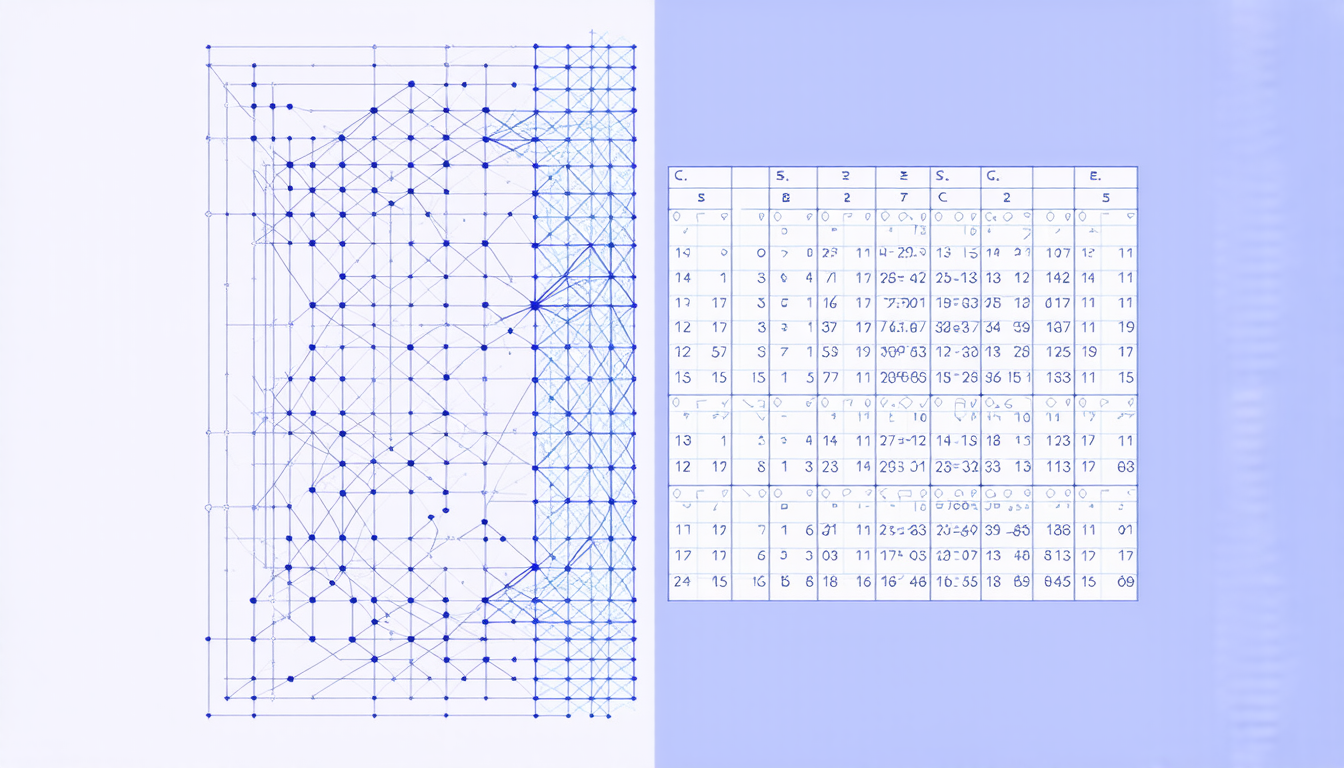
Riordan arrays are named after their discoverer, Ronald Riordan, who first described them in the 1950s. They are essentially tables of numbers that follow specific rules, allowing mathematicians to use them to solve complex problems in a variety of areas. However, despite their importance, many aspects of Riordan arrays remain poorly understood.
One of the key challenges facing researchers is the study of pseudo-involutions, which are a type of symmetry that can be applied to Riordan arrays. Pseudo-involutions have been shown to play a crucial role in understanding the properties of these arrays, but they are notoriously difficult to work with due to their complex mathematical structure.
The new paper tackles this problem by developing a novel approach to studying pseudo-involutions in Riordan arrays. By using a combination of algebraic and combinatorial techniques, the researchers have been able to gain a deeper understanding of how these symmetries work and how they can be used to solve problems.
One of the key findings of the paper is that pseudo-involutions are closely related to Chebyshev polynomials, a type of mathematical function that has many practical applications. This connection has significant implications for fields such as computer science, where Chebyshev polynomials are commonly used in algorithms and data analysis.
The researchers have also developed new methods for calculating the B-function of Riordan arrays, which is a fundamental property of these structures. The B-function is a type of mathematical function that describes the relationship between different elements of a Riordan array, and it plays a crucial role in many applications.
In addition to its theoretical significance, this research has important practical implications. For example, it could be used to improve the efficiency of algorithms used in computer science and cryptography. It also opens up new possibilities for studying other types of mathematical structures that are related to Riordan arrays.
Overall, this paper represents a major advance in our understanding of Riordan arrays and their properties. Its findings have significant implications for many fields, and it is likely to be an important reference point for researchers in the years to come.
Cite this article: “Breakthrough in Understanding Riordan Arrays and Pseudo-Involutions”, The Science Archive, 2025.
Mathematics, Riordan Arrays, Combinatorics, Computer Science, Algebraic Techniques, Combinatorial Techniques, Pseudo-Involutions, Chebyshev Polynomials, B-Function, Symmetries





