

Thursday 27 March 2025
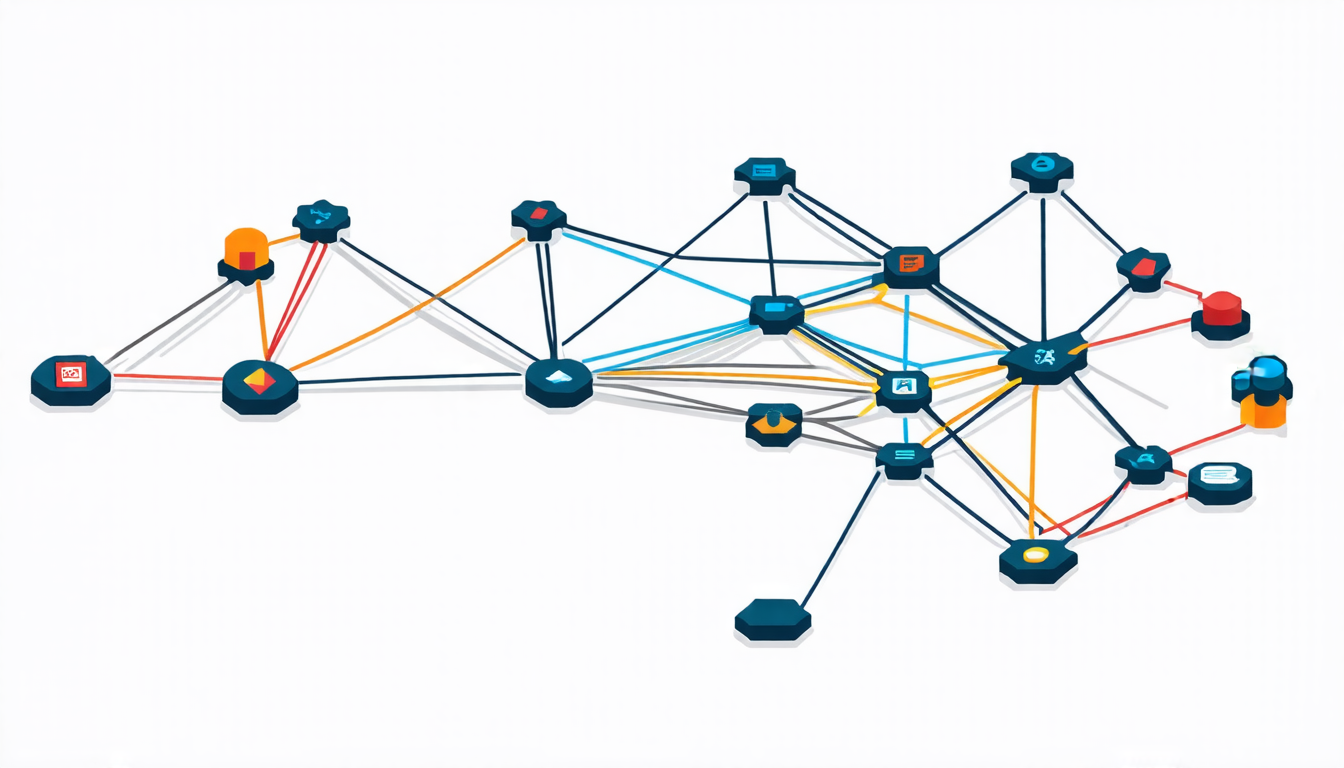
Boolean networks, those complex systems of interconnected components that govern everything from traffic flow to gene regulation, have long been the subject of intense study in the fields of computer science and biology. But until recently, researchers had a limited understanding of how these networks behaved when their components were updated asynchronously – that is, at different times.
Now, a team of scientists has cracked the code on this problem, revealing a fundamental property of asynchronous Boolean networks that could have far-reaching implications for our understanding of complex systems.
The key insight comes from a simple yet powerful observation: in an asynchronous network, all states converge to a single fixed point. In other words, no matter what the initial conditions are, the system will always settle into a stable equilibrium state.
This might seem like a straightforward result, but it has significant implications for our understanding of complex systems. For example, it suggests that even in the absence of any global control mechanism, asynchronous Boolean networks can still exhibit emergent behavior – that is, behavior that arises from the interactions between individual components rather than being predetermined by some central authority.
The researchers achieved this result by developing a new mathematical framework that allows them to analyze the behavior of asynchronous Boolean networks. This framework relies on a combination of graph theory and dynamical systems techniques, which together provide a powerful tool for understanding how complex systems evolve over time.
One of the most interesting implications of this work is its potential application to biological systems. Gene regulation, for example, is often thought of as a highly complex process that involves the interactions between many different genes and proteins. By using asynchronous Boolean networks to model these interactions, researchers may be able to gain new insights into the behavior of biological systems – insights that could ultimately lead to the development of new treatments for diseases.
The study also has implications for computer science, where it could be used to design more efficient algorithms for solving complex problems. For example, asynchronous Boolean networks could be used to model traffic flow or supply chain management, allowing researchers to develop more effective strategies for optimizing these systems.
Overall, this work represents a significant advance in our understanding of complex systems – and its potential applications are vast and varied. By unlocking the secrets of asynchronous Boolean networks, researchers have taken a major step towards developing new tools and techniques for analyzing and manipulating complex systems.
Cite this article: “Unlocking the Secrets of Asynchronous Boolean Networks”, The Science Archive, 2025.
Boolean Networks, Asynchronous Updating, Complex Systems, Graph Theory, Dynamical Systems, Gene Regulation, Biological Systems, Computer Science, Algorithms, Optimization.
Reference: Brigitte Mossé, Sasha Pignol, Elisabeth Remy, “On a theorem of François Robert” (2025).





