

Thursday 27 March 2025
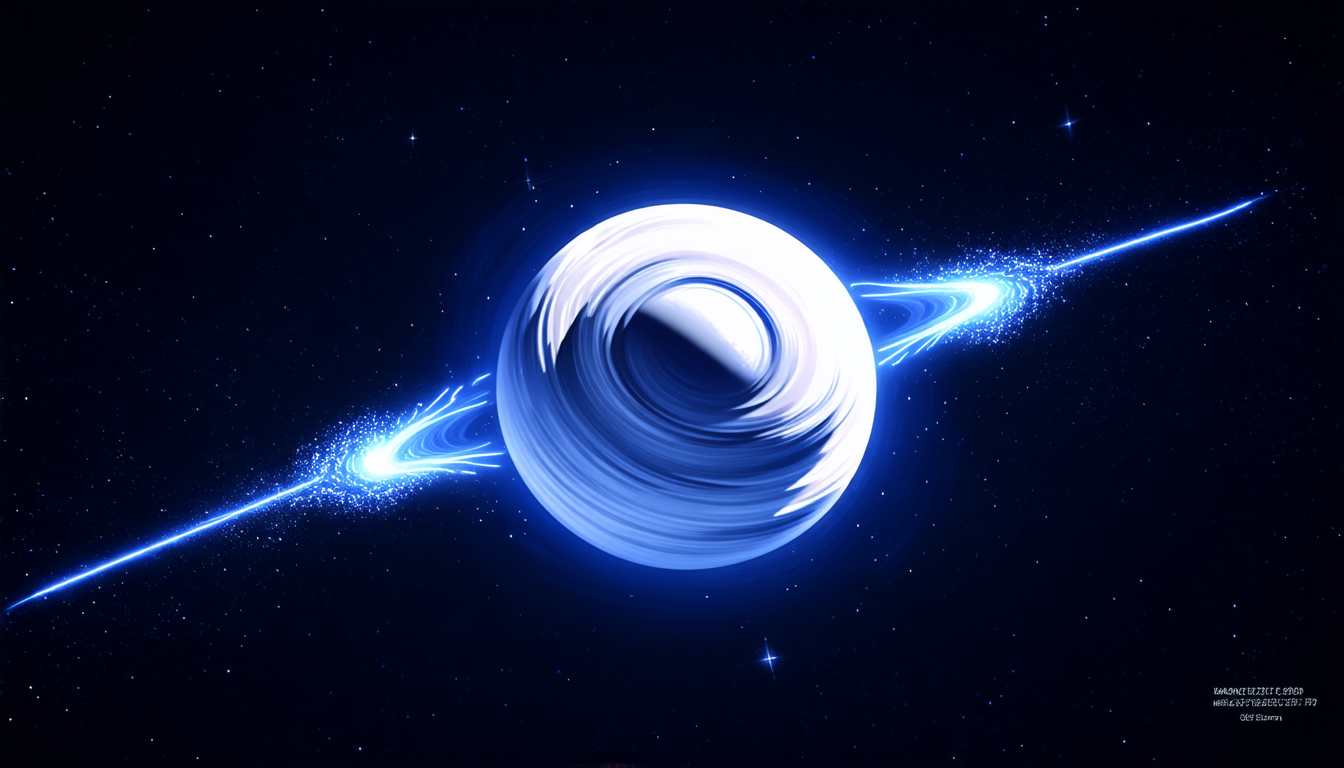
Astronomers have made a fascinating discovery about GK Persei, an old nova and intermediate polar star system located around 432 light-years away from Earth. By studying X-ray emissions from the system during a recent outburst, researchers have shed new light on the complex magnetic interactions within the star.
GK Persei is an unusual object because it exhibits both novae-like eruptions, where a massive amount of energy is released as a result of material accumulating on the surface of a white dwarf star, and intermediate polar behavior, characterized by strong magnetic fields that cause the star’s rotation to modulate its X-ray emission. This combination makes GK Persei an attractive target for scientists seeking to understand the intricate relationships between magnetic fields, mass accretion, and energy release in these systems.
By analyzing data from NASA’s Swift Gamma-Ray Burst Mission, astronomers have identified a series of spin-modulated X-ray pulses emanating from GK Persei during its 2010 outburst. These pulses are thought to be caused by the star’s strong magnetic field, which interacts with the accreted material in a way that creates regions of intense radiation.
The researchers used sophisticated computer simulations and data analysis techniques to disentangle the complex patterns of X-ray emission from GK Persei. They found that the system’s soft X-ray emission, which is thought to originate near the magnetic poles, exhibits a different modulation pattern than its harder X-ray emission, which arises from hotter regions closer to the white dwarf star.
This finding suggests that there may be two distinct components contributing to the system’s overall X-ray luminosity. The softer radiation could be produced by matter flowing along strong magnetic field lines, while the harder radiation might originate from hot plasma flows triggered by reconnection events in the magnetic field.
The study of GK Persei offers valuable insights into the intricate physics governing these complex astrophysical systems. By understanding how magnetic fields and mass accretion interact to produce X-ray emission, scientists can gain a better grasp of the underlying processes driving the behavior of cataclysmic variable stars like GK Persei.
In addition to advancing our knowledge of these star systems, this research has implications for the broader field of astrophysics. The study of magnetic fields and their role in shaping the behavior of celestial objects is crucial for understanding a wide range of phenomena, from the dynamics of black holes and neutron stars to the formation of planetary systems.
Cite this article: “Magnetic Interactions Revealed in Unusual Star System”, The Science Archive, 2025.
Gk Persei, Nova, Intermediate Polar, X-Ray Emissions, Magnetic Fields, Mass Accretion, Energy Release, Swift Gamma-Ray Burst Mission, Computer Simulations, Astrophysics





