

Thursday 27 March 2025
A recent discovery has shed new light on the intricacies of knot theory, a branch of mathematics that studies the properties of knots and their applications in various fields. Researchers have long been fascinated by the behavior of knots, which can be thought of as loops that cannot be untangled without cutting them.
Knots are an essential part of many areas of science and engineering, from the study of DNA molecules to the design of complex systems like power grids or computer networks. However, understanding the properties of knots is a challenging task, especially when it comes to unoriented knots – those that do not have a preferred direction.
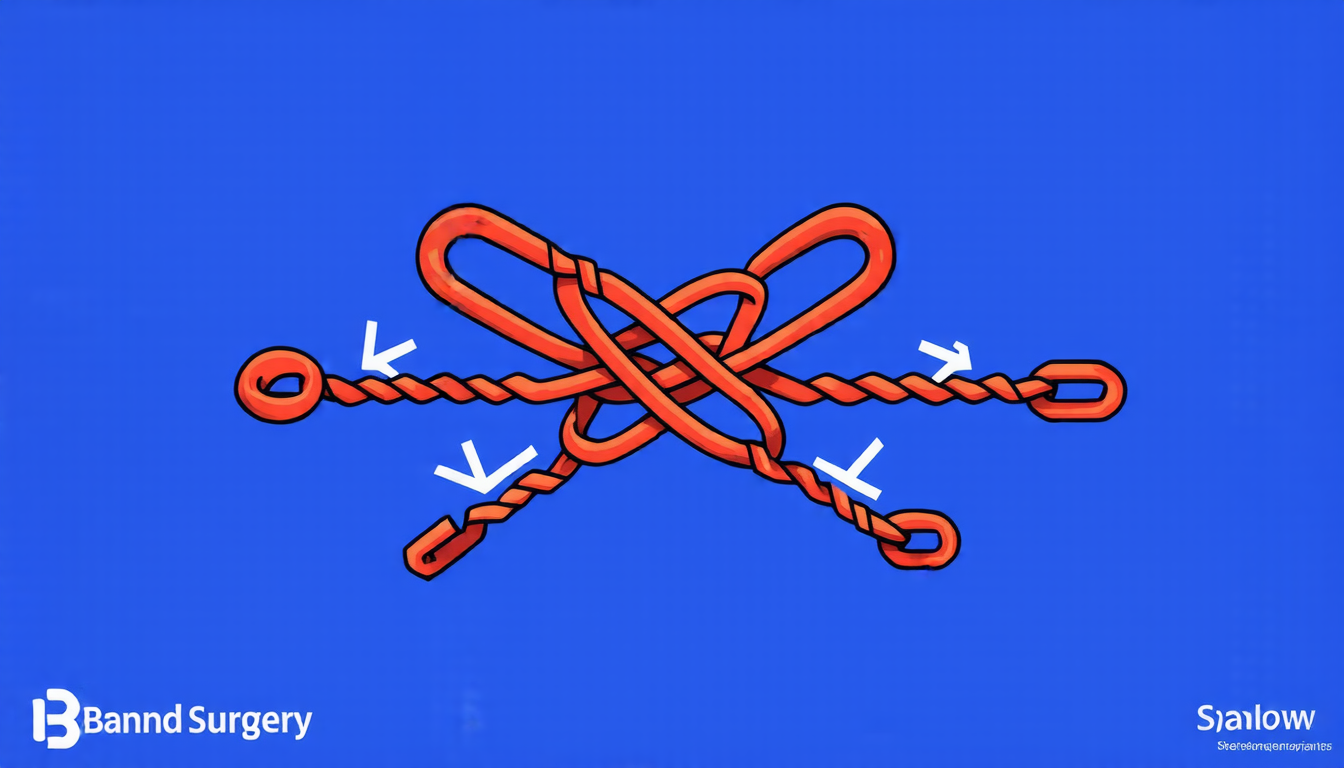
The new research focuses on the concept of band surgery, which involves cutting and rejoining a knot in specific ways to create new knots. By studying the number of times this process can be repeated before the resulting knot is transformed into the unknot (a loop that can be untangled), researchers can gain insights into the properties of unoriented knots.
In particular, the study reveals that there is a direct link between the number of band surgeries required to transform a knot and its topological properties. The research also provides a new way to calculate the unoriented band unknotting number, which measures the minimum number of band surgeries needed to turn an oriented or unoriented knot into the unknot.
The implications of this discovery are far-reaching, with potential applications in fields such as materials science, where understanding the behavior of knots can help design new materials with unique properties. The research also opens up new avenues for studying the properties of complex systems, such as networks and biological molecules.
One of the key challenges in knot theory is the difficulty of visualizing and manipulating knots, which are often three-dimensional objects that cannot be easily represented on a two-dimensional surface. To overcome this challenge, researchers use mathematical tools and computer simulations to study the behavior of knots.
The new research builds upon previous work in knot theory, which has shown that certain types of knots can be transformed into each other through band surgery. However, until now, it was not clear how many times this process could be repeated before the resulting knot is transformed into the unknot.
The discovery is a significant step forward in understanding the properties of unoriented knots and their applications in various fields. It highlights the importance of mathematical research in advancing our knowledge of complex systems and their behavior.
Cite this article: “Unlocking the Secrets of Unoriented Knots”, The Science Archive, 2025.
Knot Theory, Unoriented Knots, Band Surgery, Topological Properties, Unknot, Materials Science, Computer Networks, Dna Molecules, Power Grids, Mathematical Research
Reference: Keisuke Himeno, “The unoriented band unknotting numbers of torus knots” (2025).





