

Friday 28 March 2025
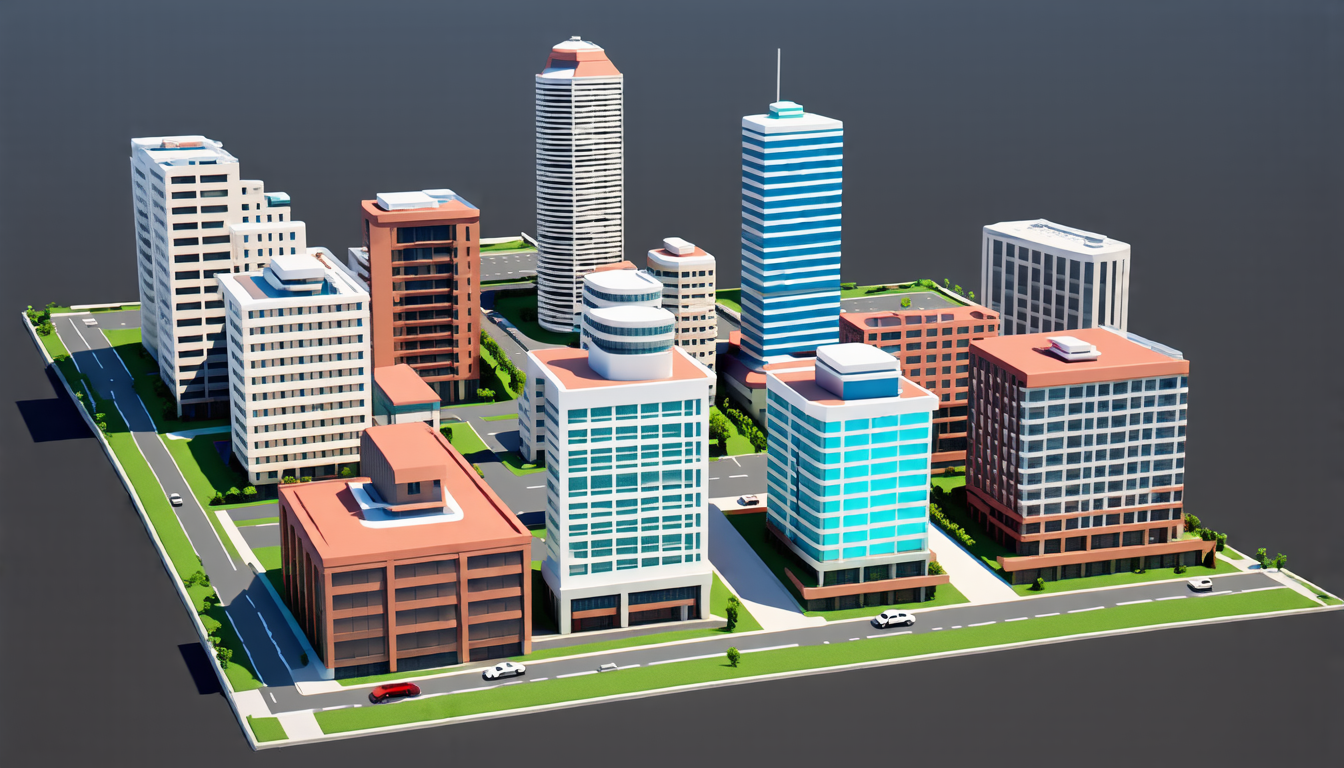
The quest for more accurate and detailed 3D city models has been a long-standing challenge in the field of computer vision and geographic information systems (GIS). These models are crucial for various applications, such as urban planning, infrastructure management, and natural disaster response. Recently, researchers have made significant progress in this area by developing new methods for generating high-quality 3D building models from point clouds.
One of the key challenges in generating 3D city models is dealing with incomplete or missing data. This can occur due to various factors such as limited sensor coverage, occlusions, or noise in the point cloud data. To address this issue, researchers have developed a novel approach that combines deterministic ray analysis with personalized Stable Diffusion (SD) inpainting.
The new method, dubbed FacaDiffy, uses a text prompt to guide the inpainting process and ensure that the generated 3D building models are semantically meaningful and accurate. The authors of the study evaluated FacaDiffy on a dataset of annotated facade images and found that it outperformed existing image inpainting baselines in terms of structural similarity and semantic consistency.
FacaDiffy’s ability to handle incomplete data is particularly impressive, as it can effectively complete conflict maps derived from point clouds. Conflict maps are essential for various applications such as urban planning and infrastructure management. The authors demonstrated the effectiveness of FacaDiffy by applying it to a real-world scenario involving the reconstruction of a 3D building model.
The study’s findings have significant implications for the development of more accurate and detailed 3D city models. By combining deterministic ray analysis with personalized SD inpainting, researchers can generate high-quality 3D building models from point clouds even in the presence of incomplete or missing data. This breakthrough has the potential to revolutionize various fields such as urban planning, infrastructure management, and natural disaster response.
The authors’ approach is not limited to 3D city modeling; it can be applied to other applications where high-quality image reconstruction is required. The study’s results demonstrate the power of combining traditional computer vision techniques with deep learning methods to tackle complex problems.
In the future, researchers may build upon this work by exploring new ways to incorporate domain knowledge and user feedback into the inpainting process. Additionally, they may investigate the application of FacaDiffy to other types of data, such as video or sensor data.
Cite this article: “Revolutionizing 3D City Modeling with FacaDiffy: A Novel Approach for Inpainting Point Clouds”, The Science Archive, 2025.
3D City Models, Computer Vision, Geographic Information Systems, Point Clouds, Ray Analysis, Stable Diffusion Inpainting, Facade Images, Urban Planning, Infrastructure Management, Natural Disaster Response





