

Friday 28 March 2025
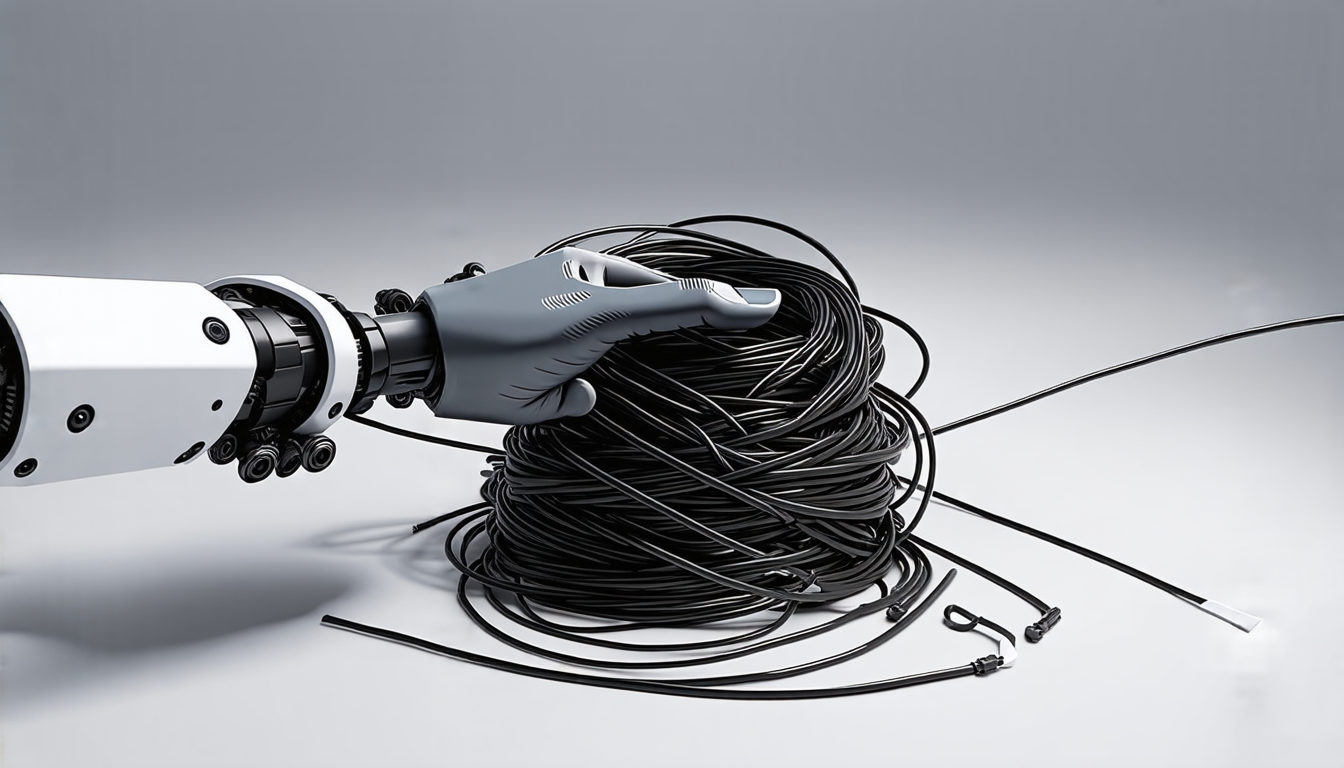
Robots are getting better at manipulating complex objects, like tangled wires or knotted ropes, thanks to a new paper that’s making waves in the field of robotics.
The problem is that these objects can be tricky to work with because they’re made up of many flexible pieces that can twist and turn in all sorts of ways. This makes it hard for robots to predict exactly how they’ll behave when they try to manipulate them.
But a team of researchers has come up with a solution that uses a combination of physics-based modeling and machine learning to help robots figure out what’s going on. They call their new system DEFT, which stands for Differentiable Branched Discrete Elastic Rods.
The idea behind DEFT is to break down the complex object into smaller pieces, called segments, and then use math to predict how each segment will behave when it’s manipulated. This allows the robot to plan its movements in advance and make adjustments as needed to achieve its goal.
One of the key innovations of DEFT is its ability to handle objects with branching structures, like a rope that splits into two separate pieces. This is a common problem in robotics, but most existing systems struggle to deal with it.
DEFT uses a special type of math called differential equations to model how each segment of the object behaves when it’s manipulated. This allows the robot to plan its movements in advance and make adjustments as needed to achieve its goal.
The system has been tested on a variety of different objects, including ropes, wires, and even flexible tubes. In each case, DEFT was able to accurately predict how the object would behave when manipulated by a robot.
This could have all sorts of applications in the real world. For example, robots could be used to quickly and efficiently untangle cables or repair complex machinery. They could also be used to help with tasks like surgery or search and rescue operations, where delicate manipulation is essential.
The researchers behind DEFT are excited about the potential of their system, and they’re already working on ways to improve it further. With this technology, robots may soon be able to handle even the most complex objects with ease.
Cite this article: “Robots Get Smarter at Manipulating Complex Objects”, The Science Archive, 2025.
Robots, Manipulation, Complex Objects, Wires, Ropes, Flexible Pieces, Machine Learning, Physics-Based Modeling, Deft, Robotics.





