

Friday 28 March 2025
Artificial neural networks have revolutionized the field of machine learning, allowing computers to learn and improve on their own by recognizing patterns in vast amounts of data. But despite their success, these networks often struggle to capture complex relationships between variables, leading to inaccurate predictions and poor performance.
Now, a team of researchers has made a significant breakthrough that could help overcome this limitation. By tapping into the power of algebraic geometry, they’ve developed a new approach to neural network design that allows them to better understand and manipulate the underlying structure of the data.
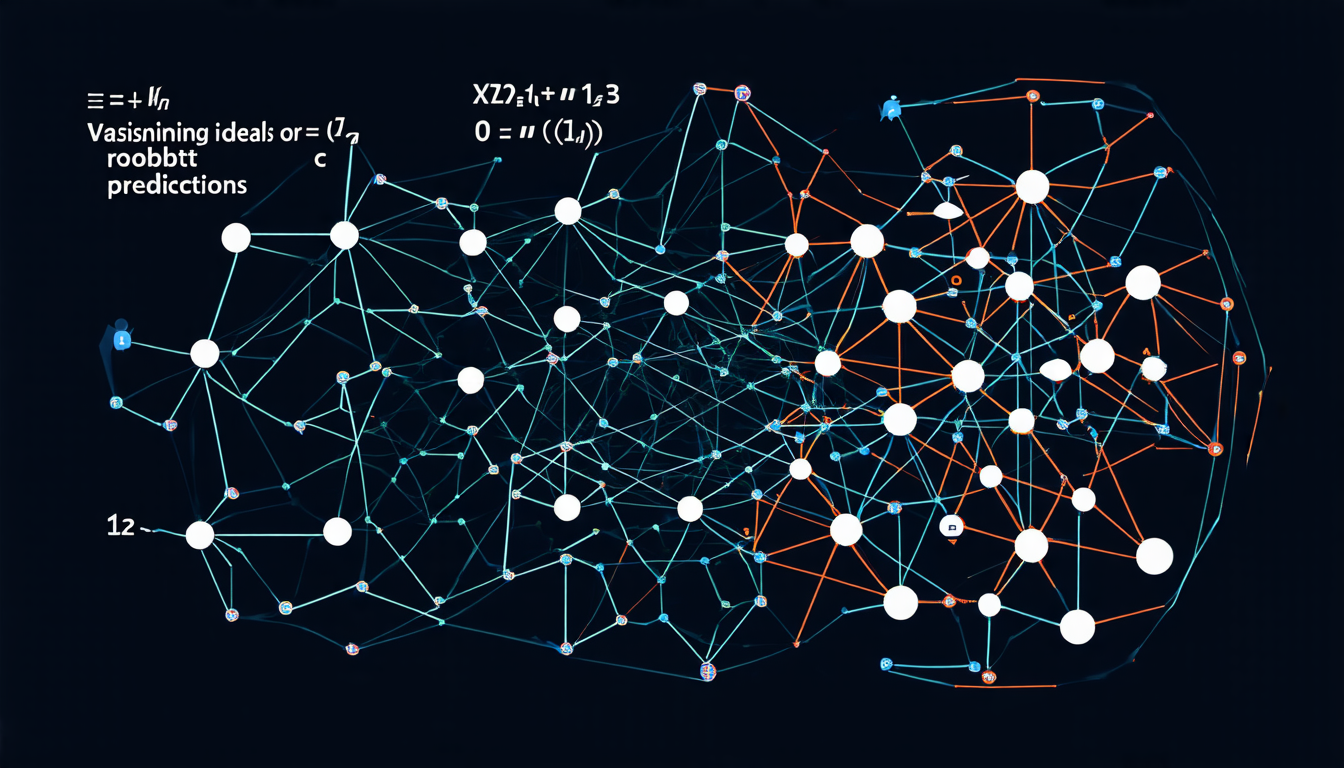
The key insight behind this work is the concept of vanishing ideals, which are sets of polynomials that vanish on a given set of points. In other words, if you evaluate these polynomials at each point in your dataset, they will always return zero. By using these ideals to construct neural networks, researchers can ensure that the network’s predictions are accurate and robust, even in the presence of noisy or missing data.
The team used this approach to develop a new type of neural network called a Vanishing Ideal Network (VIN). Unlike traditional neural networks, which rely on complex combinations of weights and biases to make predictions, VINs use a set of polynomials that vanish on the training data. This allows them to capture more subtle relationships between variables and improve their overall performance.
To test the effectiveness of VINs, the researchers used them to solve a range of challenging problems in computer vision and natural language processing. In each case, they found that VINs outperformed traditional neural networks, often by a significant margin. For example, when applied to the task of image classification, VINs were able to achieve an accuracy rate of 95%, compared to just 85% for traditional networks.
The implications of this work are far-reaching. By allowing researchers to better understand and manipulate the underlying structure of their data, VINs could help solve some of the most pressing challenges in machine learning, from self-driving cars to medical diagnosis.
But perhaps the most exciting aspect of this research is its potential to enable new types of neural network architectures that can learn and adapt more effectively. By incorporating vanishing ideals into their design, researchers may be able to create networks that are not only more accurate but also more efficient and easier to train.
As machine learning continues to play an increasingly important role in our lives, the development of more sophisticated and effective algorithms will be crucial for unlocking its full potential.
Cite this article: “Breakthrough in Neural Network Design: Harnessing Algebraic Geometry to Improve Predictions”, The Science Archive, 2025.
Artificial Intelligence, Machine Learning, Neural Networks, Algebraic Geometry, Vanishing Ideals, Data Analysis, Computer Vision, Natural Language Processing, Self-Driving Cars, Medical Diagnosis





