

Friday 28 March 2025
Scientists have long been fascinated by the properties of non-hermitian systems, where complex-valued physical quantities can exhibit unique behaviors that don’t follow traditional rules. In a recent study, researchers have made significant progress in understanding and manipulating these phenomena, specifically in a type of circuit called a generalized Brillouin zone.
At its core, a non-hermitian system is one where the usual rules of physics no longer apply. Traditional systems are hermitian, meaning that if you flip all the signs of the physical quantities involved, the equations describing them remain unchanged. Non-hermitian systems, on the other hand, can exhibit properties like decay or growth over time, which aren’t possible in traditional systems.
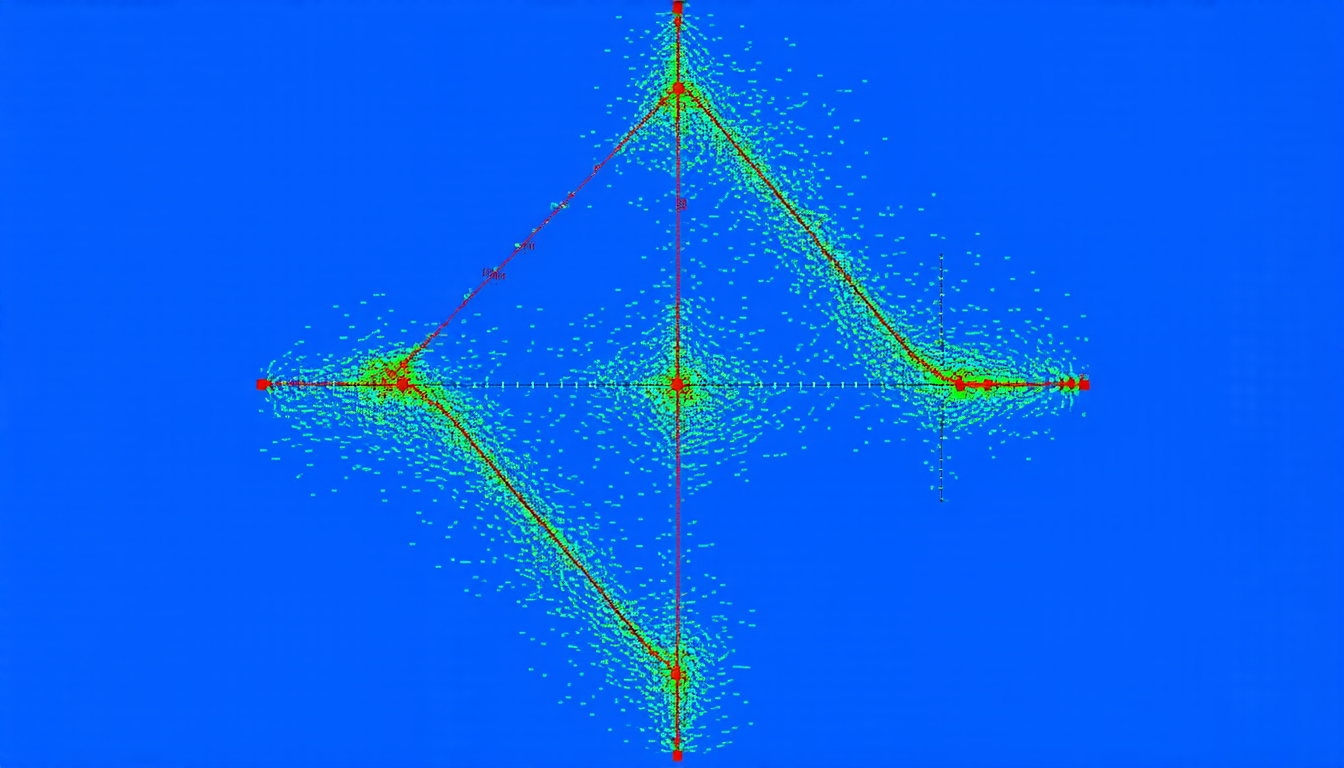
The researchers focused on a specific type of circuit called a generalized Brillouin zone (GBZ). This is essentially a framework for understanding non-hermitian systems by mapping them onto a complex plane. By manipulating the boundary conditions of this plane, scientists can create unique topological properties that wouldn’t be possible in traditional systems.
The study reveals that by adjusting the boundary Hamiltonian – a mathematical concept describing the behavior of physical systems – researchers can create multiple separated manifolds containing both decaying and growing wave functions. This is a significant departure from previous observations, where non-hermitian skin effects were typically seen under open boundary conditions.
One of the key findings is that topological phase transitions occur when the boundary parameters are changed. These transitions lead to the appearance of topological boundary modes in complex and real space simultaneously. In other words, scientists can create specific patterns on the complex plane that don’t exist elsewhere.
The researchers also explored the next-nearest-neighbor (NNN) model, where additional long-range coupling components were introduced. This led to the emergence of multiple topological boundary states at complex plane, further demonstrating the power of manipulating non-hermitian systems.
The implications of this study are far-reaching. By understanding and controlling these phenomena, scientists can develop new technologies that take advantage of non-hermitian properties. For example, researchers have proposed using non-hermitian systems for topological sensing and imaging applications.
Furthermore, the study has significant potential for advancing our knowledge in fields like condensed matter physics, optics, and electrical engineering. By exploring the boundaries of what is possible in non-hermitian systems, scientists can uncover new principles that could lead to breakthroughs in areas like quantum computing or advanced materials design.
Cite this article: “Manipulating Non-Hermitian Systems: Unlocking New Properties and Applications”, The Science Archive, 2025.
Non-Hermitian Systems, Complex Plane, Topological Phase Transitions, Boundary Conditions, Hamiltonian, Wave Functions, Decaying And Growing, Skin Effects, Next-Nearest-Neighbor Model, Non-Hermitian Properties





