

Friday 28 March 2025
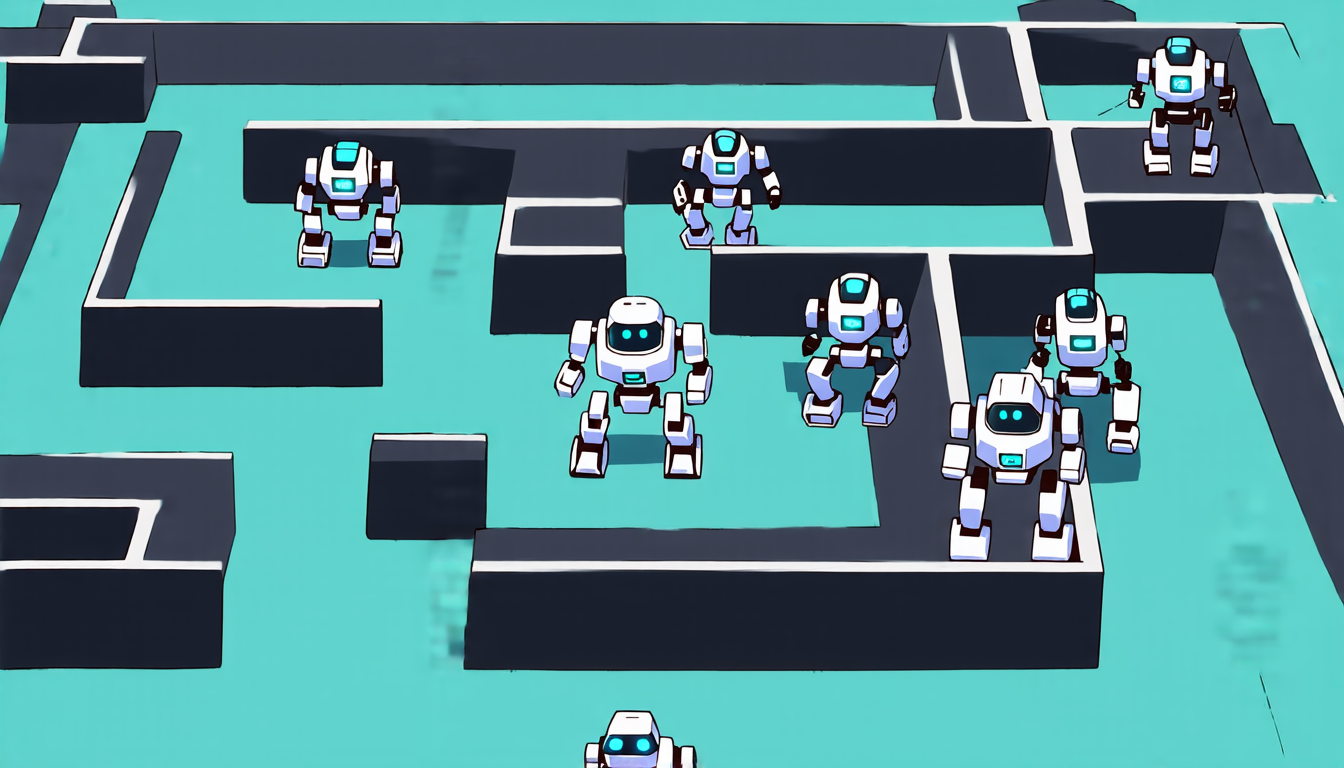
The quest for seamless connectivity has long been a holy grail in robotics, particularly when it comes to multi-robot systems. As these autonomous machines venture into complex, unknown environments, maintaining line-of-sight (LoS) connections between them becomes increasingly crucial. A team of researchers has now developed a novel approach that ensures LoS connectivity among robots while exploring uncharted territories.
The proposed method, which combines point cloud visibility analysis and graph theory, eliminates the need for known environment models, a common assumption in many existing solutions. Instead, it directly formulates LoS constraints from real-time point cloud measurements, allowing robots to dynamically adapt to their surroundings. This flexibility is particularly important when navigating through dense obstacles or sharp turns.
The method’s core innovation lies in its ability to fuse multiple sensors and create a shared understanding of the environment. By processing point clouds from LiDAR sensors, robots can identify visible regions and adjust their movements accordingly. The resulting LoS-distance metric quantifies both the urgency and sensitivity of losing connectivity with neighboring robots, enabling more informed decision-making.
To further enhance connectivity maintenance, the researchers introduced a novel fusion function that balances the weights of different LoS-distances between robots. This approach ensures that less urgent connections are still preserved, preventing disconnections when two robots move in opposite directions. The resulting potential function is encoded into the graph Laplacian matrix, which preserves the positivity of its Fiedler eigenvalue, guaranteeing connectivity.
Theoretical and experimental results demonstrate the effectiveness of this method in maintaining LoS connectivity among robots while exploring complex environments with obstacles. In simulations, the proposed approach outperformed existing methods in terms of connectivity maintenance and reduced the number of disconnections. Real-world experiments using DJI Tello Mini drones further validated the technique’s ability to maintain connections in dynamic environments.
The implications of this research extend beyond robotics, influencing fields such as autonomous inspection, search and rescue operations, and environmental monitoring. As multi-robot systems become increasingly prevalent, the need for reliable connectivity solutions will only continue to grow. This innovative approach provides a crucial step forward in addressing this challenge, enabling robots to work together more effectively and efficiently in the face of uncertainty.
The researchers’ focus on practical applications and real-world testing is particularly noteworthy, as it underscores the importance of validating theoretical concepts through experimentation. The resulting method offers a tangible solution for robotics engineers and researchers seeking to deploy multi-robot systems in complex environments.
Cite this article: “Maintaining Line-of-Sight Connectivity among Robots in Complex Environments”, The Science Archive, 2025.
Multi-Robot Systems, Line-Of-Sight Connectivity, Point Cloud Visibility Analysis, Graph Theory, Robotics, Autonomous Systems, Lidar Sensors, Connectivity Maintenance, Dynamic Environments, Obstacle Avoidance





