

Saturday 29 March 2025
The quest for resilient multi-robot systems has been an ongoing challenge in robotics research. These teams of robots, often equipped with sensors and communication devices, are designed to work together to accomplish complex tasks such as environmental monitoring, search and rescue operations, or even fighting fires. However, the presence of faults, cyberattacks, or sensor malfunctions can quickly turn these collaborative efforts into chaos.
To address this issue, researchers have been exploring ways to enhance the structural resilience of multi-robot systems, allowing them to adapt and recover from unexpected failures. One approach is to incorporate bearing rigidity, a property that ensures the robots maintain their formation despite changes in their relative positions or sensor readings.
In a recent study, a team of researchers proposed a hierarchical framework for area coverage control, combining centralized coordination with decentralized model predictive control (MPC). The system uses Voronoi partitioning to divide the coverage area into smaller regions, each assigned to a specific robot. The MPC controller then ensures that each robot maintains its desired position and trajectory while adapting to changes in the environment.
The key innovation lies in the use of bearing rigidity, which is enforced through decentralized MPC controllers. These controllers not only track reference centroids but also maintain the robots’ formation by adjusting their relative positions and sensor readings. This approach allows the system to detect and mitigate the effects of localization errors and robot loss during the mission.
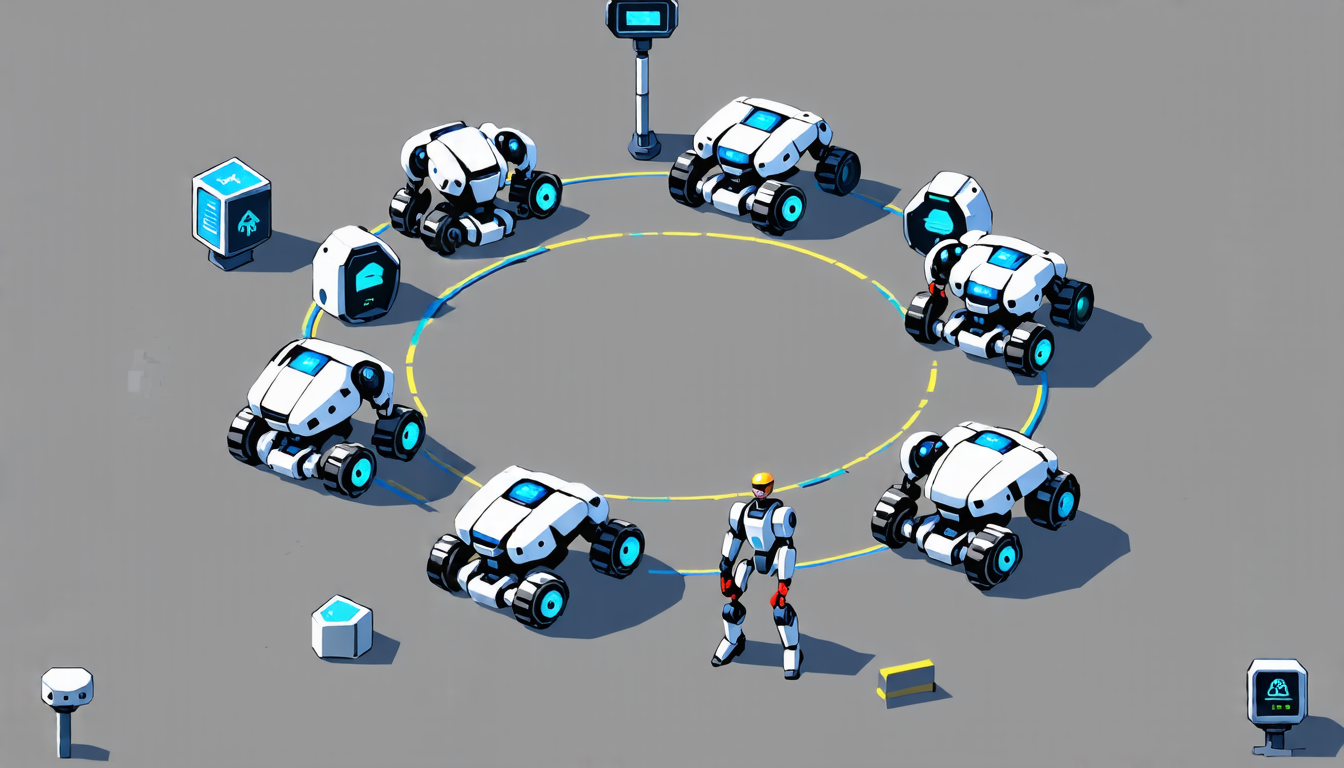
To demonstrate the effectiveness of this framework, the researchers simulated a team of robots tasked with covering an environmental monitoring area. The results showed that the system was able to recover from faults and cyberattacks, maintaining its coverage performance even in the presence of significant disturbances.
This research has significant implications for the development of autonomous systems capable of adapting to uncertain environments. By incorporating bearing rigidity into decentralized MPC controllers, the proposed framework provides a robust foundation for multi-robot systems to operate reliably and efficiently in complex scenarios.
The study’s findings also highlight the importance of considering both centralized coordination and decentralized control in designing resilient multi-robot systems. By balancing these two approaches, researchers can create more effective solutions that are better equipped to handle unexpected failures and adapt to changing environmental conditions.
In summary, this research represents a significant step forward in the development of resilient multi-robot systems. By incorporating bearing rigidity into decentralized MPC controllers, the proposed framework demonstrates the ability to detect and mitigate faults, cyberattacks, and localization errors, ensuring reliable coverage performance even in complex scenarios.
Cite this article: “Enhancing Resilience in Multi-Robot Systems through Bearing Rigidity and Decentralized Control”, The Science Archive, 2025.
Multi-Robot Systems, Bearing Rigidity, Decentralized Mpc Controllers, Fault Tolerance, Cyberattacks, Localization Errors, Area Coverage Control, Environmental Monitoring, Search And Rescue Operations, Robustness.





