

Saturday 29 March 2025
The quest for efficiency in computer science has led researchers to develop innovative solutions that can tackle complex problems more effectively. A recent breakthrough in graph theory, known as ShareDP, demonstrates a novel approach to finding disjoint paths in large networks.
Graphs are ubiquitous in modern computing, serving as the backbone of social media platforms, online marketplaces, and communication systems. Within these graphs, nodes (vertices) represent entities or connections, while edges denote relationships between them. Disjoint paths, in particular, refer to routes that do not share common vertices except for the source and target nodes.
Finding disjoint paths is crucial in various applications, such as network routing, fault-tolerant computing, and cybersecurity. However, traditional methods often struggle with scalability and computational complexity when dealing with large graphs. ShareDP aims to address these limitations by introducing a shared computation framework that consolidates queries across multiple vertex pairs.
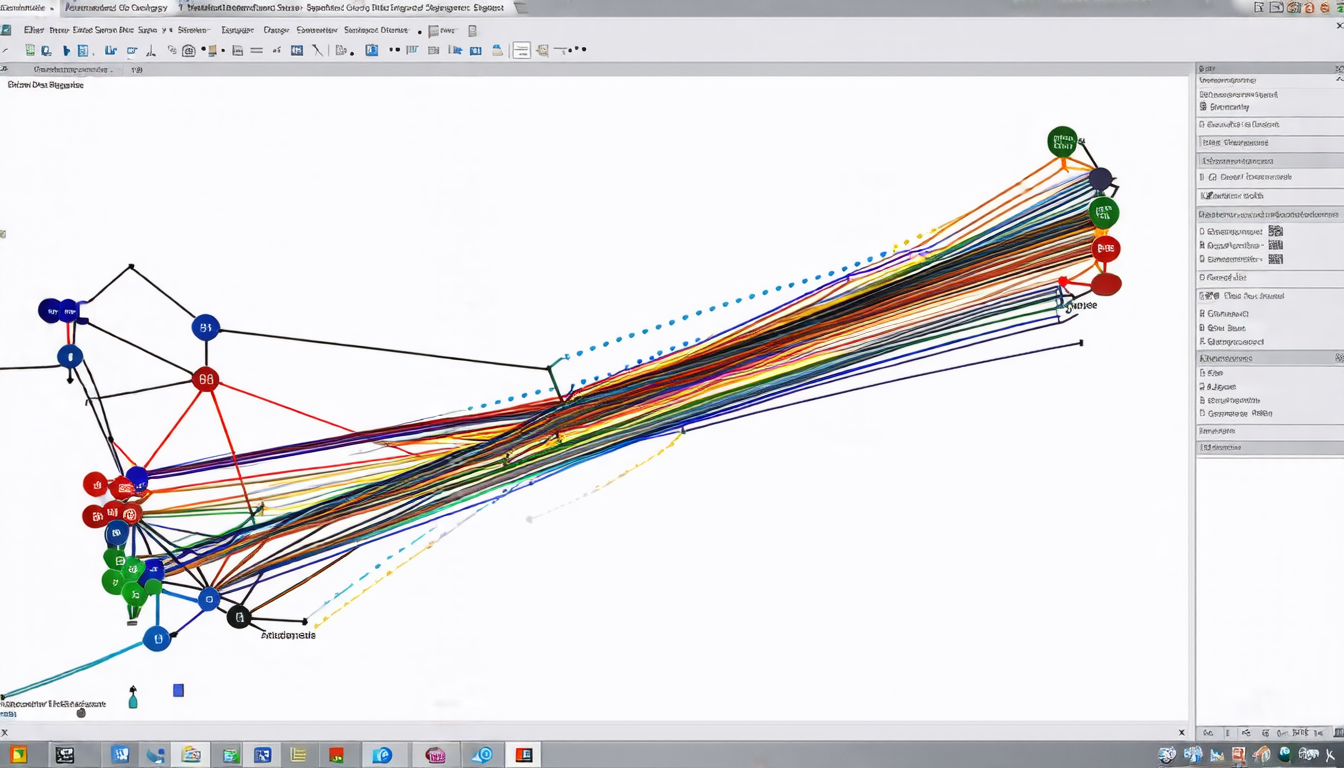
The key innovation lies in the merged split-graph representation, which combines individual split-graphs for each query into a single structure. This allows ShareDP to leverage shared computations and reduce redundant traversals. The algorithm employs a bidirectional breadth-first search (BFS) approach, where forward and backward searches converge at meeting points, enabling the construction of disjoint paths.
Experiments on 12 real-world datasets demonstrate the effectiveness of ShareDP. Compared to existing methods, it outperforms competitors in terms of runtime, particularly when dealing with large graphs. The algorithm’s efficiency is further emphasized by its ability to handle an increasing number of queries without significant performance degradation.
The ablation study reveals the importance of each component within ShareDP. Merging split-graphs and sharing traversals are critical factors that contribute to the algorithm’s superior performance. These findings highlight the potential for future research in optimizing graph algorithms for large-scale applications.
ShareDP’s impact extends beyond academia, as it can be applied in various industrial settings where efficient graph processing is essential. For instance, it could improve network routing efficiency in telecommunications or optimize supply chain logistics in e-commerce platforms.
In summary, ShareDP represents a significant advancement in the field of graph theory, offering a novel solution for finding disjoint paths in large networks. Its shared computation framework and bidirectional BFS approach enable efficient and scalable processing, making it an attractive option for researchers and practitioners alike. As computing demands continue to grow, innovations like ShareDP will play a crucial role in driving progress in this field.
Cite this article: “Unlocking Efficient Graph Processing with ShareDP”, The Science Archive, 2025.
Graph Theory, Disjoint Paths, Network Routing, Fault-Tolerant Computing, Cybersecurity, Sharedp, Large Networks, Graph Processing, Scalability, Efficiency





