

Sunday 30 March 2025
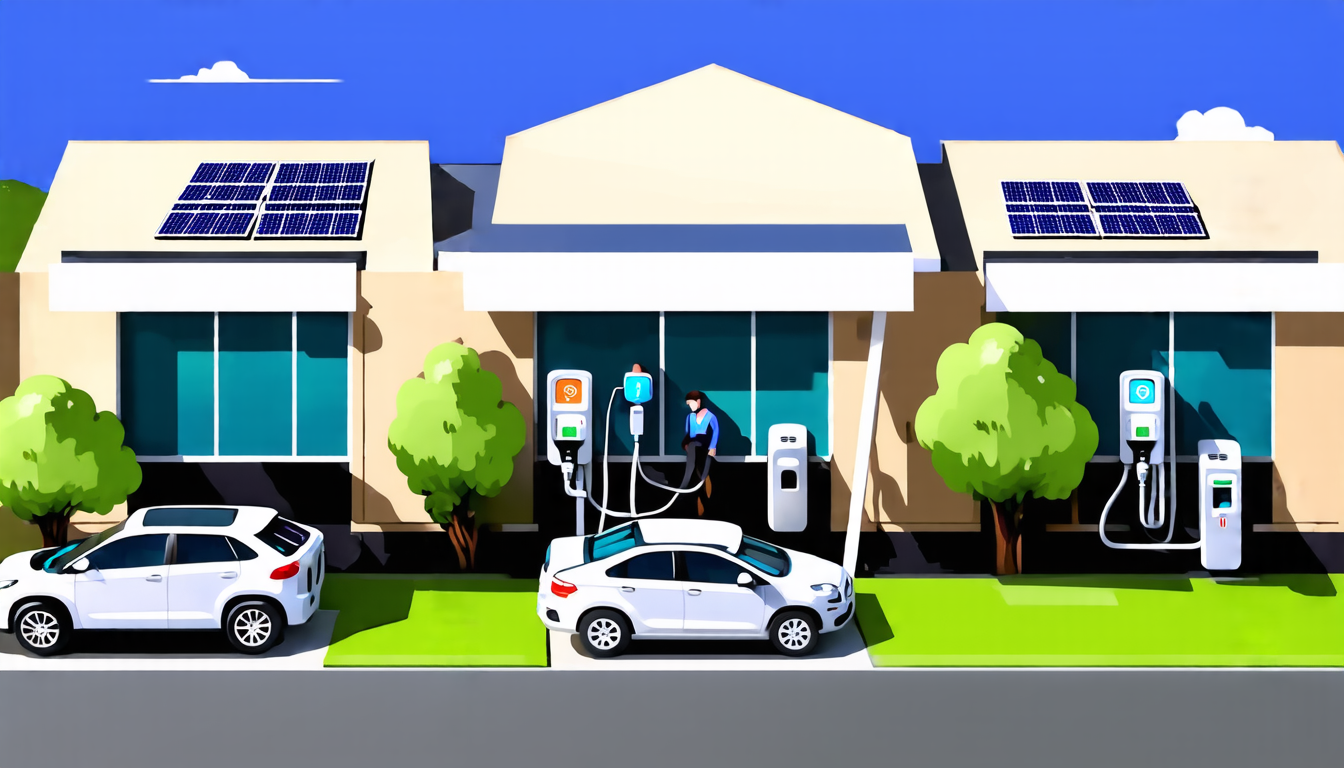
Researchers have been working on a new approach to optimize energy consumption in large office buildings, leveraging the power of electric vehicles (EVs) to reduce peak energy demand and costs. The concept is known as Vehicle-to-Building (V2B) charging, where EVs are not just recharged at night but also act as temporary energy storage units during the day.
The traditional approach to managing energy consumption in large buildings involves using energy-efficient systems and optimizing lighting and HVAC usage. However, these methods have limitations, particularly when it comes to peak demand periods. V2B charging aims to address this issue by aggregating EV batteries to provide additional energy storage capacity.
A team of researchers has developed a novel Reinforcement Learning (RL) framework that combines the Deep Deterministic Policy Gradient approach with action masking and efficient MILP-driven policy guidance. This innovative method balances the exploration of continuous action spaces to meet user charging demands while minimizing energy costs.
The RL algorithm is trained using real-world data from a major electric vehicle manufacturer, which provides insight into EV usage patterns, building energy consumption, and peak demand periods. The model learns to optimize charging schedules for each EV, taking into account factors such as battery capacity, SoC, and user preferences.
The results are impressive: the RL approach outperforms traditional heuristic-based strategies and traditional RL models in terms of cost savings while meeting all charging requirements. This breakthrough has significant implications for large office buildings, which can reduce their energy bills by up to 20% using this novel V2B charging system.
One of the key advantages of this approach is its ability to adapt to changing user behavior and energy demand patterns. The RL algorithm learns to adjust charging schedules in real-time, ensuring that EVs are charged efficiently while minimizing peak energy consumption.
The researchers have also developed two additional algorithms: Charge First with Least Laxity First (CF-LLF) and Trickle Charging with Least Laxity First (T-LLF). These methods focus on optimizing charging rates for individual EVs, taking into account factors such as SoC, battery capacity, and user preferences.
The results of the ablation study demonstrate that the RL approach outperforms these additional algorithms in terms of cost savings. However, CF-LLF shows promise in certain scenarios, particularly when there is a high demand for charging during peak periods.
Cite this article: “Optimizing Energy Consumption with Vehicle-to-Building Charging and Reinforcement Learning”, The Science Archive, 2025.
Electric Vehicles, Vehicle-To-Building Charging, Reinforcement Learning, Deep Deterministic Policy Gradient, Action Masking, Milp-Driven Policy Guidance, Energy Consumption, Peak Demand Periods, Cost Savings, Large Office Buildings





