

Sunday 30 March 2025
Scientists have long been fascinated by the behavior of fluids when they’re subjected to different forces and conditions. One area that’s garnered significant attention is the study of surface waves, which occur when a fluid is disturbed in some way, such as by a vibrating object or a change in temperature.
Recently, researchers have made significant progress in understanding how these surface waves behave when they interact with other factors, like noise and turbulence. In a new paper, scientists have explored this phenomenon using the example of parametrically excited surface waves in a fluid layer.
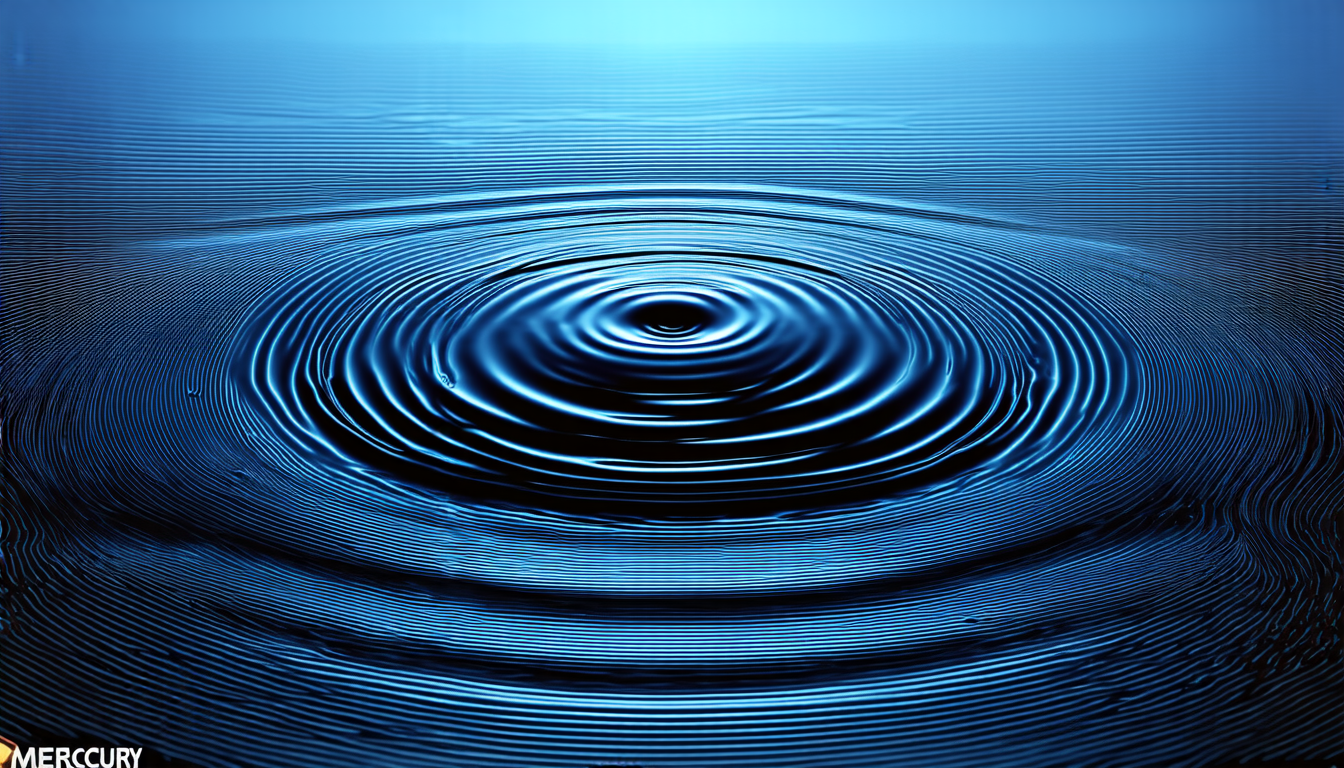
To understand what’s going on, let’s start with the basics. Surface waves are ripples that form on the surface of a fluid, such as water or mercury, when it’s disturbed. These waves can be caused by all sorts of things, like wind, sound waves, or even vibrations from an external source.
In this study, the researchers focused on a specific type of surface wave known as parametrically excited waves. These waves are created when the fluid layer is subjected to a periodic force, such as a vibrating plate or a rotating drum. This force causes the fluid to oscillate, creating waves that propagate across the surface.
The interesting thing about these parametrically excited waves is that they can be influenced by external factors, like noise and turbulence. Noise, in this context, refers to random fluctuations in the environment that can affect the behavior of the waves. Turbulence, on the other hand, is a type of chaotic motion that can occur when there are changes in the flow of the fluid.
To study these effects, the researchers used an experimental setup involving a shallow layer of mercury and a vortex flow created by an electromagnetic field. The vortex flow was designed to mimic the kind of turbulence that might occur in real-world systems, like oceans or rivers.
The results were fascinating. When the noise level was low, the parametrically excited waves behaved as expected, growing in amplitude until they reached a certain threshold and then collapsing. But when the noise level increased, something unexpected happened. The waves began to exhibit a new type of behavior, known as quintic supercriticality.
In this state, the waves grew more rapidly than usual, eventually reaching a point where they became unstable and broke down into smaller waves. This was a significant departure from what’s typically seen in surface wave dynamics, where noise usually has a damping effect on the waves.
Cite this article: “Unraveling the Complex Behavior of Parametrically Excited Surface Waves”, The Science Archive, 2025.
Surface_Waves, Fluid_Dynamics, Parametrically_Excitedwaves, Noise, Turbulence, Mercury, Vortex_Flow, Electromagnetic_Field, Quintic_Supercriticality, Wave_Behavior





