

Sunday 30 March 2025
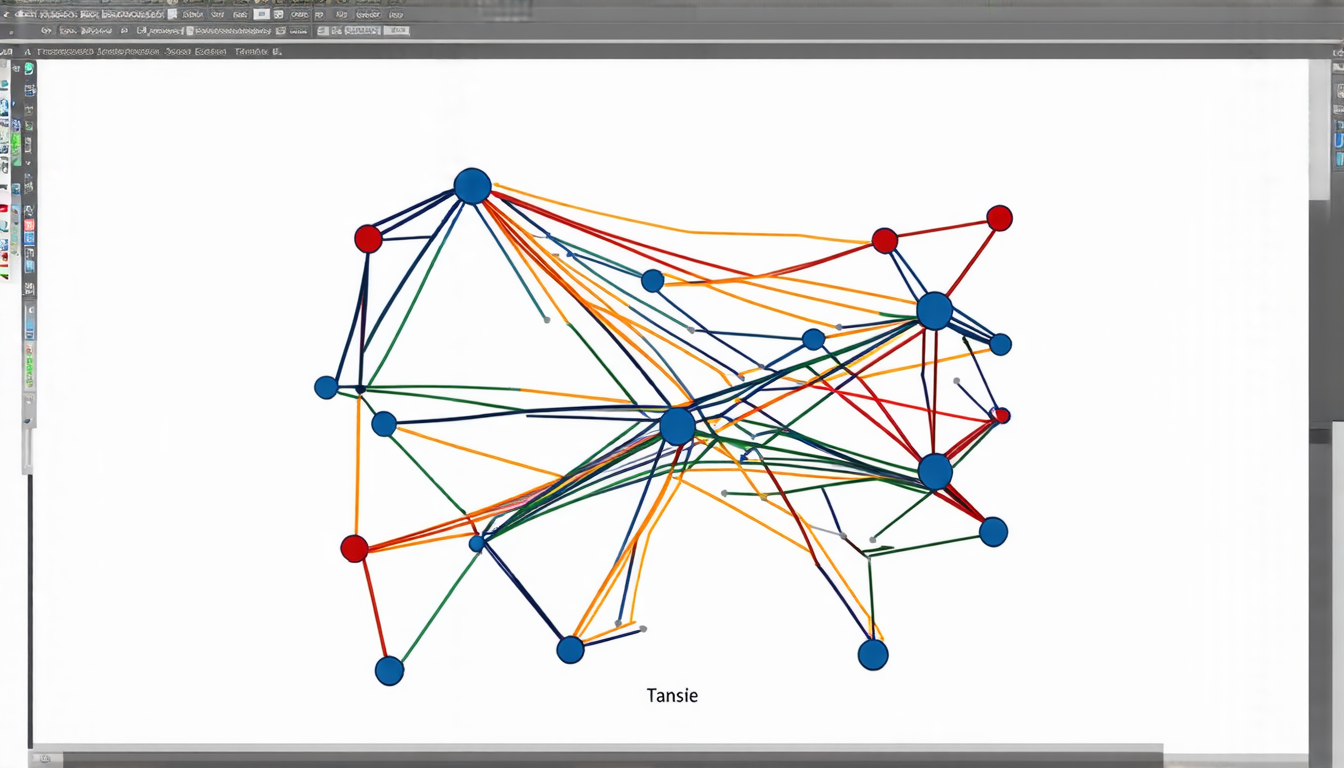
A recent study has shed new light on a long-standing problem in graph theory, a field that deals with the connections and patterns within networks. The researchers have discovered a way to ensure that certain types of graphs contain a specific structure, known as an independent transversal blow-up.
Independent transversals are sets of vertices that do not share any common neighbors. In other words, if you take two vertices from the same set and look at their connections, they will not have any edges in common. This concept is important because it has applications in a wide range of fields, including computer networks, biology, and social network analysis.
The problem that the researchers tackled is known as the Zarankiewicz problem. It was first posed by the Polish mathematician Kazimierz Zarankiewicz in 1951 and deals with finding the minimum degree required for a graph to contain a complete r-partite subgraph. A complete r-partite subgraph is a subset of vertices that can be divided into r sets, such that every vertex has edges only to vertices in other sets.
The researchers used a technique called the auxiliary graph method to tackle this problem. This involves creating a new graph, known as an auxiliary graph, which contains information about the original graph. By analyzing the properties of the auxiliary graph, the researchers were able to determine the minimum degree required for the original graph to contain an independent transversal blow-up.
The study has important implications for our understanding of complex networks and how they are structured. It could also have practical applications in fields such as computer science and biology, where understanding the patterns and connections within networks is crucial.
One of the key findings of the study was that the minimum degree required for an independent transversal blow-up to exist is much lower than previously thought. This has significant implications for our understanding of how complex networks are structured and could have important practical applications.
The researchers used a combination of mathematical techniques, including graph theory and combinatorics, to tackle this problem. They also used computer simulations to verify their findings and ensure that they were accurate.
The study is an important contribution to the field of graph theory and has significant implications for our understanding of complex networks. It could also have practical applications in a wide range of fields, from computer science to biology.
Cite this article: “New Insights into Graph Theory: Ensuring Independent Transversals in Complex Networks”, The Science Archive, 2025.
Graph Theory, Independent Transversal Blow-Up, Zarankiewicz Problem, Minimum Degree, Complex Networks, Computer Science, Biology, Social Network Analysis, Combinatorics, Graph Theory.
Reference: Tianjiao Dai, Weichan Liu, Xin Zhang, “Independent transversal blow-up of graphs” (2025).





