

Monday 31 March 2025
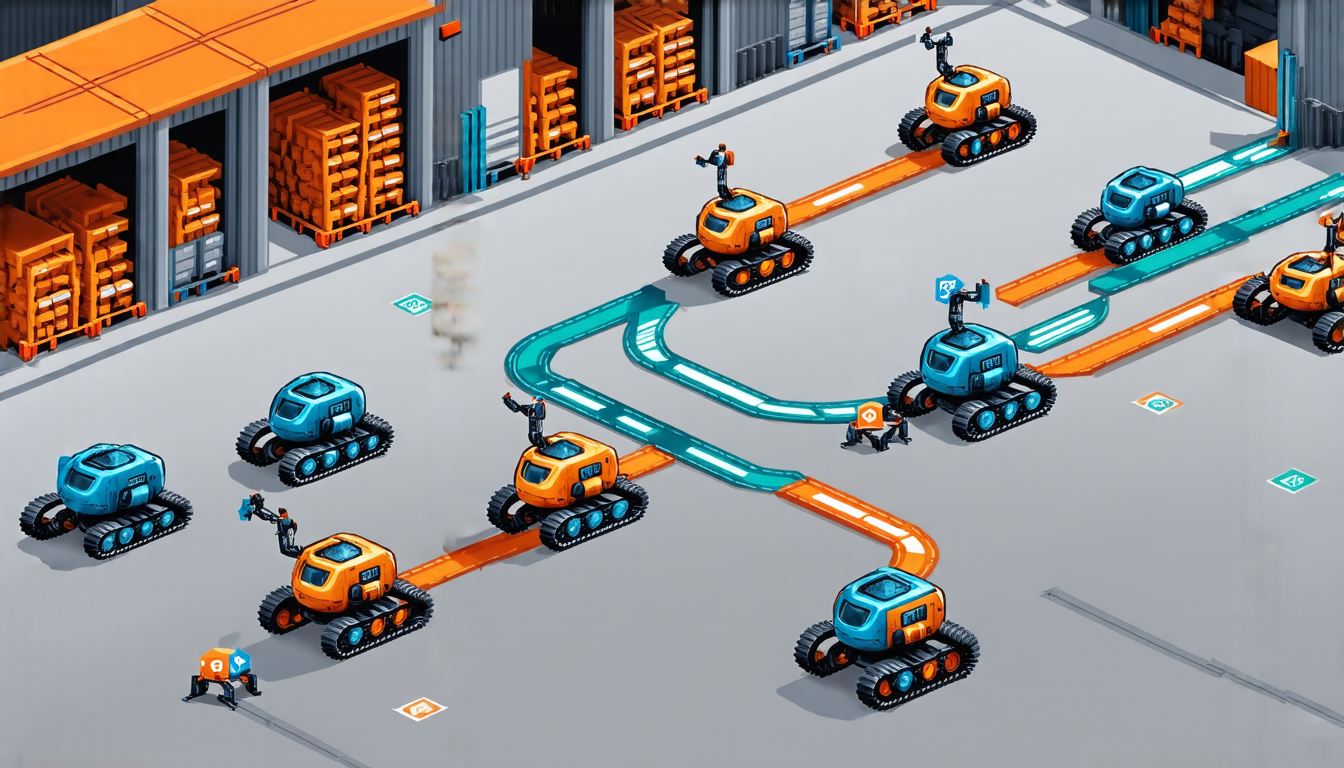
A team of researchers has developed a new approach to multi-agent path planning, which could revolutionize the way robots navigate complex environments. The method, known as path tracking, uses a combination of global and local planning techniques to ensure that multiple robots can move safely and efficiently through crowded spaces.
In traditional multi-agent path planning systems, each robot is given its own separate route to follow, without considering the movements of other robots in the environment. This can lead to conflicts and collisions, particularly in busy areas like warehouses or construction sites.
The new approach takes a different tack. Instead of assigning individual paths to each robot, it uses a global planner to create a single, overarching plan that accounts for the movements of all robots in the environment. This plan is then refined through local planning techniques to ensure that each robot can follow its assigned path without colliding with others.
The system is particularly effective in complex environments where multiple robots need to work together to achieve a common goal. For example, in a warehouse setting, multiple robots might be tasked with retrieving items from shelves and delivering them to different parts of the facility. Using traditional path planning methods, it would be difficult for these robots to navigate the crowded aisles and avoid collisions.
The researchers tested their system using simulations and found that it was able to reduce path deviation by 28% in single-agent scenarios and 16% in multi-agent scenarios. They also found that the system was able to eliminate collisions between robots, even in complex environments with multiple obstacles and constraints.
One of the key advantages of the new approach is its ability to adapt to changing circumstances on the fly. For example, if a robot encounters an unexpected obstacle or delay, the global planner can quickly re-route it around the problem without disrupting the plans of other robots.
The researchers believe that their system has significant potential for real-world applications in fields such as logistics, construction, and healthcare. By enabling multiple robots to work together more efficiently and safely, they could help improve productivity, reduce costs, and enhance overall performance.
In the future, the team plans to continue refining their approach and exploring its potential applications. They are also working on integrating their system with other AI technologies, such as computer vision and machine learning algorithms, to create even more sophisticated navigation systems.
Cite this article: “Revolutionary Multi-Agent Path Planning Method for Efficient Robot Navigation”, The Science Archive, 2025.
Robotics, Path Planning, Multi-Agent, Artificial Intelligence, Global Planner, Local Planning, Collision Avoidance, Navigation, Logistics, Construction





