

Monday 31 March 2025
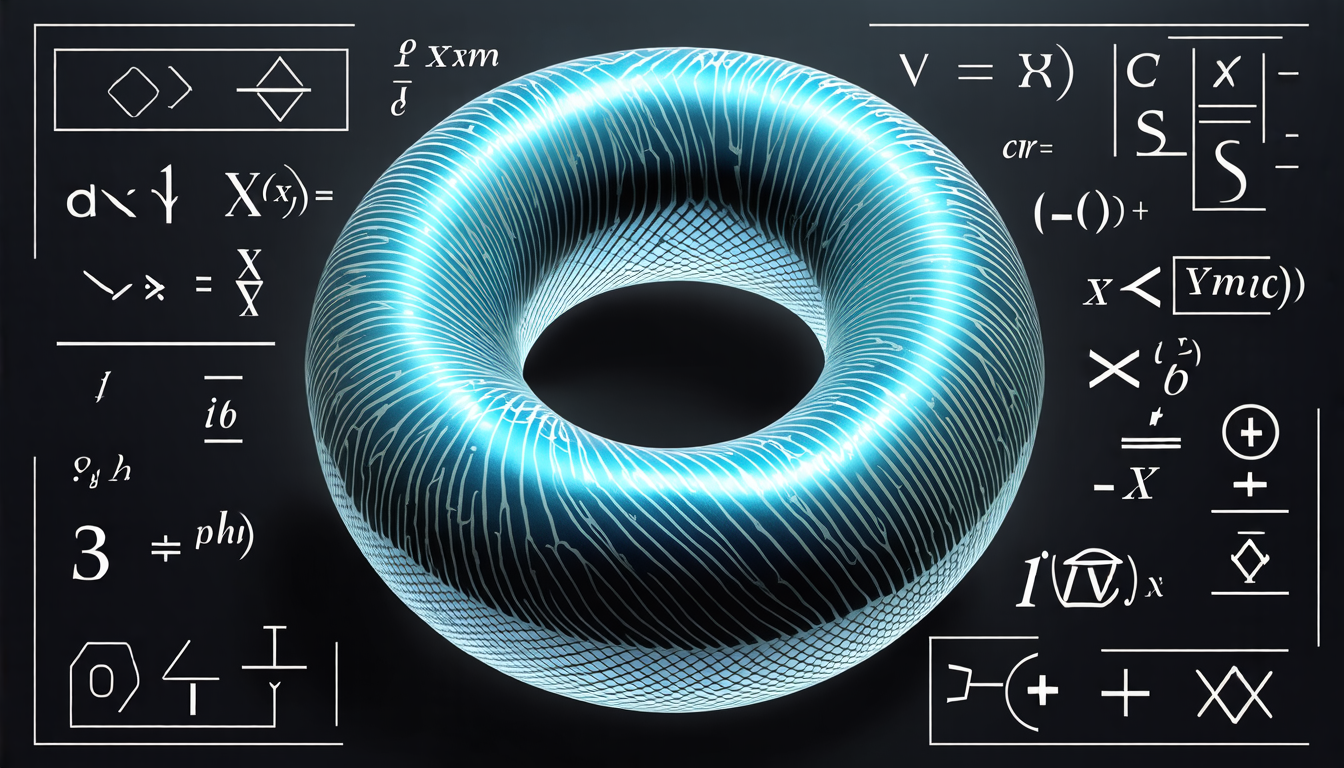
The intricate dance of mathematical operators on the torus, a compact and fascinating geometric structure. Mathematicians have long been fascinated by the properties of these operators, which are used to describe complex phenomena in physics, engineering, and other fields.
Recently, researchers have made significant progress in understanding the behavior of pseudo-differential operators on the torus. These operators are a type of mathematical tool that can be used to analyze and solve equations that arise from physical systems. The key innovation is the development of new methods for estimating the properties of these operators, which has far-reaching implications for our ability to understand complex phenomena.
One of the main challenges in studying pseudo-differential operators on the torus is that they are highly non-linear, meaning that their behavior cannot be easily predicted by simply examining their individual components. This non-linearity makes it difficult to estimate the properties of these operators using traditional methods.
However, researchers have developed new techniques for estimating the properties of pseudo-differential operators on the torus. These techniques involve using a combination of mathematical tools and physical insights to analyze the behavior of the operators. The result is a more accurate understanding of how these operators work, which can be used to make predictions about complex phenomena.
The implications of this research are significant. For example, it could lead to new methods for analyzing and solving equations that arise from physical systems. This could have important applications in fields such as engineering, where the ability to accurately predict the behavior of complex systems is crucial.
Another area where this research could have a major impact is in our understanding of quantum mechanics. Pseudo-differential operators play a key role in many areas of quantum mechanics, and a deeper understanding of their properties could lead to new insights into the nature of reality itself.
In addition to its potential applications, this research also has important implications for our understanding of the fundamental laws of physics. The development of new methods for estimating the properties of pseudo-differential operators on the torus could lead to a greater understanding of the underlying principles that govern complex phenomena.
Overall, the study of pseudo-differential operators on the torus is an active area of research with significant implications for our understanding of complex phenomena and the fundamental laws of physics.
Cite this article: “Deciphering the Mysteries of Pseudo-Differential Operators on the Torus”, The Science Archive, 2025.
Mathematical Operators, Torus, Pseudo-Differential Operators, Non-Linear Systems, Estimation Methods, Physical Insights, Quantum Mechanics, Fundamental Laws Of Physics, Complex Phenomena, Engineering Applications.





