

Monday 31 March 2025
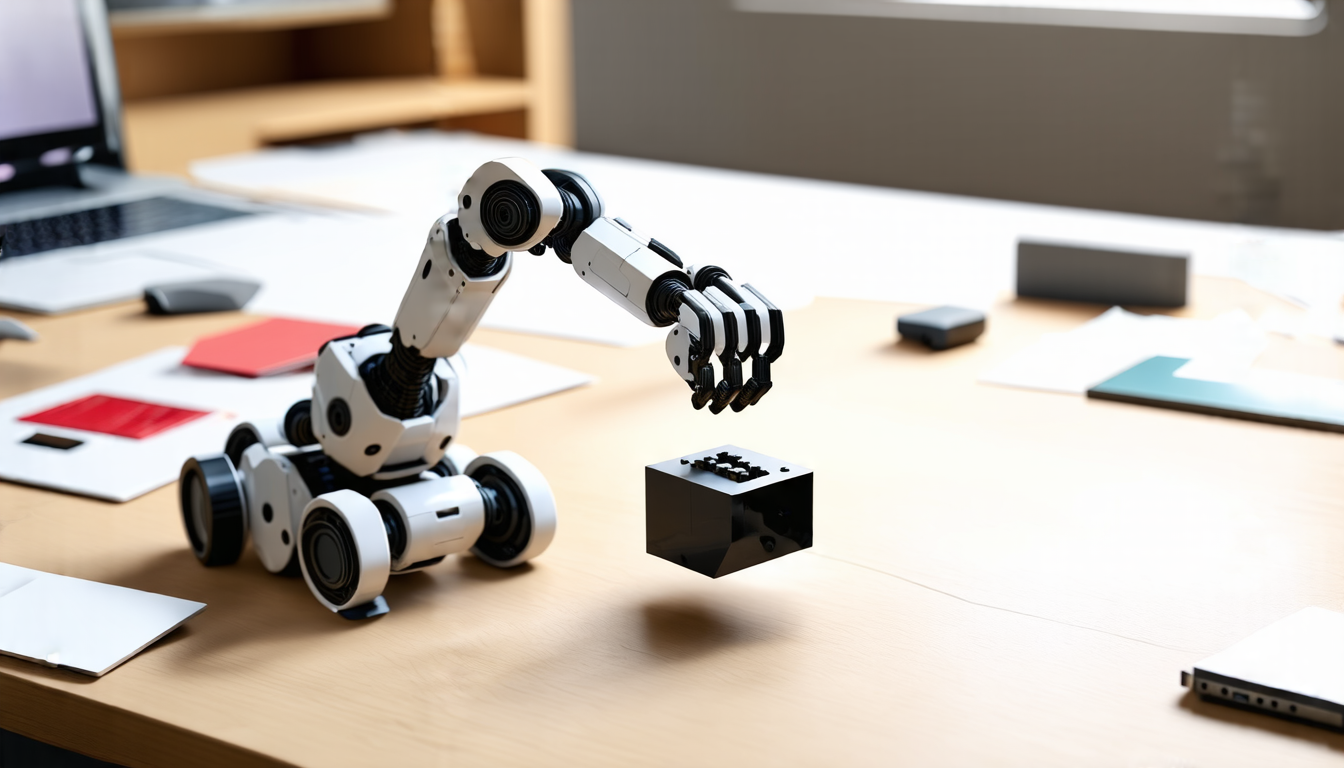
The quest for efficient object manipulation and mapping in cluttered environments has long been a challenge for robotics researchers. The complexity of these scenarios stems from the presence of occlusions, which can make it difficult to accurately perceive the environment and plan effective actions. To tackle this problem, a team of researchers has developed a novel framework that combines neural networks with probabilistic reasoning to enable robots to efficiently map and manipulate objects in cluttered environments.
The framework, called Calibrated Neural-Accelerated Belief Updates (CNABU), uses a combination of convolutional and recurrent neural networks to process 3D point cloud data and predict the likelihood of object presence and shape. The network is trained using a large dataset of simulated scenes, which are designed to mimic real-world environments.
One of the key innovations of CNABU is its ability to incorporate uncertainty into the mapping process. Traditional mapping algorithms often rely on perfect knowledge of the environment, but in reality, sensors can be noisy and incomplete data can lead to incorrect conclusions. By modeling this uncertainty as a probability distribution over possible object configurations, CNABU can more accurately represent the ambiguity inherent in real-world sensing.
The framework is also designed to be highly efficient, allowing it to process large amounts of data quickly and make decisions in real-time. This is achieved through the use of parallel processing and optimized algorithms, which enable the network to handle complex computations on high-resolution point clouds.
To evaluate the performance of CNABU, the researchers conducted a series of experiments using a robotic arm equipped with a depth sensor and a gripper. The robot was tasked with manipulating objects in cluttered environments, including pushing and grasping tasks. The results showed that CNABU outperformed traditional mapping algorithms in terms of accuracy and efficiency.
The implications of this research are significant for the field of robotics. By enabling robots to efficiently map and manipulate objects in cluttered environments, CNABU has the potential to revolutionize applications such as warehouse management, search and rescue, and household chores.
One of the most exciting aspects of CNABU is its ability to generalize to new scenarios. The framework’s neural network architecture allows it to learn from a diverse range of training data, which enables it to adapt to novel environments and tasks with ease. This means that robots equipped with CNABU could potentially be deployed in a wide range of applications without requiring extensive retraining.
Cite this article: “Efficient Object Mapping and Manipulation in Cluttered Environments Using Calibrated Neural-Accelerated Belief Updates (CNABU)”, The Science Archive, 2025.
Robotics, Object Manipulation, Cluttered Environments, Neural Networks, Probabilistic Reasoning, Mapping, Uncertainty Modeling, Real-Time Processing, Efficiency, Generalization





