

Friday 04 April 2025
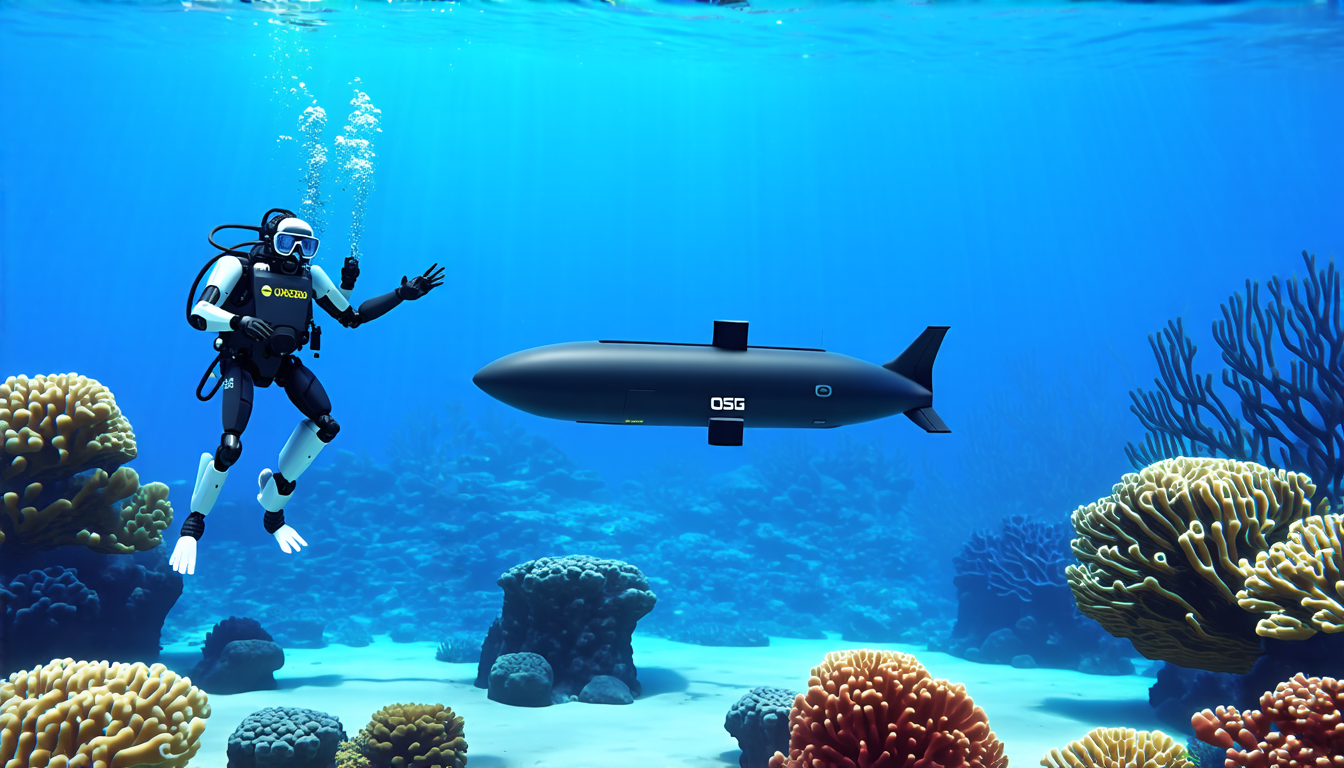
Scientists have made significant strides in developing a new system for underwater human-robot interaction, allowing divers and robots to communicate more effectively in challenging aquatic environments.
The researchers, led by Junaed Sattar, created a one-shot gesture recognition framework called OSG (One-Shot Gesture Recognition). This innovative approach enables robots to recognize and respond to gestures made by humans underwater without requiring extensive training or data collection. In essence, the system allows for instant communication between divers and robots.
OSG relies on shape-based classification, analyzing the geometric and structural features of gestures to identify them. This method is particularly effective in underwater environments where traditional communication methods, such as acoustic signals or pre-defined gesture languages, often fail due to signal degradation or complexity.
To test OSG’s capabilities, the researchers designed a custom gesture language consisting of 15 distinct shapes, including circles, triangles, and rectangles. They then recorded human gestures using a camera and used OSG to recognize and classify the movements in real-time.
The results were impressive: OSG achieved an accuracy rate of 98% on the custom gesture language, outperforming existing machine learning-based approaches that require extensive dataset collection or re-training. Moreover, OSG’s low computational cost and energy efficiency make it suitable for deployment on autonomous underwater robots (AUVs) and other resource-constrained devices.
The potential applications of OSG are vast. For instance, in search-and-rescue operations, OSG could enable AUVs to quickly locate and respond to divers’ signals, increasing the chances of successful rescue missions. In environmental monitoring, OSG could facilitate communication between humans and robots for more effective data collection and analysis.
While there are still limitations to OSG’s capabilities, such as its reliance on shape-based recognition and potential struggles with gestures that vary in speed or directionality, the researchers are optimistic about future developments. By refining the algorithm and integrating it with other technologies, they envision a future where humans and robots can collaborate seamlessly underwater, unlocking new possibilities for exploration, conservation, and innovation.
The OSG framework offers a promising solution for improving underwater human-robot interaction, paving the way for more effective communication and collaboration in aquatic environments. As research continues to advance, we may see even more innovative applications of this technology in the years to come.
Cite this article: “Revolutionizing Underwater Communication: One-Shot Gesture Recognition for Real-Time Human-Robot Collaboration”, The Science Archive, 2025.
Underwater, Human-Robot Interaction, Gesture Recognition, One-Shot Learning, Machine Learning, Autonomous Underwater Robots, Search And Rescue, Environmental Monitoring, Aquatic Environments, Communication





