

Saturday 05 April 2025
The intricate dance of numbers and geometry has long fascinated mathematicians, but a recent discovery has shed new light on the complex relationships between them. Researchers have uncovered a hidden pattern in the way numerical semigroups, a type of mathematical structure, behave under certain conditions.
Numerical semigroups are collections of integers that can be added together to form other integers within the same set. They’re like a game of arithmetic tag, where each number is trying to catch its neighbors. But unlike traditional games, these numbers have their own rules and patterns, which mathematicians have been working to unravel for decades.
The new discovery revolves around the concept of factorization lengths, which measures how many ways there are to break down an integer into smaller parts within a given semigroup. It’s like trying to find the shortest route between two points on a map, but instead of roads and highways, you’re navigating a complex web of arithmetic operations.
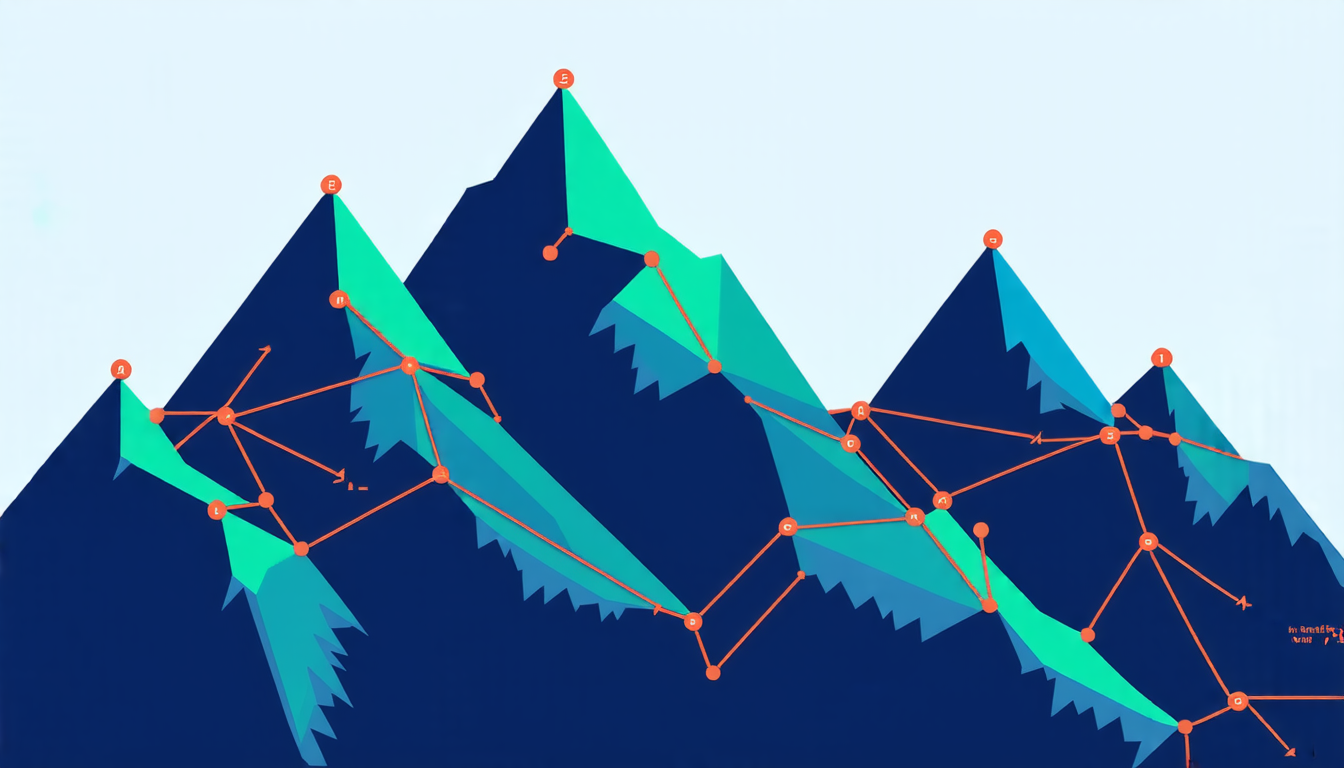
The researchers found that under certain conditions, the distribution of factorization lengths follows a predictable pattern, similar to the way the peaks and valleys of a mountain range might unfold. This pattern is not only fascinating in its own right but also has implications for various fields, from cryptography to coding theory.
One of the most striking aspects of this discovery is how it bridges the gap between two seemingly unrelated areas of mathematics: combinatorics and algebraic geometry. Combinatorics is the study of counting and arranging objects in various ways, while algebraic geometry focuses on the geometric properties of equations and functions.
The connection between these two fields was thought to be tenuous at best, but this research has shown that they are intimately linked through the concept of numerical semigroups. This new understanding has far-reaching implications for our ability to analyze and manipulate complex mathematical structures.
The discovery also highlights the importance of interdisciplinary collaboration in mathematics. By combining insights from combinatorics, algebraic geometry, and other areas, researchers can uncover hidden patterns and relationships that might have gone unnoticed otherwise.
As we continue to explore the vast expanse of mathematical possibility, it’s clear that there is still much to be discovered. The intricate dance of numbers and geometry continues to unfold, revealing new secrets and surprises at every turn.
Cite this article: “Cracking the Code of Factorization Lengths in Affine Semigroups”, The Science Archive, 2025.
Numerical Semigroups, Combinatorics, Algebraic Geometry, Factorization Lengths, Mathematical Structures, Arithmetic Operations, Cryptography, Coding Theory, Interdisciplinary Collaboration, Geometric Properties





