

Sunday 06 April 2025
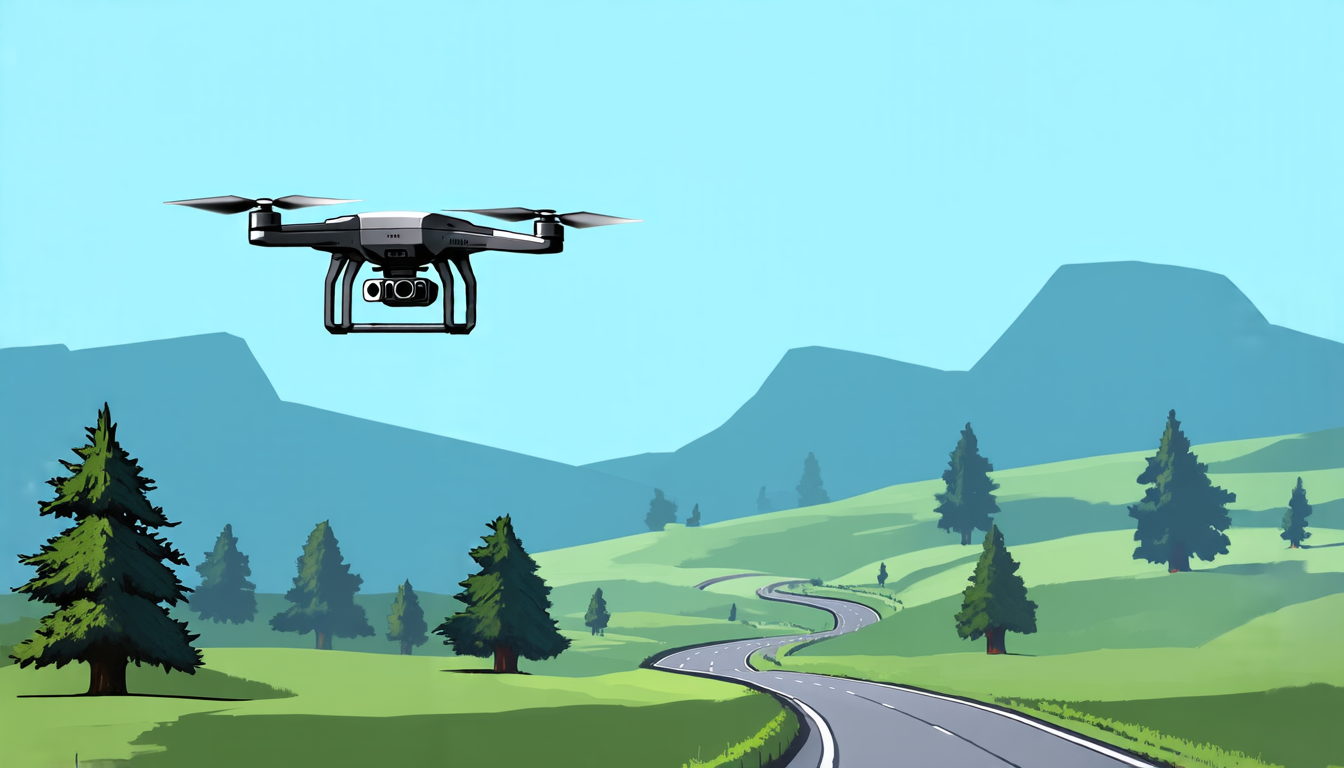
For decades, researchers have been working on developing autonomous aerial vehicles (AAVs) that can navigate through complex environments without human intervention. These vehicles, often referred to as drones, are designed to perform tasks such as surveillance, mapping, and even search and rescue operations.
However, one of the biggest challenges in creating AAVs is programming them to make decisions quickly and efficiently while avoiding obstacles. This is where the concept of path planning comes in – it’s the process of determining the most optimal route for an AAV to take from point A to point B while avoiding any potential hazards along the way.
Recently, a team of researchers has made significant progress in developing a new system that combines vision-based navigation with language processing and mathematical optimization techniques. This system, known as UAV- VLPA*, is designed to enable AAVs to generate optimal flight plans for complex missions.
The key innovation behind UAV-VLPA* lies in its ability to integrate multiple sources of information, including visual data from cameras, linguistic instructions from human operators, and mathematical models of the environment. This allows the system to create highly detailed maps of the area being surveyed, which can then be used to generate optimal flight paths.
One of the most impressive aspects of UAV-VLPA* is its ability to adapt to changing environmental conditions in real-time. For example, if an AAV encounters an unexpected obstacle during a mission, it can quickly adjust its flight plan to avoid the hazard and continue completing its objectives.
The researchers behind UAV-VLPA* have tested their system using a variety of scenarios, including simulated missions and real-world experiments with actual drones. The results are impressive – in many cases, the system was able to generate optimal flight plans that were significantly more efficient than those generated by human operators.
So what does this mean for the future of AAVs? With UAV-VLPA*, we can expect to see significant advances in areas such as search and rescue operations, environmental monitoring, and even package delivery. The technology has the potential to revolutionize the way we think about autonomous systems, enabling them to perform complex tasks with greater speed, accuracy, and efficiency.
In addition to its practical applications, UAV-VLPA* also represents an important milestone in the development of artificial intelligence (AI). By integrating multiple sources of information and using mathematical optimization techniques to generate optimal solutions, the system demonstrates a level of complexity and sophistication that is typically associated with human intelligence.
Cite this article: “Revolutionizing Aerial Robotics: A Novel Vision-Language-Action System for Efficient and Safe Drone Navigation”, The Science Archive, 2025.
Autonomous Aerial Vehicles, Drones, Path Planning, Vision-Based Navigation, Language Processing, Mathematical Optimization, Uav-Vlpa, Artificial Intelligence, Search And Rescue, Environmental Monitoring.





