

Sunday 06 April 2025
Researchers have long been fascinated by the mysteries of neural networks, those complex systems that allow computers to learn and adapt like humans do. But despite their impressive capabilities, these networks are still governed by a set of rules that scientists don’t fully understand.
A new study published in a recent issue of ICLR sheds light on one of these rules: how neural networks initialize themselves before learning begins. It turns out that the way these networks start out can have a profound impact on their behavior and performance, with some initializations leading to better results than others.
The researchers behind this study used a combination of theoretical models and real-world experiments to explore the relationship between initialization and specialization in neural networks. Specialization refers to the ability of a network to focus on specific tasks or features, rather than trying to do everything at once.
Their findings suggest that certain initializations can lead to more specialized networks, which are better equipped to handle complex tasks like image recognition and natural language processing. By understanding how initialization affects specialization, researchers hope to develop new techniques for designing neural networks that are more efficient and effective.
One of the most interesting aspects of this study is its use of a toy model to explore the relationship between initialization and specialization. This model, which involves simple linear equations and geometric shapes, allows scientists to test different initializations and observe how they affect the network’s behavior.
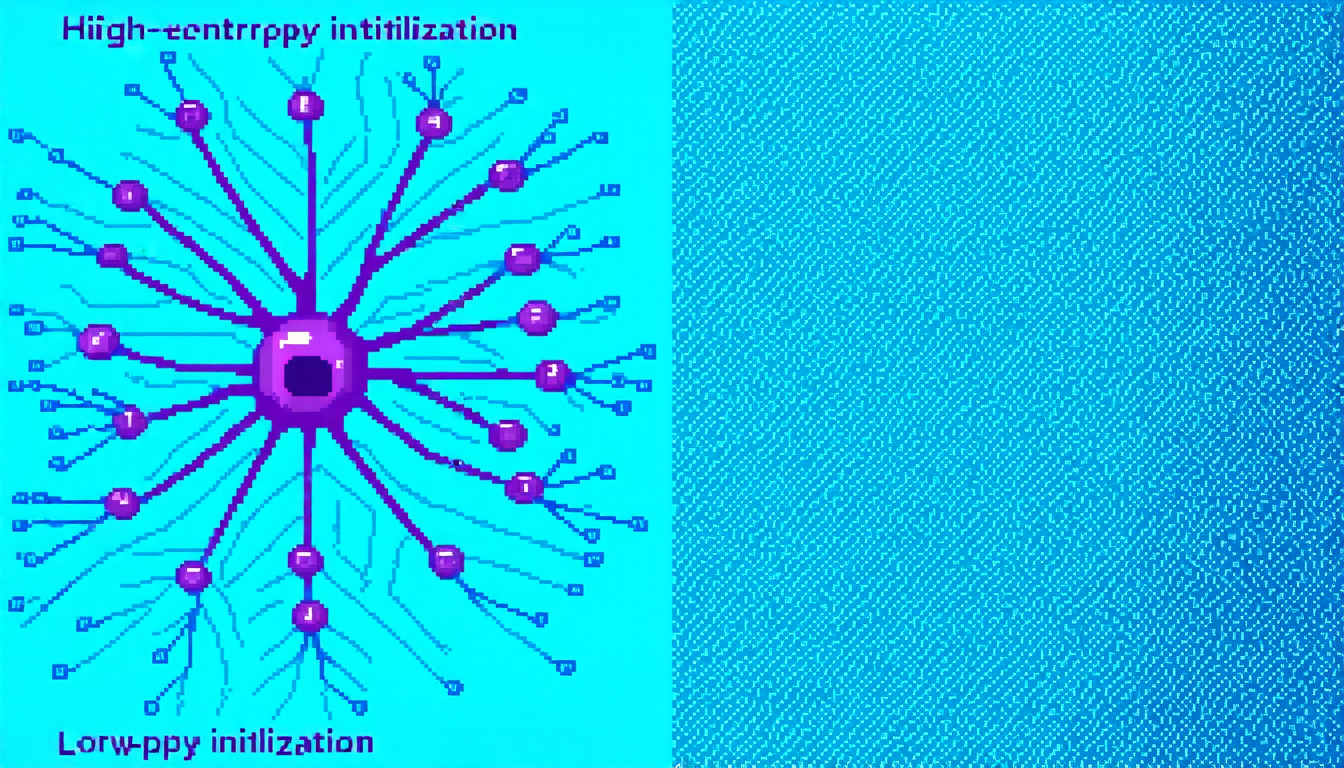
The researchers found that when a network is initialized with low entropy, meaning it starts out with a random and disordered set of weights, it is more likely to specialize in certain tasks. This is because low-entropy initialization encourages the network to focus on specific features or patterns in the data.
On the other hand, high-entropy initialization can lead to networks that are more general-purpose, but less effective at handling complex tasks. This is because high-entropy initialization makes it harder for the network to specialize and adapt to specific problems.
The researchers also experimented with real-world neural networks, using a popular dataset called MNIST to test their theories. They found that by initializing the network with low entropy, they could improve its performance on certain tasks, such as image recognition.
These findings have important implications for the design of artificial intelligence systems. As AI becomes increasingly prevalent in our lives, it is crucial that we develop algorithms that are efficient, effective, and easy to understand. By understanding how initialization affects specialization, researchers hope to create neural networks that can learn and adapt more quickly and accurately.
Cite this article: “Unlocking the Secrets of Neural Network Specialization: A Theoretical and Empirical Exploration”, The Science Archive, 2025.
Neural Networks, Initialization, Specialization, Entropy, Learning, Adaptation, Ai, Computer Science, Machine Learning, Deep Learning





