

Sunday 06 April 2025
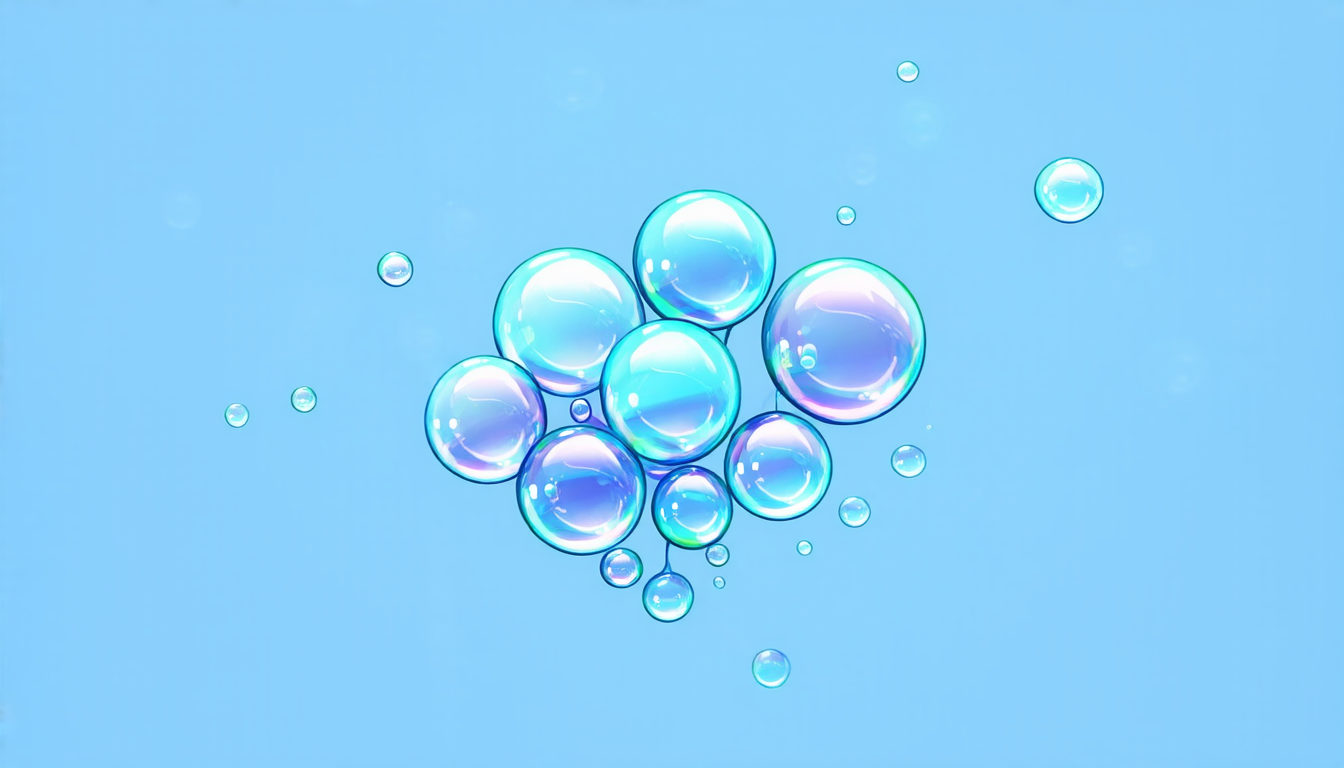
Soap bubbles have long fascinated us, their intricate shapes and mesmerizing colors captivating children and adults alike. But beneath their playful appearance lies a rich mathematical framework, waiting to be unraveled. A team of researchers has made significant strides in this area, discovering that soap bubble clusters can contain multiple torus bubbles – a finding with far-reaching implications for our understanding of the physical world.
The study began by examining the geometry of foams, complex systems composed of bubbles and liquid interfaces. By manipulating the surface tensions of these interfaces, scientists can create a wide range of shapes and configurations. The researchers focused on clusters of five bubbles or more, which can exhibit surprisingly complex behavior.
One of the key breakthroughs came when the team discovered that certain clusters could be stabilized by incorporating torus-shaped bubbles – think of a doughnut with no hole in the center. These tori add an extra layer of complexity to the cluster’s geometry, allowing for novel interactions and arrangements. The researchers found that these torus bubbles can appear in clusters containing as many as 20 or more individual bubbles.
The implications of this finding are significant. In physics and mathematics, the study of soap bubbles has long been used as a tool for understanding complex systems and phenomena. By exploring the properties of multiple-torus bubble clusters, scientists may uncover new insights into topics such as fluid dynamics, surface tension, and even quantum mechanics.
Moreover, the discovery of these torus bubbles opens up new avenues for applications in fields like materials science and engineering. Imagine designing materials with specific properties by carefully crafting their internal structure – a goal that now seems within reach.
The researchers achieved their findings using a combination of computational simulations and experimental techniques. They employed Surface Evolver, a software tool designed to model complex surface geometries, alongside a custom-built viewer for analyzing multimaterial meshes.
In the future, scientists plan to explore further the properties and behavior of these multiple-torus bubble clusters. They hope to uncover new patterns and relationships between the bubbles’ shapes, sizes, and arrangements, ultimately shedding light on the fundamental laws governing their behavior.
As researchers continue to delve deeper into the world of soap bubbles, we may yet discover even more surprising secrets hidden beneath their innocent appearance. One thing is certain, however: the allure of these tiny, fleeting wonders will continue to captivate us, inspiring new breakthroughs and innovations in the years to come.
Cite this article: “Bubble Trouble: Scientists Uncover Hidden Patterns in Soap Film Geometry”, The Science Archive, 2025.
Mathematics, Physics, Soap Bubbles, Torus, Surface Tension, Fluid Dynamics, Quantum Mechanics, Materials Science, Engineering, Geometry
Reference: Fabrice Delbary, “Stable soap bubble clusters with multiple torus bubbles” (2025).





