

Sunday 06 April 2025
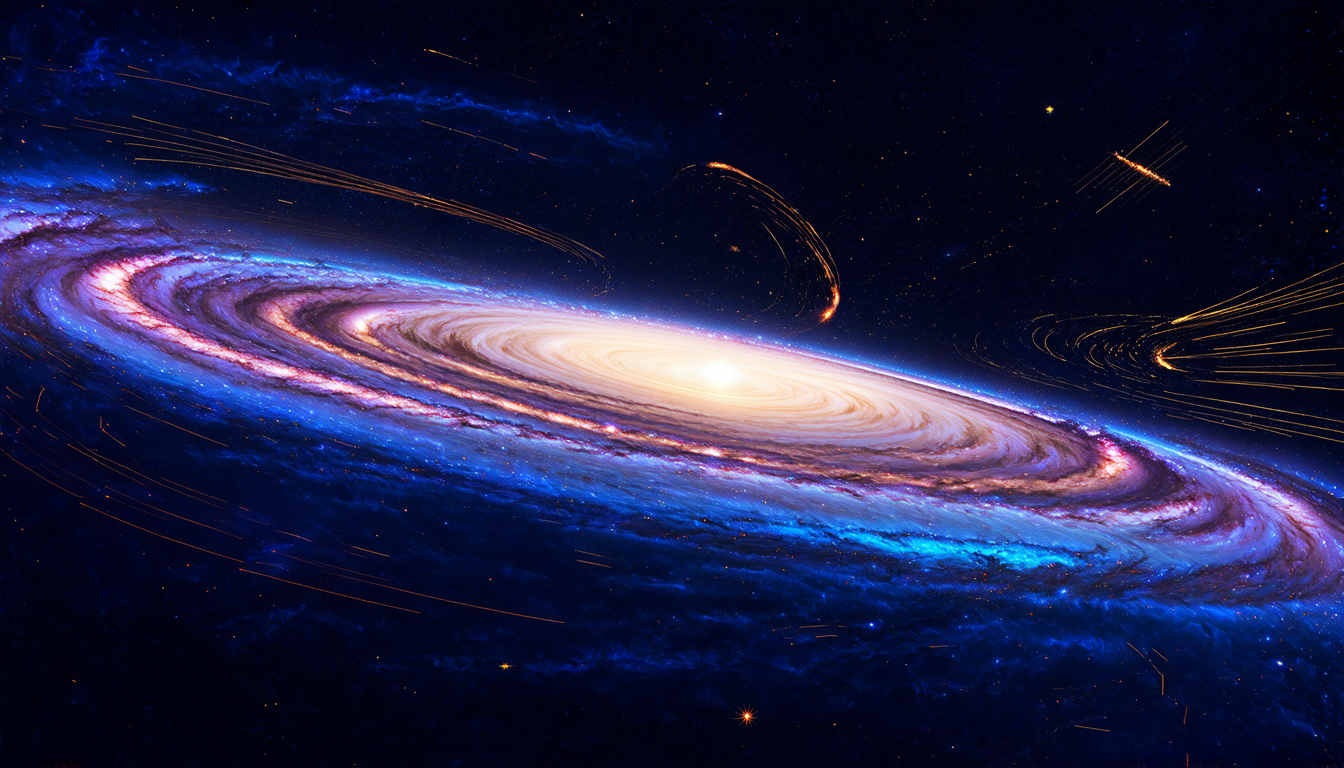
Scientists have long been fascinated by the Andromeda Galaxy, our closest galactic neighbor, and its enigmatic halo of hot gas. A recent study has shed new light on this mysterious region, using a unique probe to pierce the veil of uncertainty.
Fast Radio Bursts (FRBs) are brief, intense pulses of radio energy that originate from distant galaxies. They’re like cosmic flashbulbs, illuminating the universe for just milliseconds before fading away. Researchers have long sought to harness these fleeting events as tools for studying the intergalactic medium – the diffuse gas that fills the space between galaxies.
In this latest study, a team of scientists used FRBs to investigate the electron density distribution within Andromeda’s halo. By analyzing the signals’ dispersion – how they’re affected by the intervening gas – the researchers were able to map the density of electrons across vast distances. This revealed a complex pattern of hot and cold regions, with temperatures ranging from tens of thousands to millions of degrees Celsius.
The results have significant implications for our understanding of Andromeda’s evolution. The halo is thought to be a remnant of the galaxy’s merger history, with gas stripped from smaller galaxies accumulating over billions of years. The new data suggests that this process has been more turbulent than previously believed, with hot gas forming in regions where cooler material was compressed.
The study also highlights the potential of FRBs as probes of the intergalactic medium. By analyzing the signals’ properties and behavior, scientists can gain valuable insights into the properties of the gas itself – its density, temperature, and composition. This could ultimately help us better understand how galaxies interact with their surroundings, shaping their growth and evolution.
The Andromeda Galaxy is our closest galactic neighbor, a mere 2.5 million light-years away. Yet, despite its proximity, much remains unknown about this majestic spiral. The new study offers a glimpse into the galaxy’s hidden corners, revealing secrets that were previously shrouded in mystery. As scientists continue to explore the cosmos with FRBs and other novel tools, we can expect many more surprises and discoveries in the years to come.
The researchers’ findings have been published in a recent issue of The Astrophysical Journal.
Cite this article: “Unlocking the Secrets of Andromedas Halo: Fast Radio Bursts Reveal Hidden Galactic Structure”, The Science Archive, 2025.
Andromeda Galaxy, Fast Radio Bursts, Intergalactic Medium, Electron Density, Dispersion, Halo, Galaxy Evolution, Mergers, Spiral Galaxy, Astrophysical Journal





