

Sunday 06 April 2025
A newly discovered black hole binary system, Swift J151857.0–572147, has yielded a treasure trove of insights into these enigmatic celestial bodies. By analyzing data from multiple X-ray telescopes, including Insight-HXMT and NICER, scientists have been able to pin down several key properties of the black hole.
At the heart of the system lies a black hole with a mass around 3.67 times that of our sun. This is not particularly unusual for a stellar-mass black hole, which is the type formed from the collapse of individual stars. What’s more interesting is its spin rate – clocked at approximately 0.84 times the speed of light. This means it’s spinning relatively quickly compared to other known black holes.
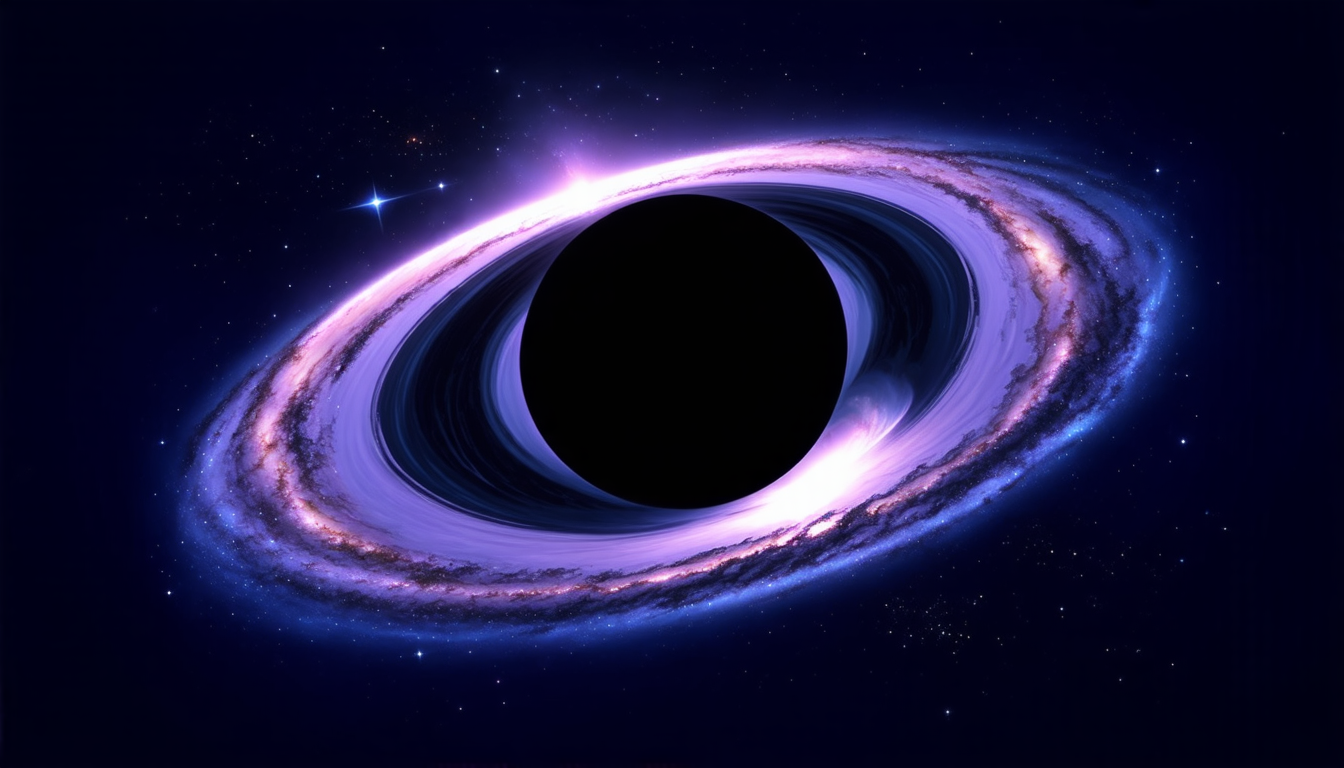
The team also found that the black hole is surrounded by an accretion disk, a swirling vortex of hot gas that’s fed by material falling towards the event horizon. The disk’s properties, such as its temperature and emission rate, are closely tied to the spin rate of the black hole itself. By studying these relationships, scientists can gain valuable insights into how black holes form and evolve over time.
One notable aspect of Swift J151857.0–572147 is its relatively high distance from Earth – about 5.8 kiloparsecs (or roughly 18,800 light-years). This makes it one of the most distant stellar-mass black hole binaries ever observed. The team was able to estimate this distance by analyzing the decay rate of the system’s X-ray flux over time.
The study also shed light on the black hole’s inner workings, including its innermost stable circular orbit (ISCO). This is the point at which matter in the accretion disk begins to spiral towards the event horizon. By studying the ISCO, scientists can better understand how black holes interact with their surroundings and how they affect the motion of nearby stars.
Swift J151857.0–572147 is an exciting discovery that promises to reveal more about these mysterious objects. As astronomers continue to study this system, we’re likely to learn more about how black holes form, evolve, and shape the universe around them.
Cite this article: “Unlocking the Secrets of a newly Discovered Black Hole: A Breakthrough in Astrophysics”, The Science Archive, 2025.
Black Hole, Binary System, X-Ray Telescopes, Insight-Hxmt, Nicer, Stellar-Mass Black Hole, Spin Rate, Accretion Disk, Distance From Earth, Kiloparsecs, Isco.





