

Sunday 06 April 2025
As we navigate through our daily routines, it’s easy to take for granted the complex systems that make modern transportation possible. From traffic lights to autonomous vehicles, the intricate dance of technology and human ingenuity is often hidden from view. However, a recent breakthrough in artificial intelligence has shed light on the inner workings of one such system: end-to-end autonomous driving.
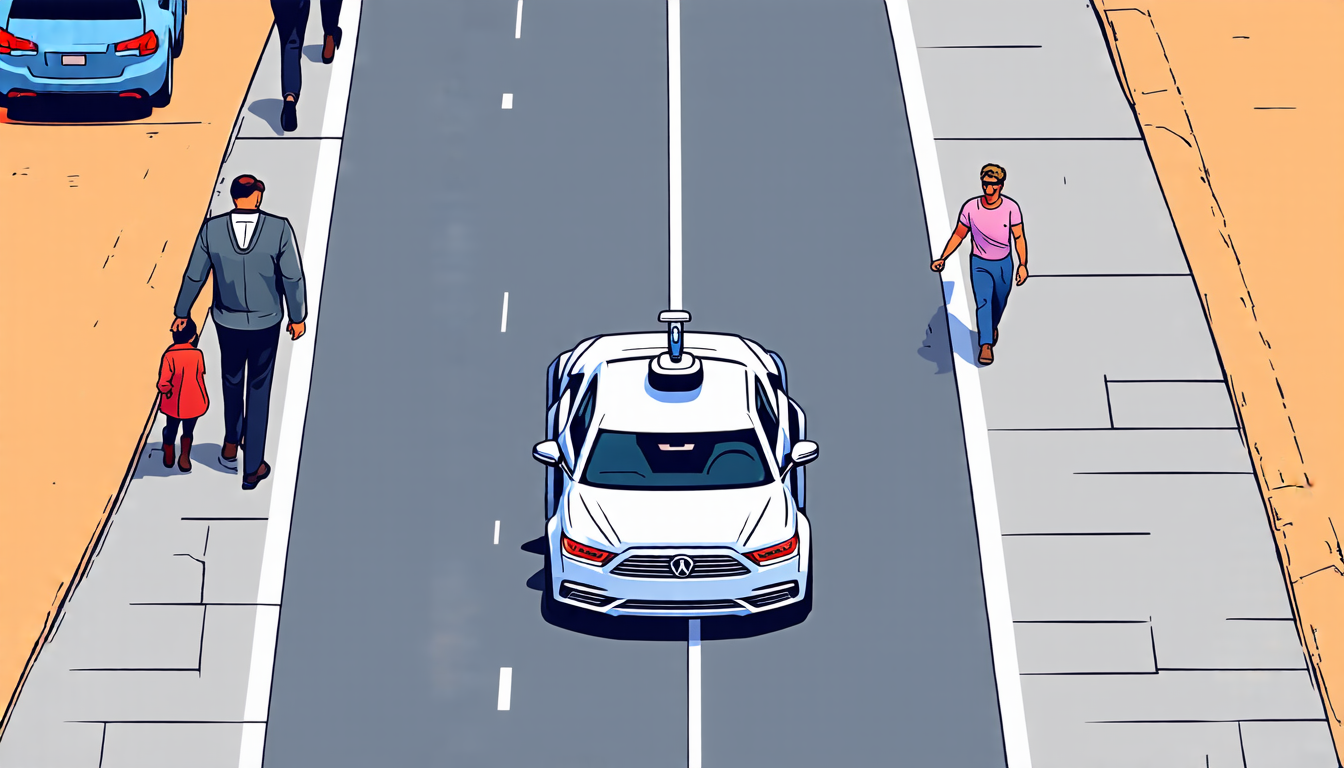
Researchers have long been working on developing self-driving cars that can safely and efficiently navigate through various environments. But despite significant progress, these vehicles still struggle with complex scenarios like turns and intersections. This is where MomAD, a new AI-powered framework, comes in.
MomAD stands for Momentum-Aware Driving, and its primary goal is to improve the stability and robustness of autonomous driving systems. By incorporating historical trajectory data into its planning process, MomAD can better anticipate and adapt to dynamic changes on the road. This results in smoother navigation, more accurate decision-making, and a significant reduction in collisions.
To test MomAD’s capabilities, researchers created a new dataset called Turning- nuScenes, which focuses specifically on turning scenarios. By evaluating their framework against established benchmarks, they found that MomAD outperformed other state-of-the-art methods by a significant margin.
One of the key challenges in autonomous driving is ensuring temporal consistency – that is, the ability to maintain a smooth and coherent trajectory over time. MomAD addresses this issue by introducing two novel modules: Topological Trajectory Matching (TTM) and Momentum Planning Interactor (MPI). TTM aligns candidate trajectories with past paths to ensure coherence, while MPI cross-references current and past data to expand the system’s perceptual awareness.
The results are impressive. When faced with complex turning scenarios, MomAD consistently produces stable and accurate trajectories, even in crowded environments. Long- horizon predictions – those that span multiple seconds – also benefit from MomAD’s momentum-aware planning, resulting in a significant reduction in oscillatory behavior.
But what does this mean for the average driver? For one, it could lead to safer roads and reduced traffic congestion. Autonomous vehicles equipped with MomAD would be better equipped to handle complex scenarios, reducing the risk of accidents and improving overall road safety.
Moreover, MomAD’s technology has far-reaching implications for the development of autonomous driving systems as a whole. As AI continues to play an increasingly important role in transportation, frameworks like MomAD will be crucial in ensuring the safe and efficient integration of these technologies into our daily lives.
Cite this article: “Revolutionizing Autonomous Driving: Momentum-Aware Planning for End-to-End Navigation”, The Science Archive, 2025.
Artificial Intelligence, Autonomous Driving, Momentum-Aware Driving, Momad, End-To-End Autonomous Driving, Self-Driving Cars, Traffic Lights, Temporal Consistency, Trajectory Planning, Safety





