

Sunday 06 April 2025
A recent study has shed new light on the way we depict electric fields, a fundamental concept in physics. The research, published in a scientific journal, challenges our traditional understanding of how these fields behave when a charged particle is moving at high speeds.
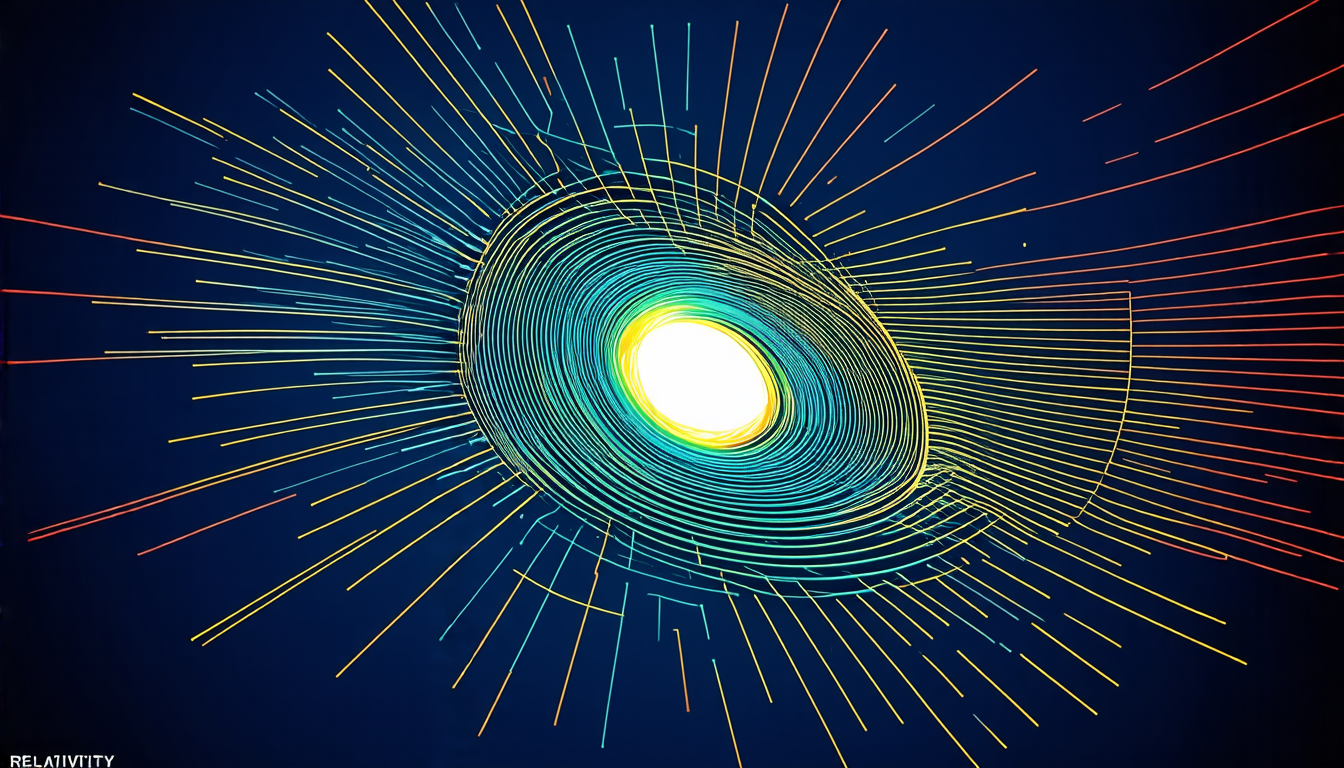
Electric fields are typically represented as lines that emanate from a positive charge and converge towards a negative one. However, this representation becomes increasingly inaccurate as the charged particle accelerates to near-light speeds. The new study reveals that the field lines do not contract in the way we previously thought, but instead undergo a complex rotation.
To understand why this is important, let’s take a step back and consider how electric fields work. When an electric charge moves through space, it creates a region around itself where other charges are either attracted or repelled. This region is known as the electric field. The strength of the field depends on the magnitude of the charge and its distance from other nearby charges.
In our everyday experience, we typically encounter charges that move at relatively slow speeds. For example, an electron orbiting a nucleus in an atom or a charged particle moving through a wire. In these cases, the electric field lines can be accurately represented as straight lines emanating from the positive charge and converging towards the negative one.
However, when charged particles approach relativistic speeds – approaching 90% of the speed of light – the situation becomes more complex. The electric field lines begin to bend and curve in ways that defy our traditional understanding. This is because time dilation and length contraction occur as an observer views the moving charge from a stationary frame of reference.
The new study uses advanced mathematical techniques to model the behavior of electric fields in these high-speed scenarios. By analyzing the equations governing the motion of charged particles, researchers have uncovered the subtle but important differences between how field lines behave at slow and fast speeds.
One key finding is that the rotation of the field lines is not simply a matter of perspective. The actual shape and orientation of the field lines change as the charged particle accelerates. This means that our traditional representation of electric fields, which relies on straight lines, becomes increasingly inaccurate as particles approach relativistic speeds.
So what does this mean for our understanding of the physical world? In short, it highlights the importance of considering relativity when studying high-speed phenomena. The study’s findings have significant implications for fields such as particle physics and astrophysics, where charged particles often move at relativistic speeds.
Cite this article: “The Elusive Truth About Electric Field Lines: A Critical Reevaluation of a Fundamental Concept in Physics”, The Science Archive, 2025.
Electric Fields, Relativity, Particle Physics, Astrophysics, Charged Particles, High-Speeds, Near-Light Speeds, Electric Field Lines, Time Dilation, Length Contraction





