

Sunday 06 April 2025
Scientists have made a significant breakthrough in predicting when massive solar storms will erupt, potentially disrupting our daily lives and technology.
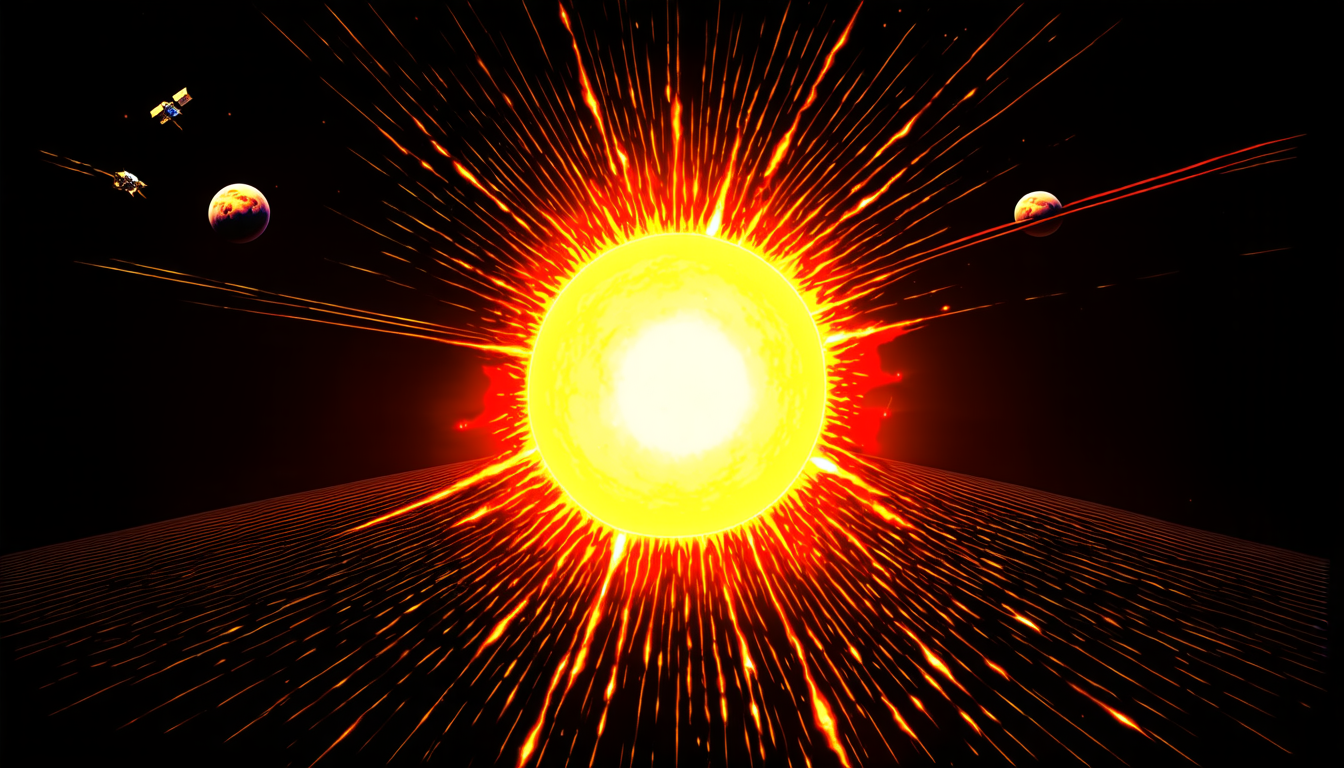
Solar coronal mass ejections (CMEs) are powerful explosions that occur on the surface of the sun, sending huge amounts of energy hurtling towards Earth. These events can cause communication blackouts, disrupt power grids, and even damage satellites. Predicting when these storms will occur is crucial for mitigating their impact.
Researchers have been working tirelessly to develop a new method for forecasting CMEs. They’ve created a deep learning model called DeepHalo that uses data from the Solar Dynamics Observatory’s Helioseismic and Magnetic Imager (HMI) to predict whether an active region on the sun will produce a halo CME within 24 hours.
The team trained their model using over 1,000 profiles of active regions taken by HMI. Each profile contains 18 parameters that describe the region’s magnetic field, temperature, and other properties. By analyzing these data points, DeepHalo can identify patterns that indicate whether a CME is likely to occur.
In tests, DeepHalo outperformed a traditional machine learning model called LSTM (Long Short-Term Memory) by accurately predicting 90% of halo CMEs. This improvement is significant because it means scientists can provide more reliable warnings to satellite operators, power grid managers, and other stakeholders.
The researchers also used attention heatmaps to visualize the model’s decision-making process. These heatmaps show which data points in each profile are most important for predicting a CME. By examining these maps, scientists can gain insights into how the model is using the available information to make its predictions.
While this breakthrough is exciting, it’s not without its limitations. The team still needs to improve their model’s ability to predict non-halo CMEs, which are less powerful but can still cause significant disruptions. Additionally, they must develop a system for integrating their predictions with existing forecasting tools and alerting systems.
Despite these challenges, the potential benefits of DeepHalo are substantial. By providing more accurate forecasts of solar storms, scientists can help mitigate the impact of these events on our daily lives and technology. As our reliance on satellite-based services continues to grow, this research is critical for ensuring the stability of our global infrastructure.
Cite this article: “Unlocking the Secrets of Solar Storms: A New AI-Powered Approach to Predicting Halo Coronal Mass Ejections”, The Science Archive, 2025.
Solar Storms, Deephalo, Cmes, Sun, Predictions, Machine Learning, Satellite, Power Grid, Communication Blackouts, Space Weather.





