

Monday 07 April 2025
Researchers have made significant strides in developing more efficient and agile legged robots, a crucial step towards creating machines that can navigate complex environments like our own bodies do. In recent years, scientists have been experimenting with various approaches to improve the energy efficiency of these robots, including the use of elastic elements to reduce motor torque.
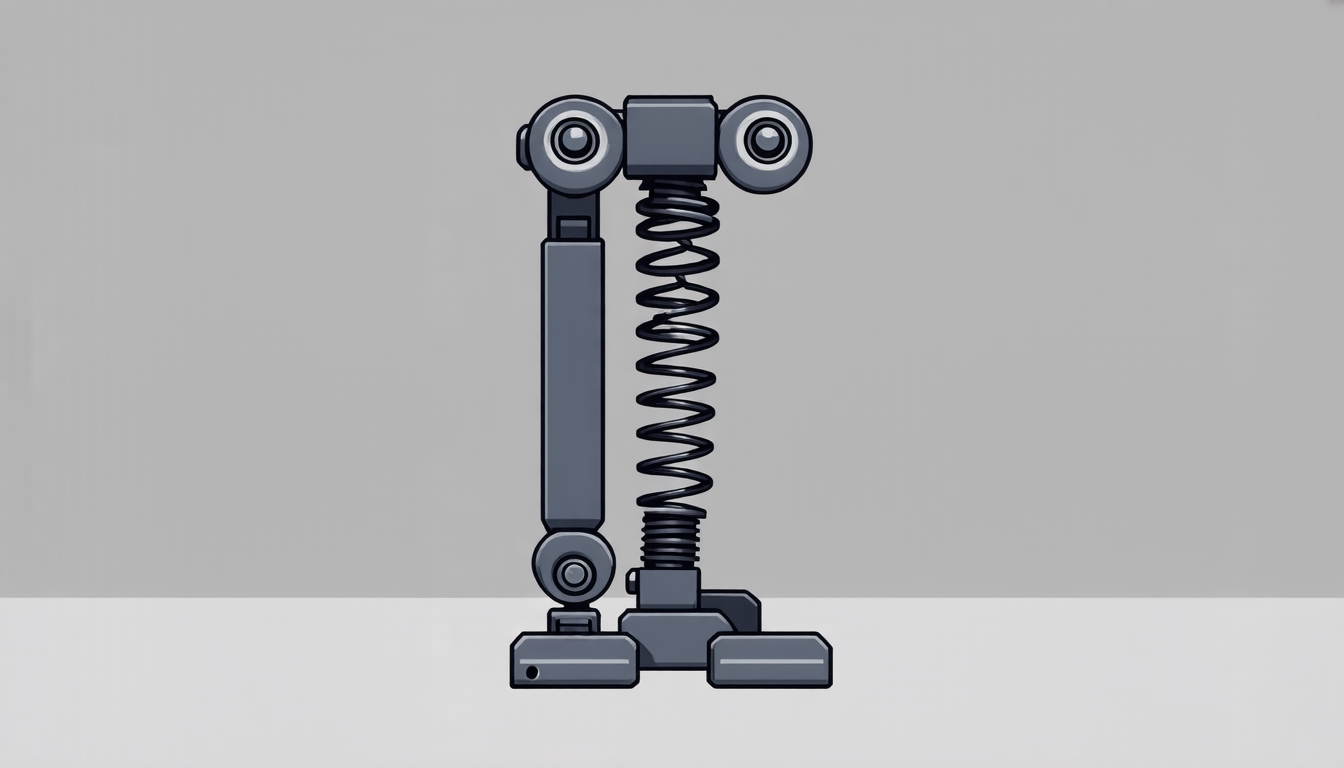
One of the most promising solutions is the unidirectional parallel spring (UPS), which has been shown to significantly reduce energy consumption in legged robots. By incorporating UPS into a monopedal robot’s design, researchers have managed to achieve an impressive 38.8% reduction in cost of transport (CoT) – a key metric for measuring a robot’s energy efficiency.
The UPS mechanism works by using a spring-loaded system that stores energy during the stance phase of the robot’s gait cycle, allowing it to reuse this energy during the swing phase. This not only reduces the amount of motor torque required but also enables the robot to maintain its stability and agility.
To further optimize the performance of their UPS-enabled monopedal robot, researchers developed a kinodynamic model predictive control (MPC) framework. This approach combines traditional MPC with a hierarchical control structure that incorporates simplified dynamic models to warm-start the optimization process.
The resulting system was tested through both simulation and hardware experiments, with impressive results. In simulations, the UPS-assisted robot achieved an average CoT reduction of 38.8% across various speeds and frequencies. Hardware experiments also showed significant energy savings, with a 14.8% reduction in consumed energy compared to a monopedal robot without UPS.
The implications of this research are far-reaching, as it could pave the way for more efficient and agile legged robots that can navigate complex environments like our own bodies do. With potential applications in fields such as search-and-rescue, planetary exploration, and even robotics-assisted healthcare, this technology has the potential to revolutionize the field of robotics.
The development of UPS-enabled legged robots is an exciting step forward in the quest for more efficient and agile machines. As researchers continue to refine their designs and optimize their control systems, we can expect to see even more impressive advancements in the years to come.
Cite this article: “Soft Landing: Robots Elastic Legs Cut Energy Consumption by 14.8% While Maintaining Agility”, The Science Archive, 2025.
Legged Robots, Energy Efficiency, Unidirectional Parallel Spring, Cost Of Transport, Robot Design, Gait Cycle, Motor Torque, Kinodynamic Model Predictive Control, Hierarchical Control Structure, Robotics





