

Tuesday 08 April 2025
Scientists have made a significant breakthrough in the field of autonomous navigation, developing a new approach that allows robots and vehicles to navigate complex environments more efficiently and effectively.
The new method, known as C-Uniform trajectory sampling, enables machines to explore and map out their surroundings more accurately and quickly. This is achieved by introducing a neural network that learns to weight the probabilities of different actions based on the robot’s current state and goals.
In traditional model predictive control (MPC) systems, robots rely on pre-defined trajectories or sampling distributions to navigate through environments. However, these approaches can be limited in their ability to adapt to changing situations or unexpected obstacles.
The C-Uniform approach addresses this issue by generating a uniform distribution of possible trajectories, which allows the robot to explore its surroundings more thoroughly and respond better to unexpected events. This is achieved by using entropy as an unsupervised loss function, which helps the neural network learn to prioritize actions that lead to more exploration.
The new method has been tested in various scenarios, including simulations and real-world experiments with a robotic vehicle. Results show that C-Uniform outperforms traditional MPC approaches in terms of navigation efficiency and adaptability.
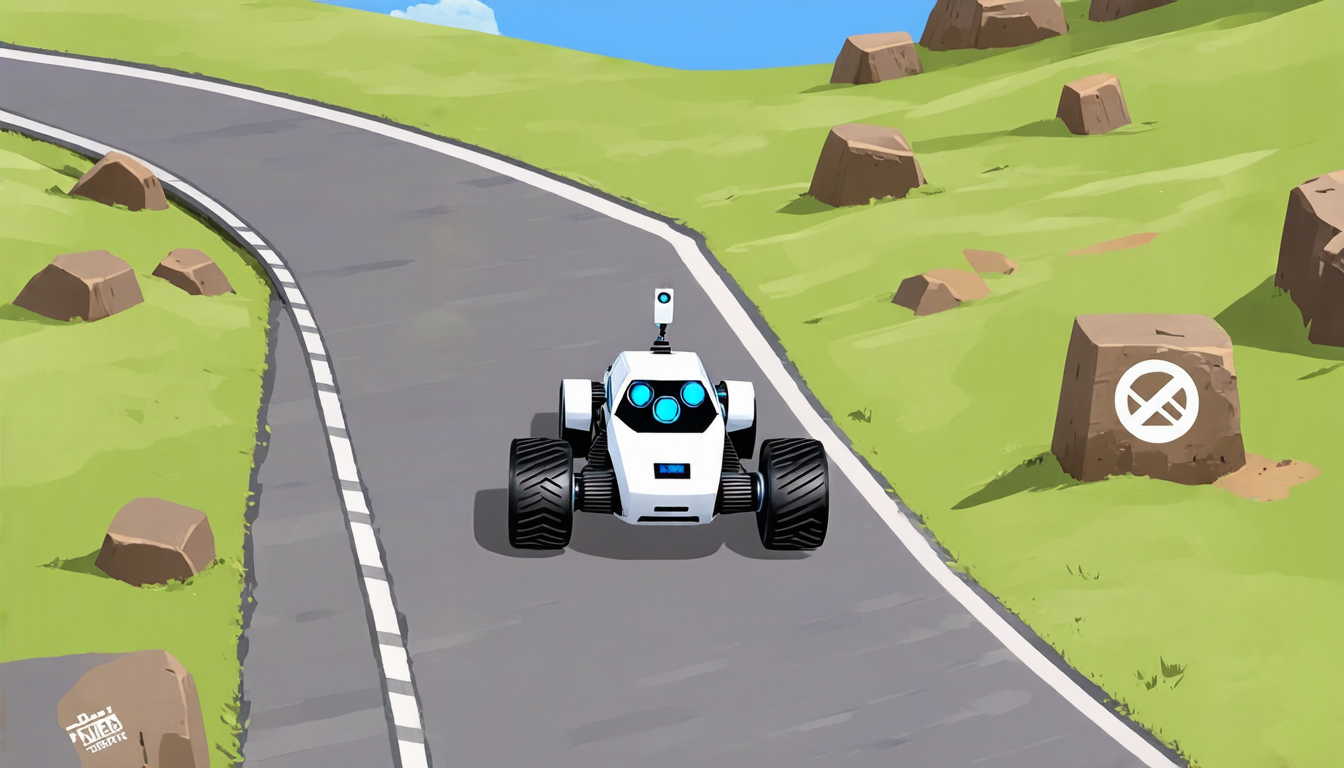
One of the key benefits of C-Uniform is its ability to handle high-curvature turns and complex environments. This is particularly important for applications such as autonomous driving, where robots need to navigate through busy streets and avoid obstacles with precision.
The researchers have also demonstrated the potential of C-Uniform in real-world scenarios, using a robotic vehicle to navigate through a cluttered environment with varying levels of difficulty. The results showed that the robot was able to adapt quickly to changing situations and avoid collisions with obstacles.
While there is still much work to be done in refining the C-Uniform approach, this breakthrough has significant implications for the development of autonomous systems. As researchers continue to explore new ways to improve navigation efficiency and adaptability, we can expect to see even more advanced robots and vehicles that are capable of navigating complex environments with ease.
The potential applications of C-Uniform are vast and varied, from search and rescue operations to logistics and transportation. By enabling robots to navigate more efficiently and effectively, this technology has the power to transform industries and improve our daily lives.
As we move forward in developing autonomous systems, it is clear that innovations like C-Uniform will play a critical role in shaping the future of robotics and AI.
Cite this article: “Revolutionizing Model Predictive Control: A Novel Approach to Trajectory Sampling and Optimization”, The Science Archive, 2025.
Autonomous Navigation, Robots, Vehicles, Neural Networks, Model Predictive Control, Trajectory Sampling, Entropy, Unsupervised Learning, Robotic Vehicle, Autonomous Driving.





