

Tuesday 08 April 2025
The quest to understand black holes has led scientists down a fascinating rabbit hole. New research has shed light on the mysterious objects, revealing that their shadows can be used as a tool to test the fundamental laws of physics.
Black holes are regions in space where gravity is so strong that nothing, not even light, can escape once it gets too close. Their intense gravitational pull warps the fabric of spacetime around them, creating an event horizon – a point of no return. But what lies beyond this boundary is still shrouded in mystery.
Researchers have long been intrigued by the idea that black holes could be used to test our understanding of gravity and the behavior of matter at the quantum level. Now, a team of scientists has made significant progress towards achieving this goal.
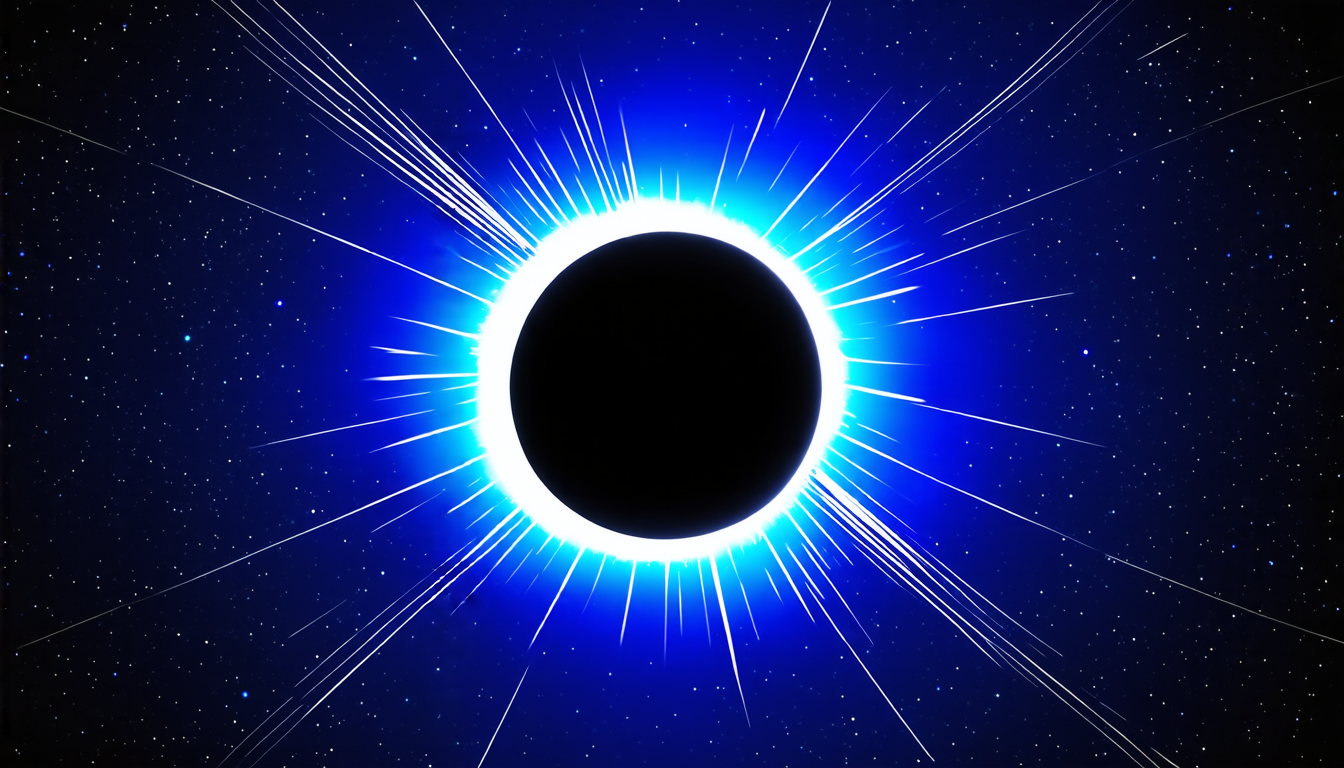
By studying the shadows of black holes, researchers can gain insight into the physics that govern their behavior. The shadow is formed when light from distant stars or other sources passes close to the event horizon and is bent by the strong gravitational field. This bending causes the light to follow a curved path, creating an image that appears as a dark circle against a brighter background.
The researchers used computer simulations to model the behavior of black holes with different properties, such as mass, spin, and charge. They then used these models to calculate the shape and size of the shadows for each type of black hole.
What they found was surprising: the shadow of a black hole can be used to determine its mass, spin, and even whether it has hair – a hypothetical property that some theories predict could exist in certain types of black holes. This is because the bending of light by the gravitational field is sensitive to these properties, allowing scientists to infer their values from the shape and size of the shadow.
The implications of this research are far-reaching. By studying the shadows of black holes, astronomers can gain a better understanding of the behavior of gravity in extreme environments, which could have significant implications for our understanding of the universe as a whole.
Furthermore, the ability to determine the properties of a black hole from its shadow could be used to test the fundamental laws of physics, such as general relativity and quantum mechanics. This is because any deviations from these theories would manifest themselves in the shape and size of the shadow, providing a way for scientists to detect them.
The study of black holes has long been a fascinating area of research, but this new work takes it to a whole new level.
Cite this article: “Unlocking the Secrets of Black Holes: New Insights from Loop Quantum Gravity”, The Science Archive, 2025.
Black Holes, Shadows, Gravity, Physics, Spacetime, Event Horizon, Quantum Mechanics, General Relativity, Mass, Spin





