

Tuesday 08 April 2025
The intricate dance of phase changes has long fascinated scientists and engineers. From the melting of ice on a summer’s day to the boiling of water in a kettle, these transitions are crucial to our daily lives. But what happens when we add multiple phases to the mix? Enter the three-phase Stefan problem, a notoriously tricky mathematical puzzle that has stumped researchers for decades.
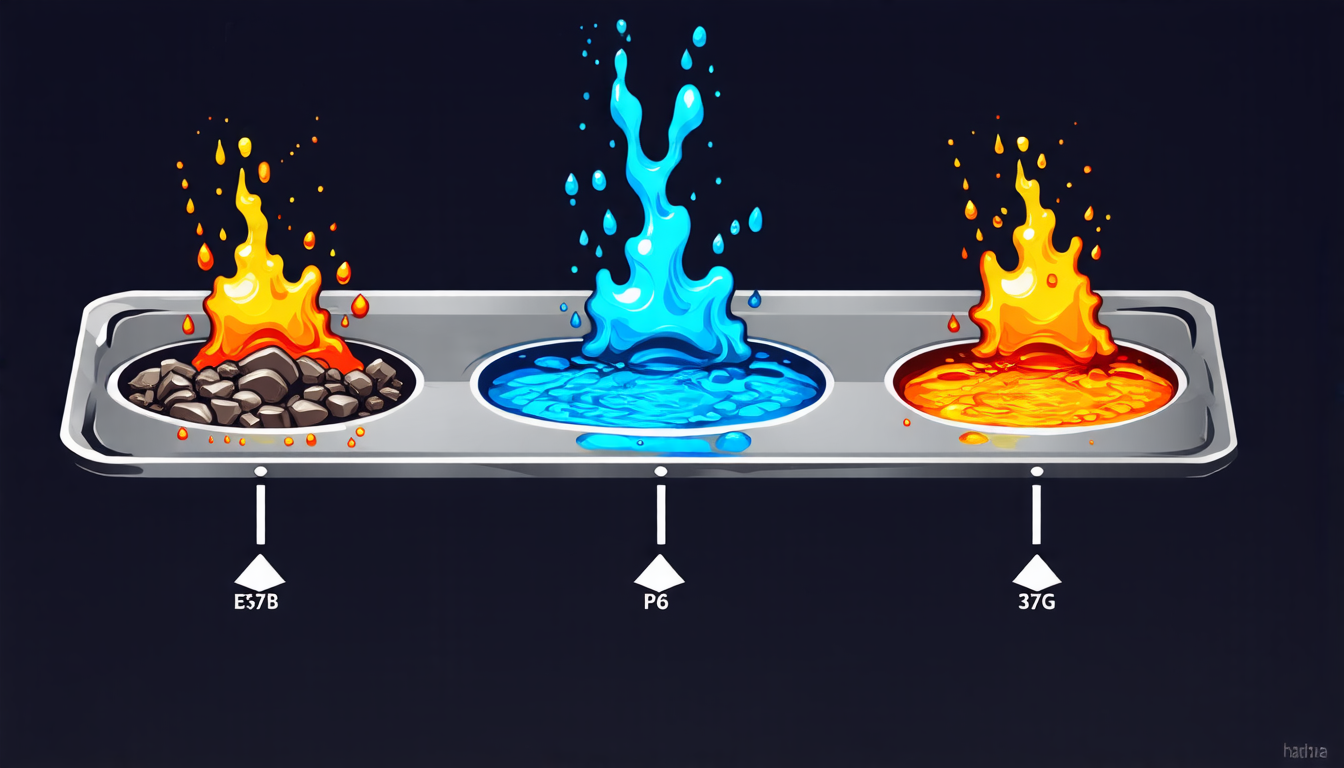
In this complex scenario, a solid material (like metal) is subjected to heat, causing it to melt and boil simultaneously. Sounds simple enough, but the math behind it is anything but straightforward. The phase transitions occur at different rates, and the interfaces between them are dynamic and constantly shifting. It’s like trying to solve a Rubik’s Cube while juggling chainsaws.
Researchers have long struggled to develop accurate models for this phenomenon, relying on simplified assumptions and approximations. But a recent breakthrough has shed new light on the problem. By applying a mathematical technique called similarity transformation, scientists can derive analytical solutions for the three-phase Stefan problem.
These solutions reveal the intricate dance of phase changes in stunning detail. The researchers used these equations to simulate the melting and boiling of aluminum, a common metal alloy used in manufacturing. The results were astonishing: the simulations accurately predicted the movement of the interfaces between the solid, liquid, and vapor phases, as well as the temperature distributions within each phase.
But what’s truly remarkable about this breakthrough is its potential impact on real-world applications. Imagine being able to precisely control the phase transitions during metal manufacturing or welding processes. This could lead to significant improvements in efficiency, product quality, and safety.
The researchers behind this study have developed a sharp interface method that can accurately simulate these complex phenomena. By using a combination of numerical methods and analytical solutions, they’ve created a powerful tool for modeling multi-phase flows with phase changes.
Of course, there are still challenges ahead. The three-phase Stefan problem is notoriously difficult to solve, even with the aid of advanced mathematical techniques. But this breakthrough has opened up new avenues for research and development, offering a glimpse into a future where complex materials processing can be precisely controlled and optimized.
As scientists continue to refine their models and simulations, we can expect to see significant advancements in fields like manufacturing, energy production, and environmental monitoring. The three-phase Stefan problem may seem esoteric at first glance, but its implications are far-reaching and profound. By unlocking the secrets of these complex phase transitions, researchers are paving the way for a new era of innovation and discovery.
Cite this article: “Unlocking the Secrets of Simultaneous Melting and Boiling in Metals: A Novel Approach to Multiphase Flow Modeling”, The Science Archive, 2025.
Mathematics, Phase Changes, Stefan Problem, Multi-Phase Flow, Heat Transfer, Materials Science, Manufacturing, Welding, Numerical Methods, Analytical Solutions





