

Tuesday 08 April 2025
The quest for photorealistic, controllable 3D scenes has been a holy grail of computer vision research. Now, a team of scientists has made significant progress towards achieving this goal by developing a system that can generate highly detailed outdoor environments using scene graphs.
Scene graphs are a way to describe the structure and relationships between objects in a 3D scene, much like a blueprint for a building. By leveraging these graphs, the researchers have created an interactive system that allows users to easily create or modify dense 3D scenes with unprecedented accuracy.
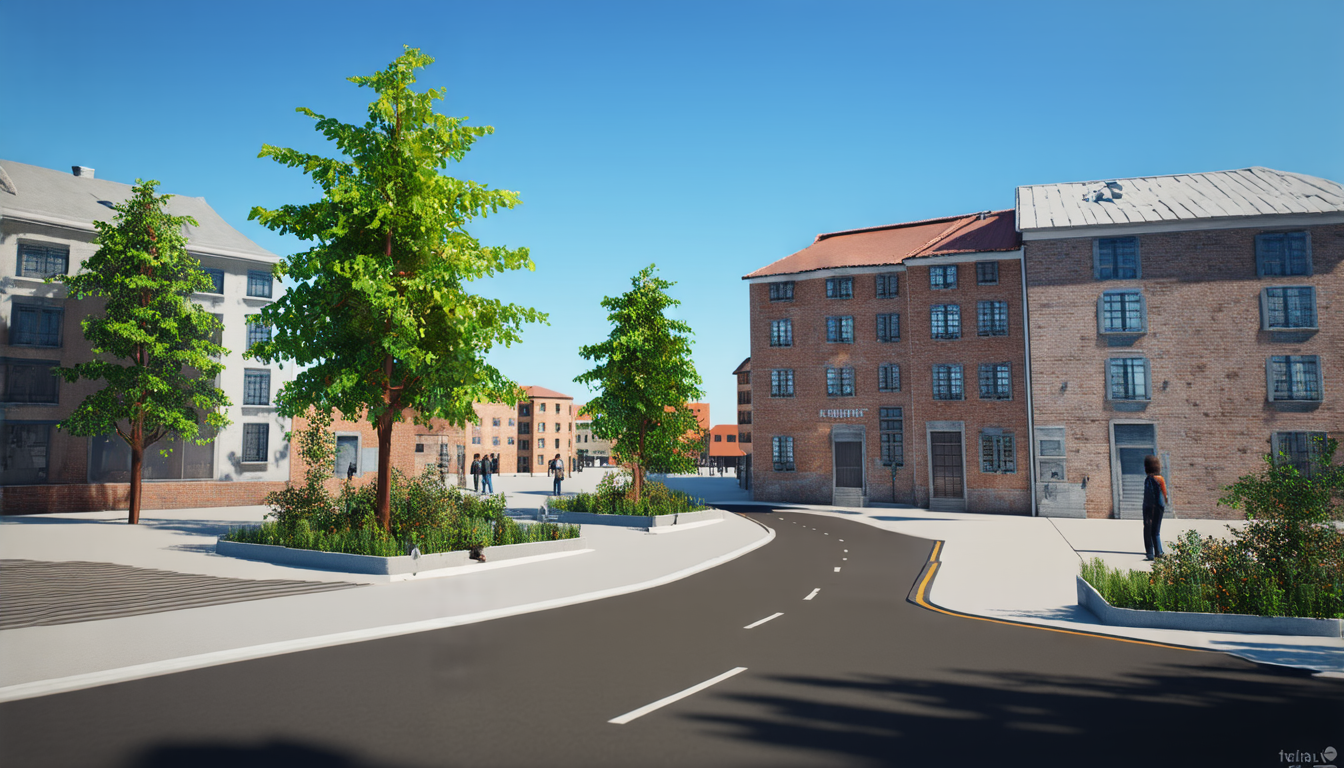
The system, which combines a diffusion model with a bird’s eye view (BEV) embedding map, is capable of generating complex outdoor environments with intricate details such as buildings, roads, and vegetation. This is achieved by transforming the sparse scene graph into a dense BEV map, which serves as a blueprint for the 3D scene generation process.
The researchers have demonstrated the effectiveness of their system through a series of experiments, showcasing its ability to generate highly realistic outdoor scenes that closely match the input scene graphs. The results indicate that the approach is not only able to produce high-quality 3D environments but also offers improved control over object quantities and alignment with the input scene graph.
One of the key advantages of this system is its scalability. Unlike other methods, which often struggle to handle large-scale outdoor scenes, this approach can generate complex environments with ease. This makes it an attractive solution for applications such as virtual reality, gaming, and urban planning.
The potential applications of this technology are vast, from creating realistic virtual environments for entertainment purposes to assisting in the design and development of real-world infrastructure projects. The ability to generate highly detailed 3D scenes on demand could revolutionize various industries, including architecture, construction, and urban planning.
While there is still much work to be done to refine the system and improve its performance, this breakthrough represents a significant step forward in the quest for photorealistic, controllable 3D scenes. As researchers continue to push the boundaries of what is possible, we can expect to see even more innovative applications of this technology in the years to come.
Cite this article: “Controlling the Narrative: A Novel Approach to 3D Outdoor Scene Generation via Scene Graphs”, The Science Archive, 2025.
3D Scenes, Computer Vision, Scene Graphs, Diffusion Model, Bev Embedding Map, Outdoor Environments, Virtual Reality, Gaming, Urban Planning, Photorealistic.





