

Tuesday 08 April 2025
As researchers delve deeper into the mysteries of hyperbolic geometry, a peculiar phenomenon has come to light. On non-orientable surfaces, it seems that certain loops can become ‘stuck’ around punctures, repeating themselves in a seemingly infinite cycle.
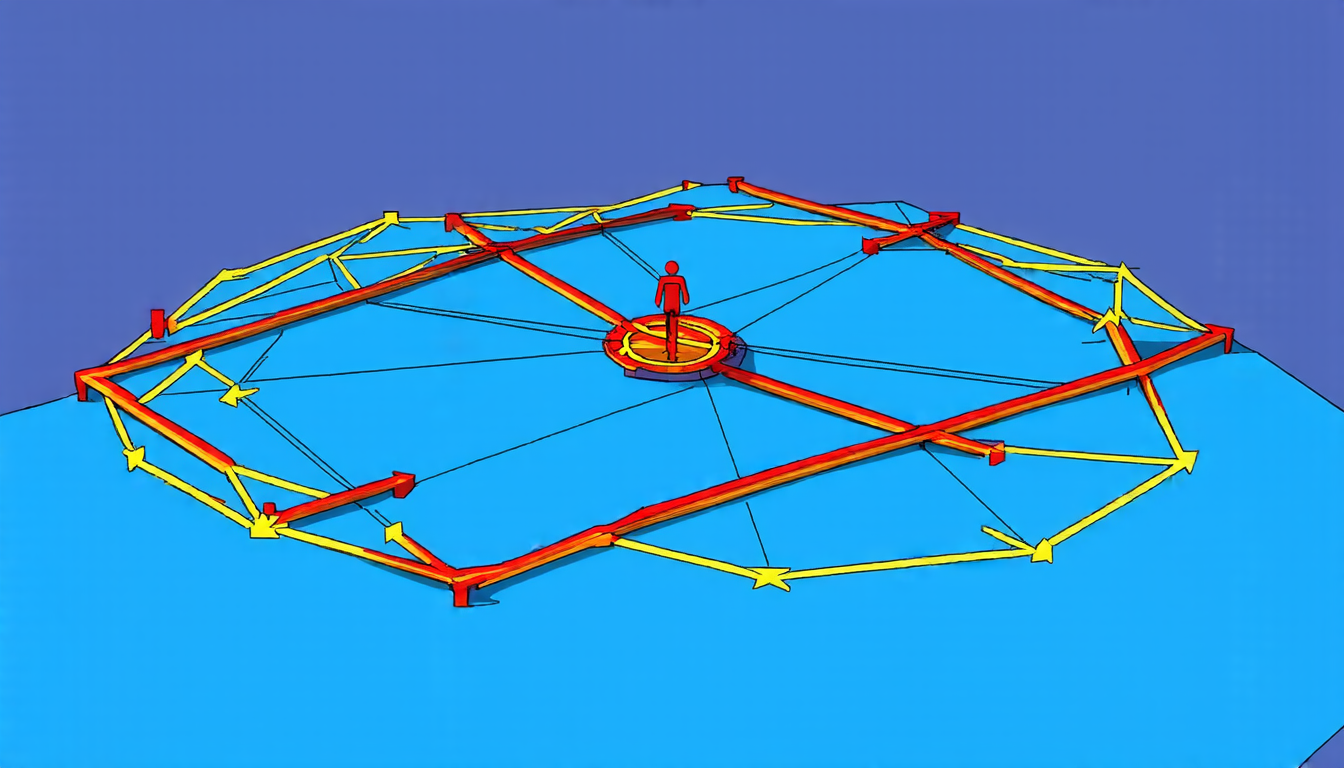
These loops, known as puncture loops, are formed when two closed geodesics intersect transversely on the surface. Geodesics, for those unfamiliar with the term, are the shortest paths possible between two points on a curved surface. In this case, they’re not just any ordinary curves – they’re the building blocks of the hyperbolic geometry that underlies our universe.
The discovery, published in a recent paper, sheds new light on the intricate dance of loops and geodesics on non-orientable surfaces. These surfaces are unlike the familiar Euclidean planes we navigate every day; they have negative Euler characteristic, which means they’re capable of folding in on themselves in ways that defy our intuition.
The researchers found that when a loop intersects with another closed geodesic at a specific angle, it can create a puncture loop. This phenomenon is not limited to just one or two instances – the study shows that multiple puncture loops can arise from a single intersection point, each one wrapping around the puncture in a unique way.
But what’s truly remarkable about these loops is their ability to become ‘stuck’ in this infinite cycle. It’s as if they’re trapped by some unseen force, repeating themselves ad infinitum. This phenomenon has far-reaching implications for our understanding of hyperbolic geometry and its applications in fields such as topology and geometry.
The study also reveals that the number of puncture loops that can arise from a single intersection point is limited to at most two consecutive odd integers. This raises intriguing questions about the underlying structure of these non-orientable surfaces – what is it about these specific angles and intersections that gives rise to this peculiar behavior?
As researchers continue to probe the mysteries of hyperbolic geometry, they’re uncovering new and unexpected phenomena that challenge our understanding of the universe. The discovery of puncture loops on non-orientable surfaces is just one example of how the intricate dance of loops and geodesics can lead to surprising and counterintuitive results.
As we continue to explore the uncharted territories of hyperbolic geometry, it’s clear that there’s still much to be discovered – and the possibilities are endless.
Cite this article: “Unlocking the Secrets of Non-Orientable Surfaces: A New Perspective on Geometry and Topology”, The Science Archive, 2025.
Hyperbolic Geometry, Non-Orientable Surfaces, Puncture Loops, Geodesics, Closed Curves, Loops, Euler Characteristic, Topology, Geometry, Angles
Reference: Aoi Wakuda, “Puncture loops on a non-orientable surface” (2025).





