

Wednesday 09 April 2025
A team of astronomers has made a significant breakthrough in understanding how supermassive black holes at the centers of galaxies form and evolve over billions of years. The study, published in the Astrophysical Journal, provides new insights into the complex dynamics that shape our understanding of galaxy evolution.
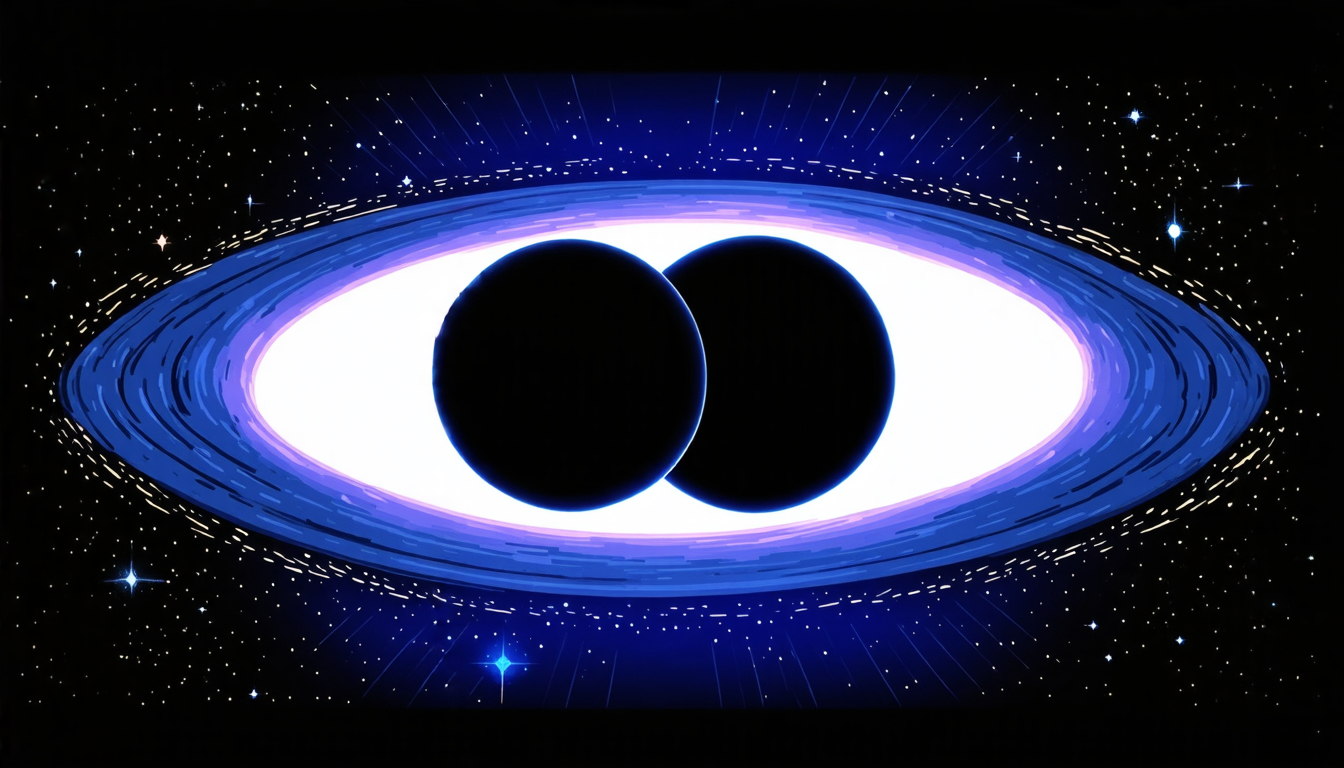
The researchers used advanced computer simulations to model the merger of two massive black holes, each with a mass equivalent to millions of times that of our sun. This event is thought to have played a crucial role in shaping the formation of galaxies as we know them today. By studying the simulation results, scientists were able to gain a deeper understanding of how these massive black holes interact with their surroundings and ultimately form.
The simulations revealed that the merger process is far more complex than previously thought. The two black holes do not simply merge into one, but rather go through a series of intricate gravitational interactions. These interactions cause the black holes to emit powerful bursts of energy in the form of gravitational waves, which are ripples in the fabric of spacetime.
The study also found that the merger process can lead to the formation of supermassive black holes with masses far exceeding those observed in our own galaxy. This has significant implications for our understanding of galaxy evolution, as it suggests that these massive black holes may have played a more important role in shaping the universe than previously thought.
One of the key findings of the study is the importance of gravitational waves in the merger process. The simulations showed that the emission of gravitational waves can have a profound impact on the dynamics of the merging black holes, causing them to become more massive and more energetic as they merge.
The study’s results also have implications for the detection of gravitational waves by future observatories such as LISA (Laser Interferometer Space Antenna). The simulations suggest that these observatories may be able to detect the merger of two supermassive black holes, providing new insights into the formation and evolution of galaxies.
In addition to its scientific significance, the study highlights the power of advanced computer simulations in understanding complex astrophysical phenomena. The simulations used in this study were performed on some of the world’s most powerful computers, using sophisticated algorithms and software to model the intricate dynamics of black hole mergers.
The findings of this study are a significant step forward in our understanding of galaxy evolution and the role that supermassive black holes play in shaping the universe.
Cite this article: “Unlocking the Secrets of the Universes Most Mysterious Galaxies: A Groundbreaking Study Reveals How Supermassive Black Holes Shape the Cosmos”, The Science Archive, 2025.
Supermassive Black Holes, Galaxy Evolution, Gravitational Waves, Black Hole Mergers, Astrophysical Journal, Computer Simulations, Galaxy Formation, Lisa, Laser Interferometer Space Antenna, Spacetime.





