

Wednesday 09 April 2025
The intricate dance of mechanical metamaterials has long fascinated scientists, as they strive to unravel the secrets of these complex systems. Recently, researchers have made significant strides in understanding the behavior of these materials, which can exhibit remarkable properties such as bistability and non-Abelian responses.
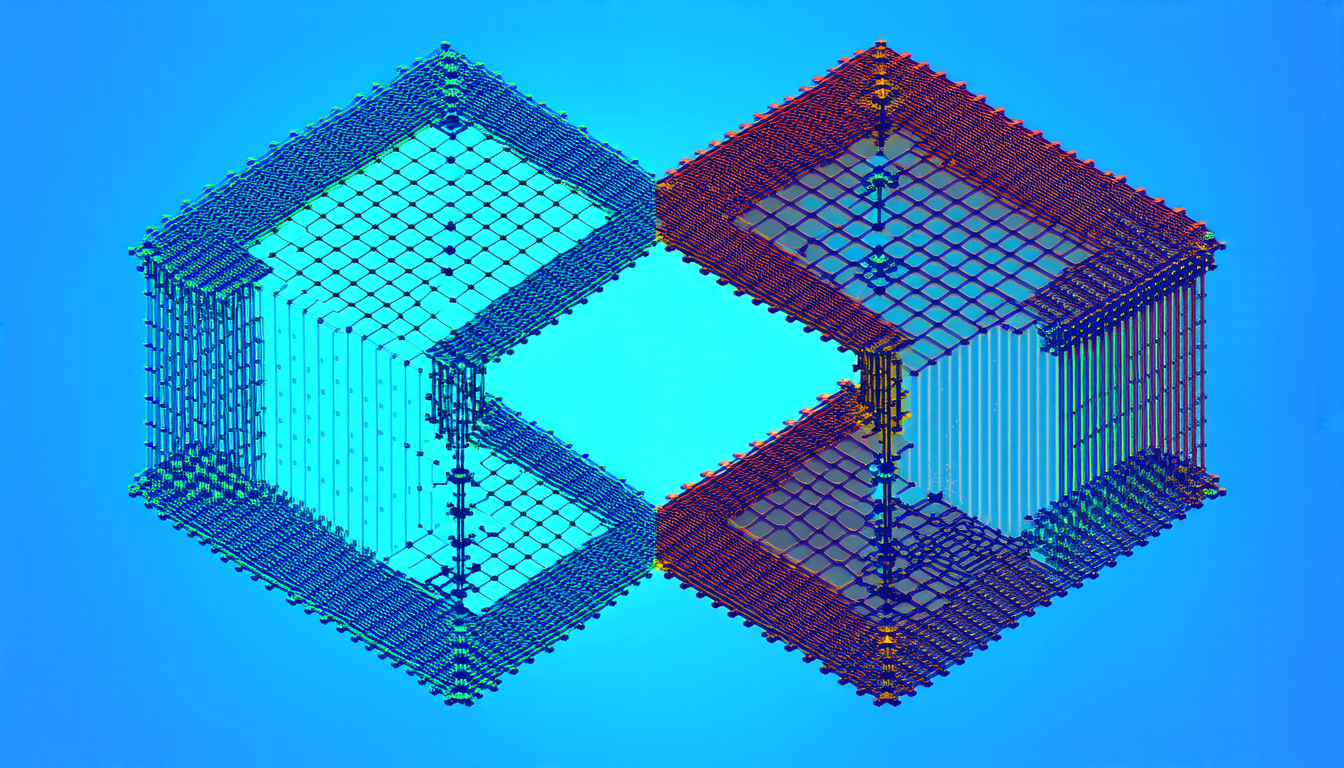
By studying the interactions between individual units within a mechanical metamaterial, scientists have been able to map the underlying logic that governs its behavior. This has led to the discovery of novel topological features, known as b-graphs, which play a crucial role in determining the material’s response to external stimuli.
One of the most striking aspects of these materials is their ability to exhibit bistability, where two distinct states can coexist and be switched between by carefully manipulating the driving forces. This property has significant implications for applications such as mechanical computing and memory storage.
Furthermore, researchers have also observed non-Abelian responses in certain metamaterials, which involve a complex interplay of multiple units and edges within the material’s structure. These responses can exhibit properties that are fundamentally different from those seen in traditional materials, opening up new avenues for research and innovation.
To better understand these phenomena, scientists have developed sophisticated numerical models and experiments to study the behavior of mechanical metamaterials under various driving protocols. By analyzing the results, researchers have been able to identify key features that govern the material’s response, including the formation of edge motifs and loop motifs within the b-graphs.
The discovery of these novel topological features has significant implications for our understanding of complex systems and their behavior. It also opens up new possibilities for the design and development of mechanical metamaterials with specific properties and functionalities.
In recent years, researchers have made significant progress in understanding the behavior of mechanical metamaterials. The development of numerical models and experiments has enabled scientists to study the intricate dance of these materials in unprecedented detail.
One of the most promising areas of research is the development of mechanical metamaterials with bistable properties. By carefully manipulating the driving forces, it may be possible to create materials that can switch between two distinct states, opening up new possibilities for applications such as mechanical computing and memory storage.
The study of non-Abelian responses in mechanical metamaterials is another area of significant research. These responses involve a complex interplay of multiple units and edges within the material’s structure, leading to properties that are fundamentally different from those seen in traditional materials.
Cite this article: “Unlocking the Secrets of Non-Linear Materials: A New Route to Artificial Intelligence”, The Science Archive, 2025.
Mechanical Metamaterials, Bistability, Non-Abelian Responses, Topological Features, B-Graphs, Numerical Models, Experiments, Driving Protocols, Edge Motifs, Loop Motifs.





