

Wednesday 09 April 2025
Scientists have made a significant discovery in their quest to detect gravitational waves, ripples in the fabric of spacetime that were predicted by Albert Einstein’s theory of general relativity. By analyzing data from the LIGO and Virgo detectors, researchers have identified a potential signal emitted by a binary system consisting of two neutron stars orbiting each other.
Neutron stars are incredibly dense objects formed when massive stars collapse under their own gravity. They’re so dense that a sugar-cube-sized amount of their material would weigh about the same as Mount Everest. When these stars are in close proximity, they can create powerful gravitational waves that travel through spacetime like ripples on a pond.
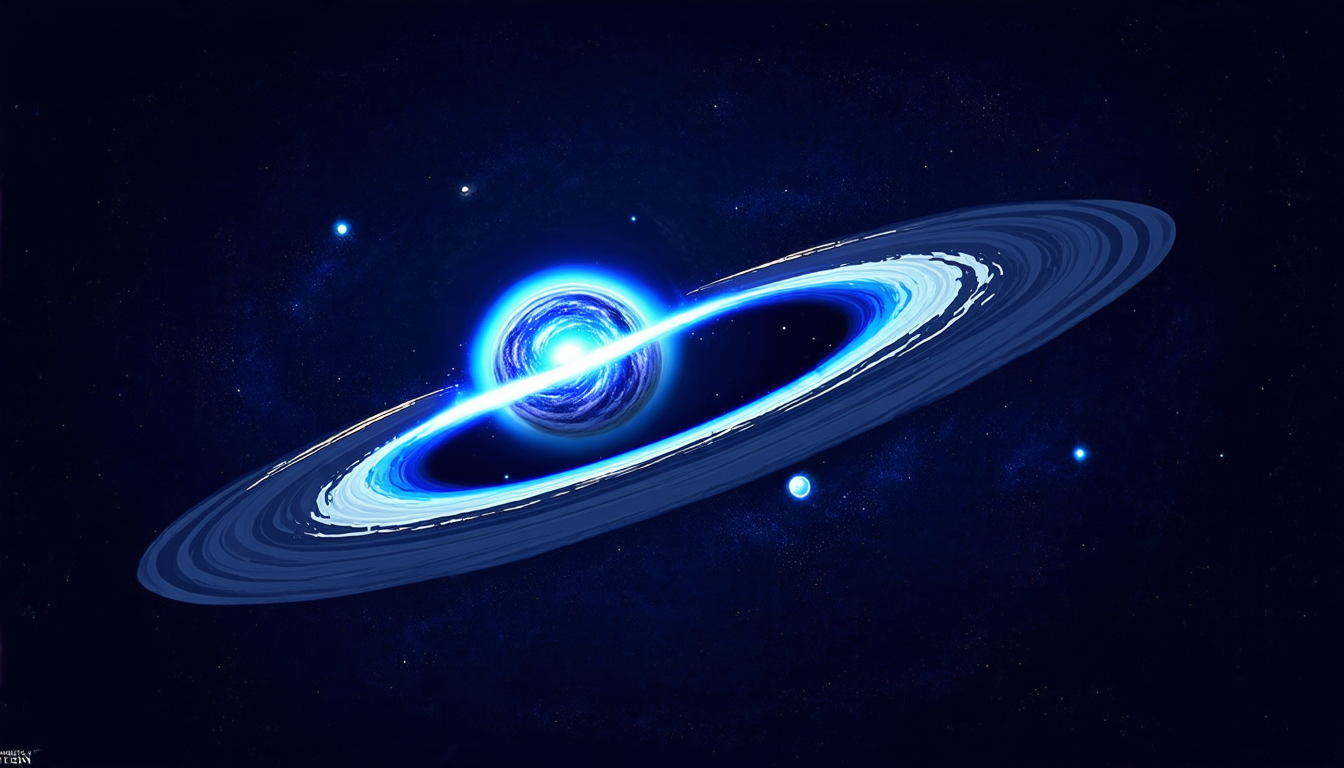
The detected signal is thought to have originated from Scorpius X-1, a binary system located about 9,000 light-years away in the constellation of Scorpius. This system consists of a neutron star and a companion star that’s likely a black hole. As the two stars orbit each other, they emit intense radiation, including gravitational waves.
The researchers used a sophisticated algorithm to search for signals in the data collected by LIGO and Virgo. The algorithm is designed to identify patterns in the noise that could indicate the presence of a gravitational wave signal. By analyzing the data from both detectors, scientists can confirm whether the signal is real or simply a result of instrumental noise.
While this finding is exciting, it’s not yet clear whether it’s actually a detection of a gravitational wave signal. The researchers have set upper limits on the strength of the signal, which means they’ve established a threshold for what would be considered a statistically significant detection. However, further analysis and verification are needed to confirm whether Scorpius X-1 is indeed emitting gravitational waves.
The implications of detecting gravitational waves from Scorpius X-1 are significant. It could provide insights into the properties of neutron stars and black holes, as well as the behavior of matter in extreme environments. Moreover, it would demonstrate the power of LIGO and Virgo’s advanced detectors in capturing these elusive signals.
As scientists continue to analyze the data, they’re refining their techniques and developing new methods to detect gravitational waves. The prospect of uncovering secrets about the universe is thrilling, and this discovery is a promising step forward in that journey.
Cite this article: “Unlocking the Secrets of Neutron Star Binaries: A New Search Method Reveals Hidden Gravitational Waves”, The Science Archive, 2025.
Gravitational Waves, Ligo, Virgo, Neutron Stars, Binary Systems, Black Holes, Scorpius X-1, Albert Einstein, General Relativity, Spacetime.





