

Wednesday 09 April 2025
As we continue to generate and store vast amounts of data, our ability to make sense of it all has become increasingly important. One key challenge is knowledge graph embedding, which involves transforming complex relationships between entities into a format that machines can understand.
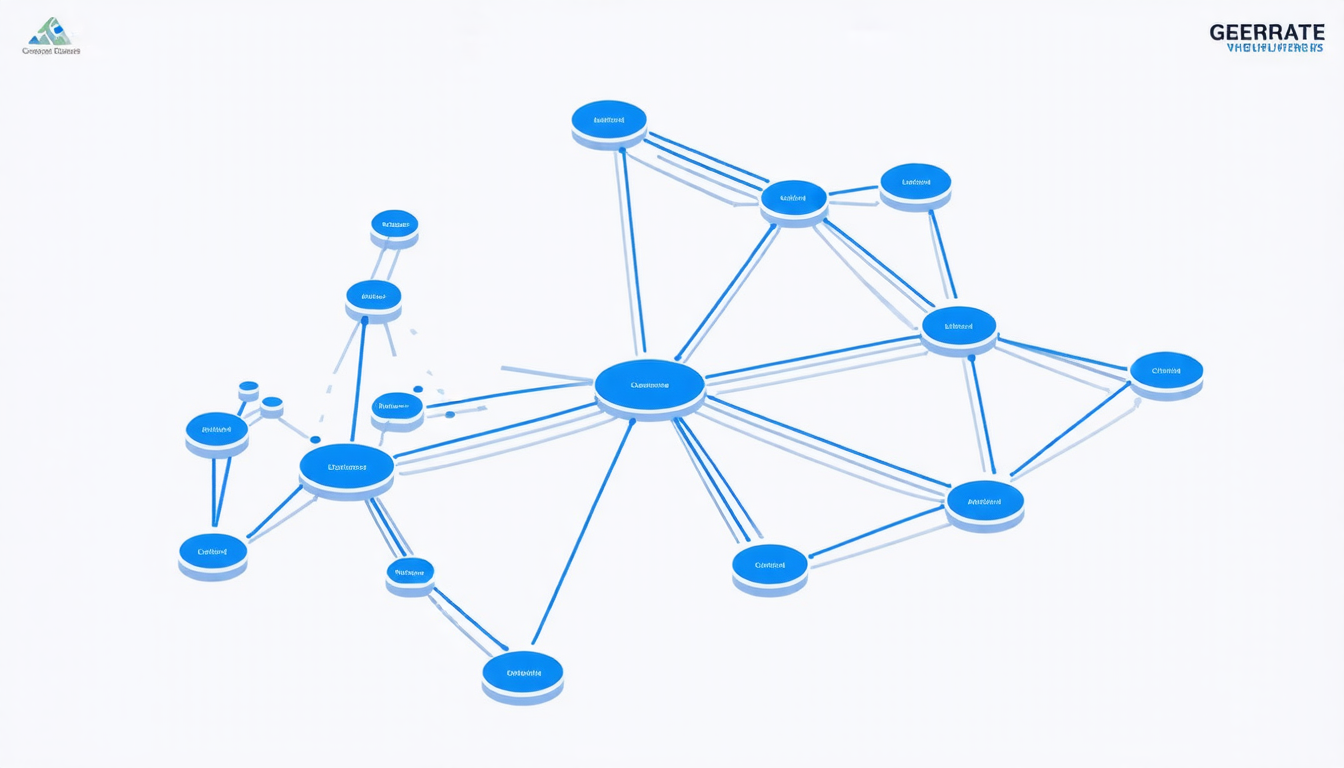
A team of researchers has proposed a novel approach to this problem, introducing a framework called SoTCKGE (Spatial Offset Transformation-based Continual Knowledge Graph Embedding). This method uses region embeddings to represent the positions of entities in a knowledge graph, allowing for more accurate modeling of complex relationships.
The traditional approach to knowledge graph embedding relies on translation-based methods, where previously learned knowledge is used as a starting point for new facts. However, this can lead to poor performance when dealing with complex relational structures or multi-hop relationships.
SoTCKGE addresses these limitations by introducing an offset vector that represents the distance between an entity’s base position and its actual location in the graph. This allows the model to capture more nuanced relationships between entities, such as those involving multiple hops.
The researchers also implemented a hierarchical update strategy, where new knowledge is integrated into the existing embedding space through simple spatial transformations. This approach ensures that old knowledge is preserved while allowing for efficient updates of new information.
To evaluate the effectiveness of SoTCKGE, the team conducted experiments on several publicly available datasets and found significant improvements in multi-hop relationship learning and overall accuracy.
One notable aspect of SoTCKGE is its ability to balance the integration of new and old knowledge. This is particularly important in real-world scenarios where data is constantly being updated or expanded.
The researchers’ approach also has implications for lifelong learning, as it allows models to adapt to new information without forgetting previously learned knowledge. This could have significant applications in fields such as natural language processing, computer vision, and recommender systems.
While SoTCKGE is not a silver bullet for all knowledge graph embedding challenges, its innovative approach has the potential to significantly improve our ability to model complex relationships between entities. As we continue to generate and store more data, developing efficient and effective methods for making sense of it will be crucial for unlocking new insights and applications.
The team’s work highlights the importance of considering the nuances of complex relational structures in knowledge graph embedding, and demonstrates a promising path forward for addressing these challenges.
Cite this article: “Rebooting Knowledge Graph Embeddings: A Novel Framework for Continual Learning and Transfer”, The Science Archive, 2025.
Knowledge Graph Embedding, Spatial Offset Transformation, Continual Learning, Entity Relationships, Multi-Hop Relations, Hierarchical Update Strategy, Lifelong Learning, Natural Language Processing, Computer Vision, Recommender Systems





