

Wednesday 09 April 2025
Scientists have made a significant breakthrough in understanding the behavior of particles at the atomic level. Researchers have discovered a new type of energy state, known as an exceptional point, which has the ability to manipulate the properties of materials.
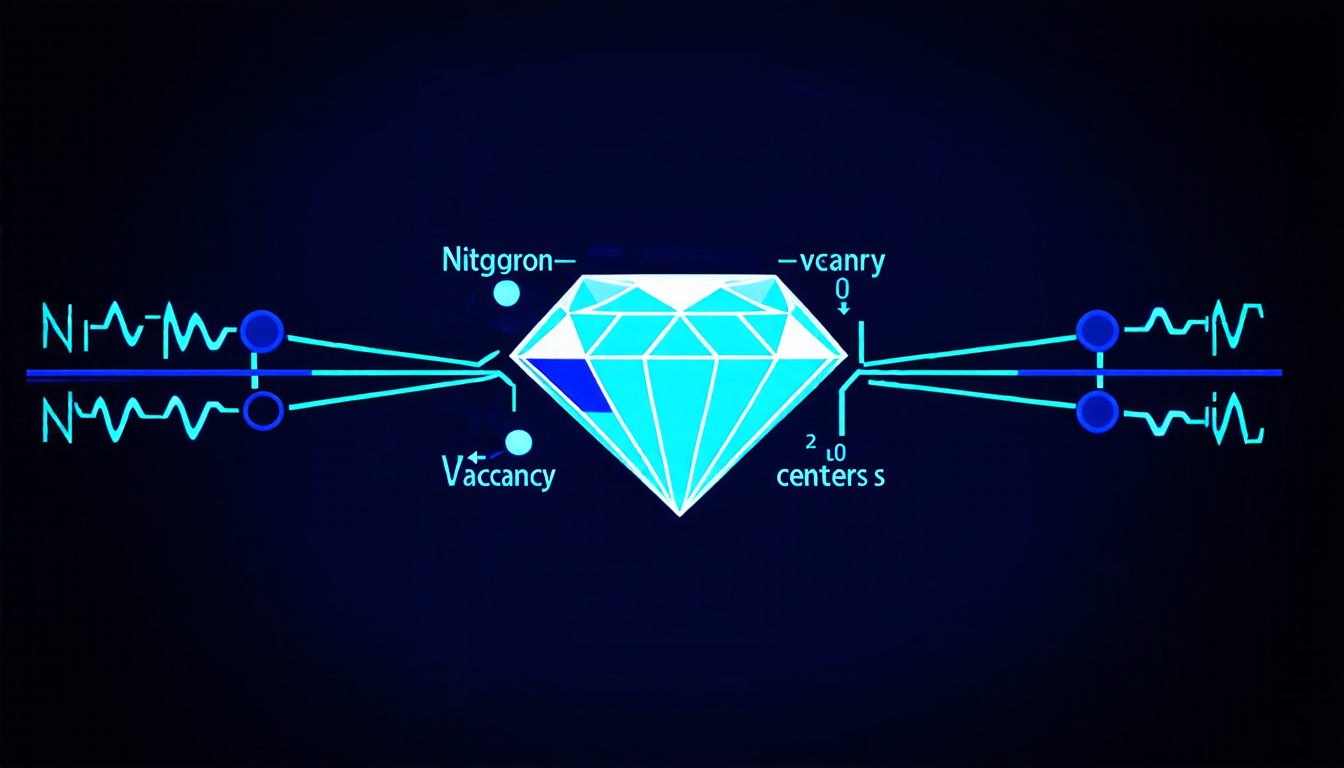
The discovery was made by observing the behavior of nitrogen-vacancy centers in diamond, tiny defects that occur when a nitrogen atom is substituted for a carbon atom and a neighboring carbon atom is missing. These defects have unique magnetic and optical properties that make them ideal for studying quantum phenomena.
By manipulating the energy levels of these defects using microwave pulses, scientists were able to create an exceptional point, where two energy states became degenerate. This means that the particles in these states began to behave identically, defying the conventional rules of quantum mechanics.
The significance of this discovery lies in its potential applications. Exceptional points have been shown to have the ability to manipulate the properties of materials, such as their conductivity and magnetism. This could lead to the development of new technologies with unique properties, such as superconductors that can operate at room temperature or magnets that are more efficient than current technology.
The discovery also sheds light on the behavior of particles in non-Hermitian systems, which are systems where the Hamiltonian operator is not equal to its adjoint. Non-Hermitian systems have been shown to exhibit unique properties, such as the ability to manipulate energy levels and create exceptional points.
The study of non-Hermitian systems has far-reaching implications for our understanding of quantum mechanics. It could lead to new insights into the behavior of particles at the atomic level and potentially even challenge our current understanding of reality.
In order to understand how this works, it’s helpful to consider the concept of degeneracy. In a system with degenerate energy levels, two or more states have the same energy. This can occur in systems where there are symmetries that cause the energy levels to become identical.
The exceptional point is created by manipulating the energy levels using microwave pulses. By applying these pulses, scientists were able to create a situation where the two energy states became degenerate. This allowed them to study the behavior of particles in this unique state.
One of the key findings of the study was that the particles in the degenerate state began to behave identically. This is known as adiabatic evolution, and it’s a fundamental property of quantum mechanics. The researchers were able to manipulate the properties of the material by controlling the energy levels of the defects.
Cite this article: “Unlocking Secrets of Exceptional Points in Quantum Systems”, The Science Archive, 2025.
Particles, Atomic Level, Quantum Mechanics, Exceptional Point, Nitrogen-Vacancy Centers, Diamond, Microwave Pulses, Energy States, Non-Hermitian Systems, Degeneracy.





