

Wednesday 09 April 2025
The quest for better understanding of our surroundings has led researchers to develop innovative methods to predict and reconstruct 3D scenes. Recently, a team of scientists has made significant progress in this field by introducing a novel approach that can accurately predict occupancy in complex environments.
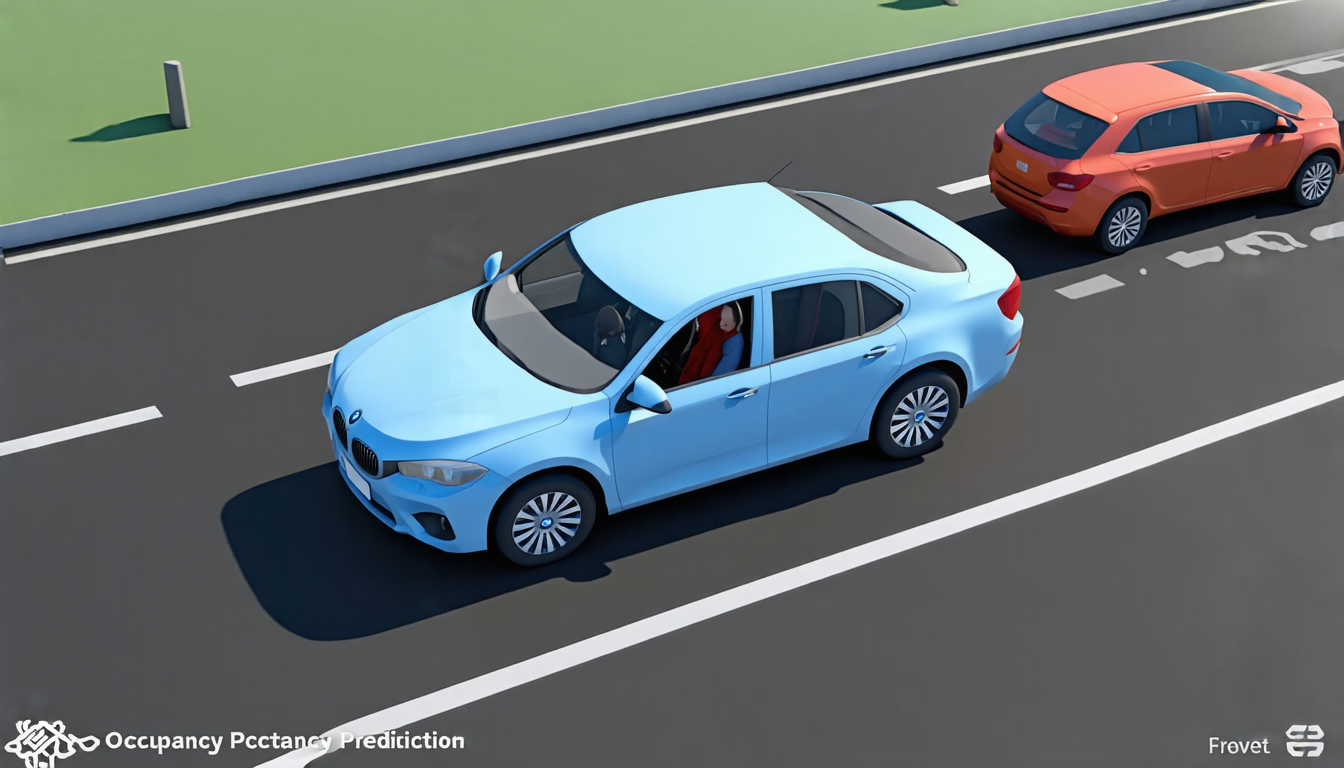
Occupancy prediction is crucial for various applications, including autonomous vehicles, robotics, and computer vision. It involves determining whether a given location in a scene is occupied by an object or not. Traditional methods rely on pre-trained models and 3D annotations, which are time-consuming to create and often limited in their ability to generalize.
The new approach, dubbed TT-GaussOcc, addresses these limitations by using raw sensor streams as input and optimizing time-aware 3D Gaussians at runtime. This allows for flexible voxelization at arbitrary user-defined resolutions, enabling the method to adapt to varying object classes and spatial resolutions without extensive retraining.
One of the key innovations is the use of trilateral RBF (radial basis function) kernels that jointly consider color, semantic, and spatial affinities. These kernels help mitigate noise in semantic predictions and scene flow vectors, leading to more accurate and coherent 3D occupancy maps.
The method’s performance was evaluated on two benchmark datasets: Occ3D-nuScenes and nuCraft. Results show significant improvements over state-of-the-art baselines, with TT-GaussOcc achieving up to a 45% increase in mean IoU (intersection over union) metric. The method also demonstrates robustness to varying object classes and spatial resolutions.
The potential applications of TT-GaussOcc are vast. For instance, it can be used to enable autonomous vehicles to better understand their surroundings, allowing them to make more informed decisions about navigation and obstacle avoidance. In robotics, the method can improve the accuracy of robot localization and mapping in complex environments.
Moreover, TT-GaussOcc has the potential to revolutionize computer vision by enabling more accurate and efficient 3D scene reconstruction from raw sensor data. This could lead to breakthroughs in fields such as augmented reality, virtual reality, and graphics rendering.
The development of TT-GaussOcc is a testament to the power of collaboration and innovation in scientific research. By combining insights from computer vision, robotics, and machine learning, researchers can create solutions that address some of the most pressing challenges in these fields.
In the future, it will be exciting to see how TT-GaussOcc continues to evolve and improve as researchers explore its potential applications and limitations.
Cite this article: “Unlocking Dynamic Scenes: A Novel Approach to Occupancy Prediction in Autonomous Driving”, The Science Archive, 2025.
3D Scene Reconstruction, Occupancy Prediction, Autonomous Vehicles, Robotics, Computer Vision, Machine Learning, Sensor Streams, 3D Gaussians, Radial Basis Function, Intersection Over Union





