

Wednesday 09 April 2025
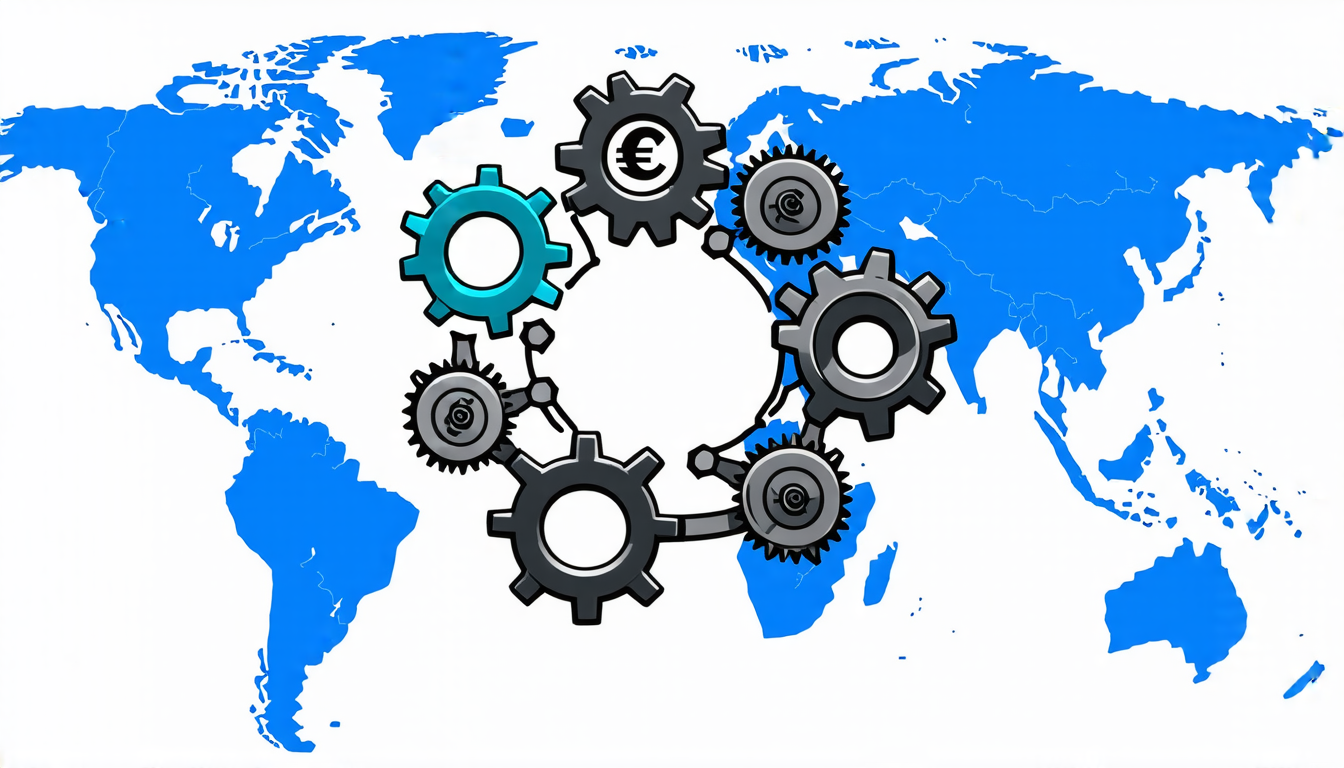
A team of researchers has made a significant breakthrough in understanding how global economies are connected and how they affect each other. By analyzing data from over 10 countries, scientists have developed a new model that takes into account the intricate web of international trade relationships between nations.
The current methods for modeling economic systems focus on individual countries or groups of countries, but this new approach recognizes that the global economy is an interconnected network. The researchers used advanced statistical techniques to analyze data from 1979 to 2019 and found that certain patterns emerged.
For instance, they discovered that changes in long-term interest rates in one country often have a ripple effect on other countries’ economies. This means that monetary policies implemented by central banks can have far-reaching consequences beyond their own borders.
The model also revealed that certain economic variables, such as stock prices and inflation rates, are more closely linked than previously thought. This suggests that global economic trends can be influenced by factors such as global trade agreements or international financial markets.
One of the key innovations of this research is its ability to account for both systematic and idiosyncratic relationships between countries’ economies. Systematic relationships refer to patterns that occur across multiple countries, while idiosyncratic relationships are unique to individual countries.
The researchers used a combination of machine learning algorithms and statistical techniques to identify these relationships. They also developed a new method for estimating the model’s parameters, which allowed them to accurately predict future economic trends.
The implications of this research are significant. By better understanding how global economies are connected, policymakers can make more informed decisions about monetary policy, trade agreements, and other economic initiatives.
For example, if a country is experiencing a recession, policymakers may be able to use the model to identify which other countries’ economies are likely to be affected and adjust their policies accordingly.
The researchers hope that their work will contribute to a more nuanced understanding of global economics and help policymakers make better decisions in an increasingly interconnected world.
Cite this article: “Deciphering Global Economic Interdependencies: A Novel Matrix-Valued Time Series Approach”, The Science Archive, 2025.
Global Economies, International Trade Relationships, Economic Systems, Statistical Analysis, Machine Learning Algorithms, Monetary Policy, Stock Prices, Inflation Rates, Global Trade Agreements, Interconnected World





