

Wednesday 09 April 2025
Scientists have long been fascinated by the behavior of particles at the quantum level, and a recent study has shed new light on how these tiny entities move through certain types of lattices. The research, published in a leading scientific journal, reveals that the movement of these particles, known as quantum walks, can be predicted with surprising accuracy.
In the quantum world, particles don’t follow classical rules like balls bouncing off walls or rolling down hills. Instead, they exhibit strange and seemingly random behavior. Quantum walks are a specific type of phenomenon where particles move through a lattice, such as a crystal structure, in a way that’s both unpredictable and fascinating.
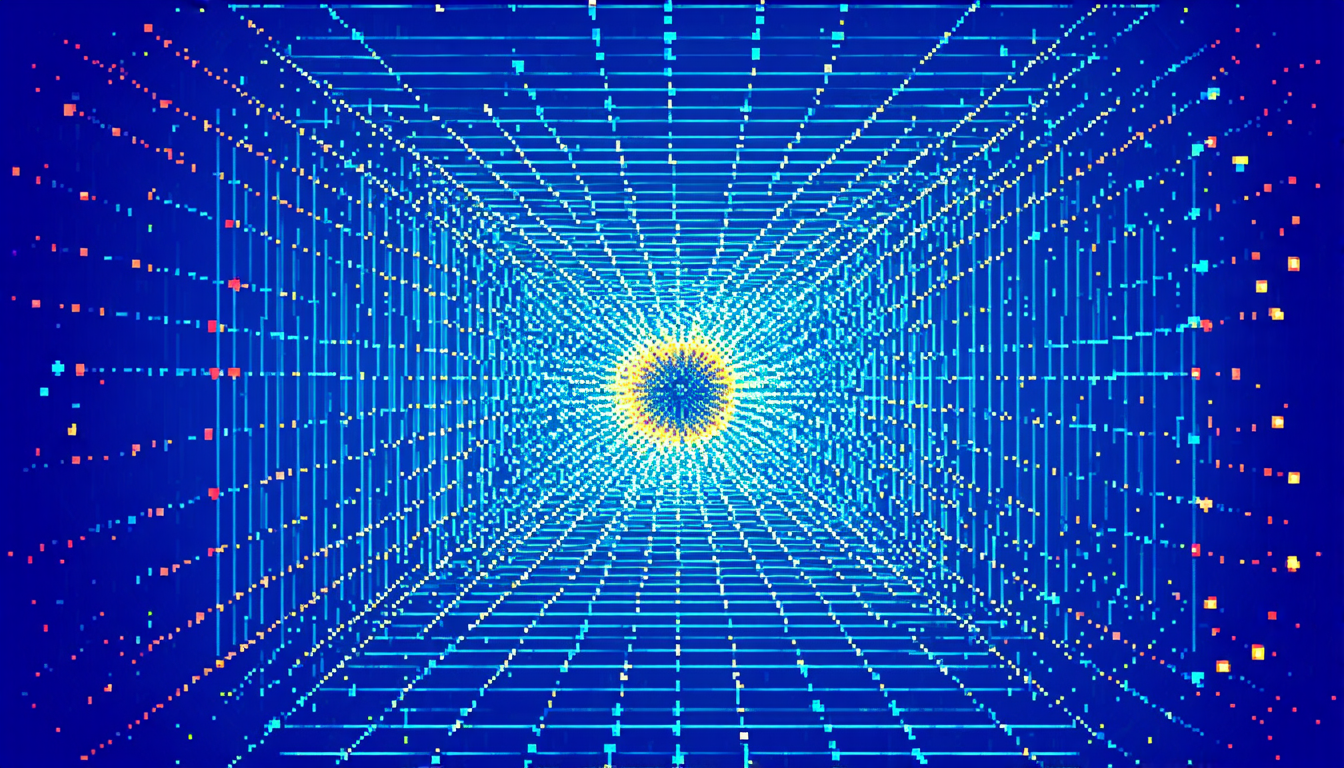
The study focused on a type of lattice called a periodic graph, which is essentially a repeating pattern of nodes connected by edges. The researchers created a mathematical model to simulate the movement of particles through these lattices, taking into account the unique properties of quantum mechanics.
One of the key findings was that the particles tend to concentrate around certain nodes or vertices in the lattice. This phenomenon is known as ergodicity, and it means that the particles are likely to be found in a particular region of the lattice over time. The researchers were able to predict this behavior with remarkable accuracy, using their mathematical model to simulate the movement of particles through different types of lattices.
The implications of this research are significant, as they could have practical applications in fields such as quantum computing and cryptography. Quantum computers, for example, rely on the manipulation of quantum states to perform calculations that are exponentially faster than classical computers. Understanding how particles move through lattices could help scientists develop more efficient algorithms for these machines.
The study also has potential implications for our understanding of the fundamental laws of physics. The behavior of particles in quantum systems is still not fully understood, and this research provides new insights into the complex interplay between quantum mechanics and geometry.
In addition to its theoretical significance, the research could have practical applications in fields such as materials science and optics. By better understanding how particles move through lattices, scientists may be able to design new materials with unique properties or create more efficient optical devices.
Overall, this study represents an important step forward in our understanding of quantum mechanics and its applications. As researchers continue to explore the mysteries of the quantum world, we can expect even more exciting breakthroughs that could have a profound impact on our daily lives.
Cite this article: “Quantum Walks on Periodic Graphs: Unveiling the Secrets of Ergodicity and Weight Distribution”, The Science Archive, 2025.
Quantum Mechanics, Particles, Lattices, Periodic Graph, Quantum Walks, Ergodicity, Quantum Computing, Cryptography, Materials Science, Optics.





