

Wednesday 09 April 2025
In a breakthrough that could revolutionize the way we navigate complex environments, researchers have developed a new approach to cooperative target pursuit using multi-agent reinforcement learning.
The study, published in a recent issue of IEEE Transactions on Robotics, demonstrates a novel framework for coordinating multiple autonomous vehicles to track and capture an elusive target. This is particularly significant in scenarios where traditional methods fail, such as in situations with limited visibility or when the target’s movement is unpredictable.
To tackle this challenge, the researchers employed a multi-agent reinforcement learning (MARL) framework, which allowed them to train multiple agents simultaneously to optimize their individual actions and maximize the chances of successful pursuit. This approach enabled the agents to adapt to changing circumstances and learn from each other’s experiences.
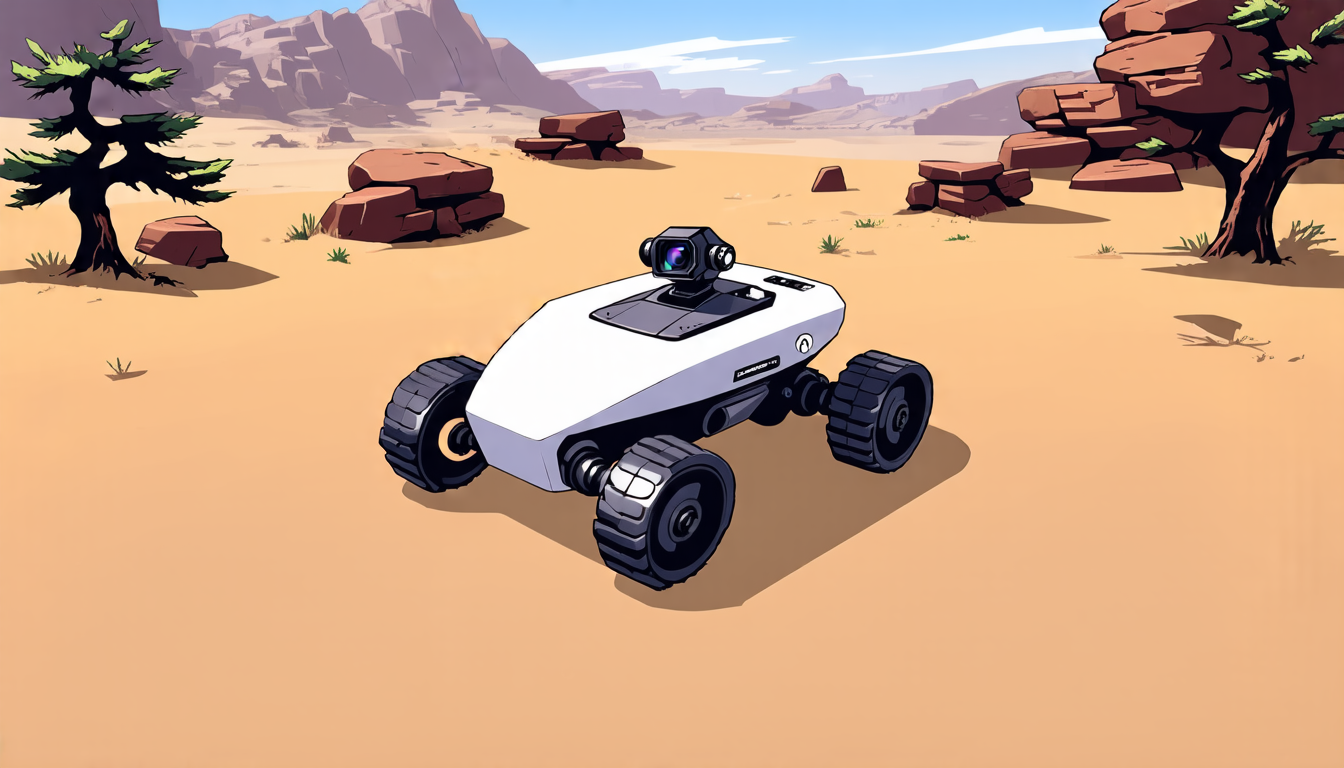
The team developed a custom-built autonomous vehicle with a LoRa communication module, which received control commands from the MARL algorithm running on a computer. The vehicle was equipped with a monocular camera, allowing it to reconstruct bearings of the target and send them back to the central controller.
The researchers then designed a novel pseudo-linear information filter (u-PLIF) to estimate the target’s position and velocity using these bearing measurements. This filter proved robust in handling noisy data and was able to accurately track the target even when the observers’ location errors were significant.
In their experiments, the team demonstrated that the MARL framework effectively coordinated multiple agents to pursue a dynamic target, achieving successful capture despite the presence of obstacles and uncertain target movements. The results showed that the system could adapt to changing environmental conditions and learn from its mistakes.
The implications of this research are far-reaching, with potential applications in areas such as search and rescue operations, surveillance, and military operations. By developing more sophisticated MARL algorithms and integrating them with advanced sensors and communication systems, researchers can create more efficient and effective autonomous teams capable of tackling complex tasks.
This study is a significant step forward in the development of cooperative target pursuit using multi-agent reinforcement learning. As we continue to push the boundaries of artificial intelligence and robotics, it will be exciting to see how this technology evolves and is applied in real-world scenarios.
Cite this article: “Cooperative Pursuit of Agile Targets via Multiagent Reinforcement Learning and Bearing-Only Measurement”, The Science Archive, 2025.
Multi-Agent Reinforcement Learning, Cooperative Target Pursuit, Autonomous Vehicles, Robotics, Ieee Transactions On Robotics, Lora Communication Module, Monocular Camera, Pseudo-Linear Information Filter, U-Plif, Search And Rescue Operations





