

Wednesday 09 April 2025
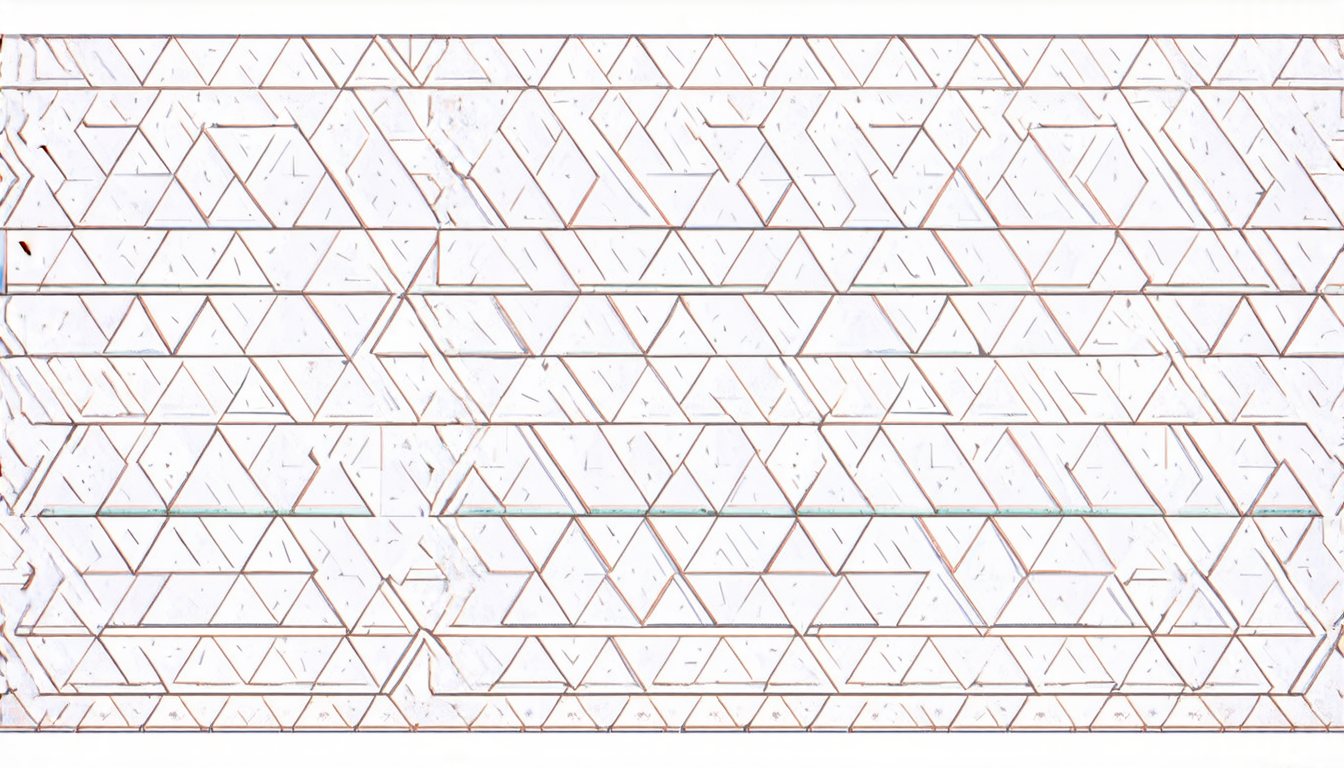
Friezes are intricate patterns that have been studied for centuries, dating back to ancient mathematicians like Leonardo of Pisa and Johannes Widmann. These geometric designs seem simple at first glance, but they can be surprisingly complex and difficult to understand. Recently, a team of researchers made significant progress in their study of friezes, using techniques from algebraic geometry and number theory to count the number of possible patterns.
The researchers started by looking at a specific type of frieze called Dynkin friezes, which are named after the Russian mathematician Evgraf Stepanovich Dynkin. These friezes have a special property: they can be created using a set of simple rules and a limited number of building blocks. Despite their simplicity, Dynkin friezes have been notoriously difficult to study, with many mathematicians struggling to understand their properties.
The researchers used a combination of computer algorithms and mathematical techniques to count the number of possible Dynkin friezes for different types of geometric patterns. They found that there are exactly 4400 positive integer solutions for one type of pattern, known as E7-friezes, and 26952 for another type, known as E8-friezes.
The significance of this finding lies in the fact that it completes our understanding of Dynkin friezes for all finite geometric patterns. In other words, we now know how many possible solutions exist for each type of pattern, which is a major milestone in the study of friezes.
The researchers’ approach was based on a technique called Diophantine enumeration, which involves counting the number of integer solutions to a set of equations. This method has been used before in other areas of mathematics, such as algebraic geometry and number theory. However, its application to Dynkin friezes required a unique combination of mathematical techniques and computer algorithms.
One of the most interesting aspects of this research is its connection to other areas of mathematics. For example, the study of Dynkin friezes has implications for our understanding of cluster algebras, which are a type of algebraic structure used in theoretical physics. The researchers also found connections between their work and other areas of number theory, such as the study of Diophantine equations.
The counting of Dynkin friezes is not just an abstract mathematical exercise; it has practical applications in fields like computer science and materials science.
Cite this article: “Unlocking the Secrets of Frieze Patterns: A Diophantine Odyssey”, The Science Archive, 2025.
Algebraic Geometry, Number Theory, Diophantine Enumeration, Dynkin Friezes, Geometric Patterns, Computer Algorithms, Cluster Algebras, Theoretical Physics, Materials Science, Mathematics
Reference: Robin Zhang, “Diophantine enumeration of Dynkin friezes” (2025).





