

Wednesday 09 April 2025
The intricate dance of diagrams and polynomials has long fascinated mathematicians, who have been seeking to understand the underlying patterns that govern their behavior. Recently, a team of researchers has made significant progress in this area, shedding light on the properties of posets – partial orders that arise from certain types of diagrams.
In essence, posets are like lattices, but with some crucial differences. While lattives have a unique maximum and minimum element, posets do not necessarily possess these extremes. This lack of structure can make it challenging to study and understand their behavior, which is precisely what the researchers set out to do.
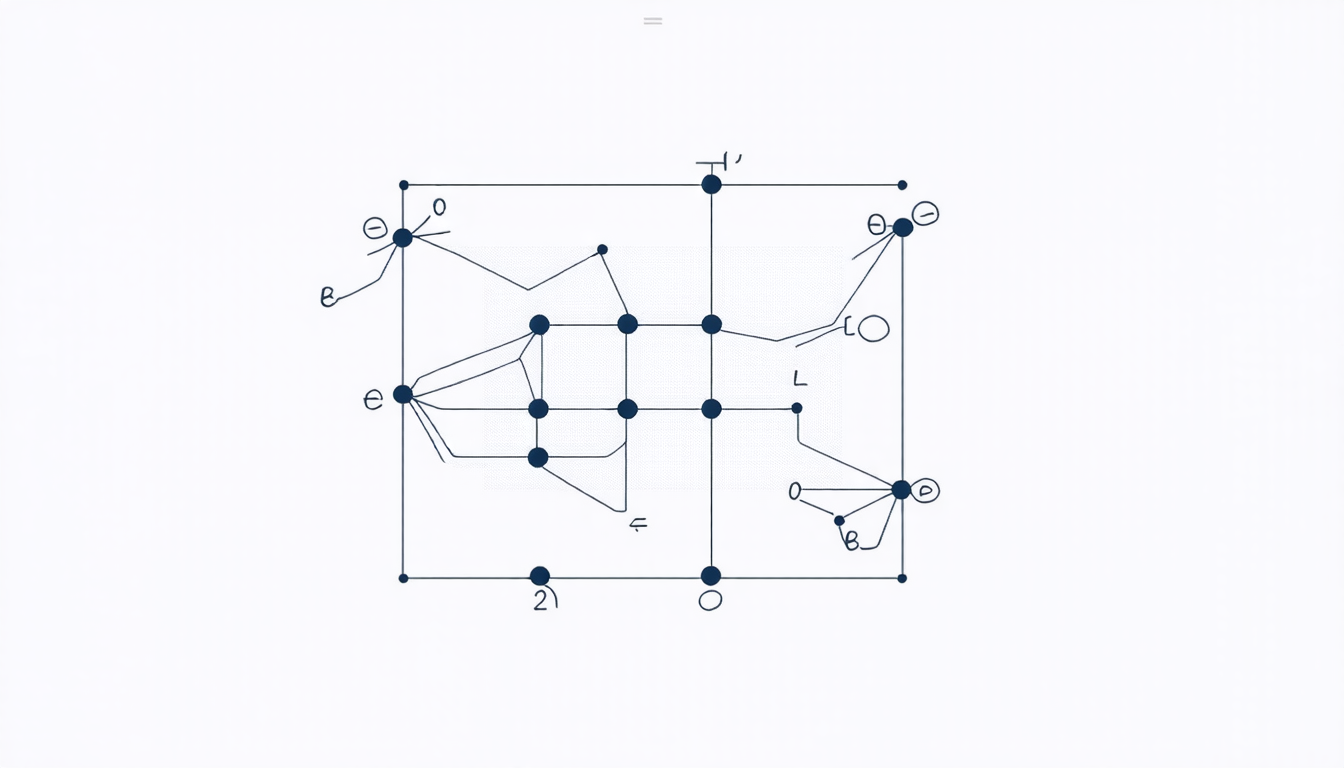
The team’s work revolves around Kohnert diagrams – intricate patterns of cells that can be thought of as combinations of rows and columns. By analyzing these diagrams, they were able to identify specific properties that govern the relationships between different elements within the poset. This insight has far-reaching implications for our understanding of algebraic combinatorics.
One of the key findings is that certain types of Kohnert diagrams can be used to define polynomials – mathematical objects that describe the behavior of systems with multiple variables. These polynomials, known as Lascoux polynomials, have been a subject of intense study in recent years due to their connections to other areas of mathematics, such as representation theory and algebraic geometry.
The researchers’ work has also shed light on the relationship between posets and lattices. While lattices are typically considered to be more structured than posets, the team’s findings suggest that certain types of posets can exhibit similar properties to lattices. This has significant implications for our understanding of the underlying mathematical structures that govern these systems.
The study also touches on the concept of boundedness – a property that describes whether or not a poset contains a unique maximum and minimum element. The researchers were able to identify specific conditions under which a poset is bounded, providing valuable insights into the behavior of these systems.
This work has far-reaching implications for our understanding of algebraic combinatorics, representation theory, and algebraic geometry. It also highlights the importance of interdisciplinary approaches to problem-solving, as mathematicians from different areas of study came together to tackle this complex problem.
The team’s findings have significant potential applications in various fields, including computer science, physics, and engineering. For example, their work on Lascoux polynomials could be used to develop new algorithms for solving complex systems of equations.
Cite this article: “Unlocking the Secrets of Kohnert Posets: A Breakthrough in Combinatorial Puzzle-Solving”, The Science Archive, 2025.
Posets, Diagrams, Polynomials, Algebraic Combinatorics, Representation Theory, Algebraic Geometry, Lattices, Boundedness, Kohnert Diagrams, Lascoux Polynomials
Reference: Kelsey Hanser, Nicholas Mayers, “Ghost Kohnert posets” (2025).





