

Wednesday 09 April 2025
A team of scientists has made a significant breakthrough in understanding the behavior of high-energy jets emitted by some of the most extreme objects in the universe, known as blazars. These jets are incredibly powerful and can outshine entire galaxies.
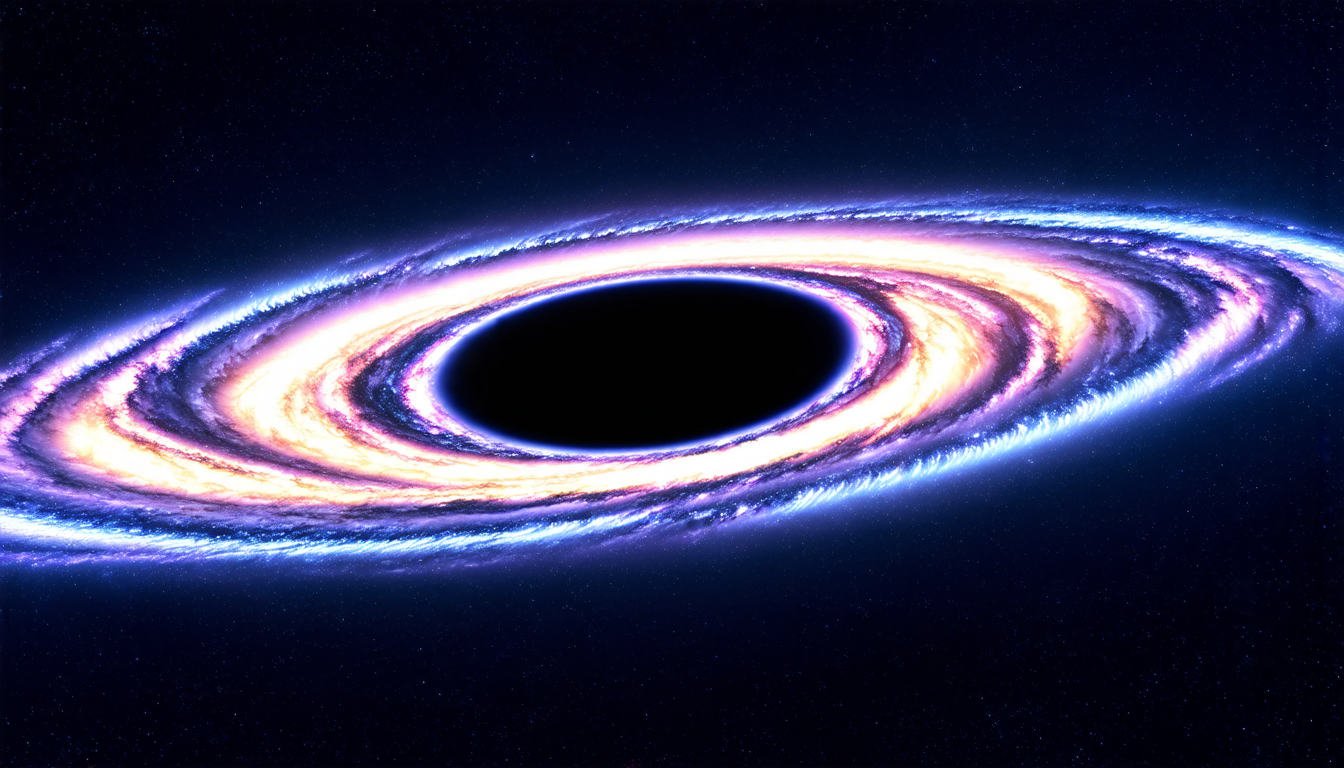
Blazars are active galactic nuclei (AGN) that are powered by supermassive black holes at their centers. As matter spirals towards these black holes, it becomes hotter and denser, eventually reaching temperatures of millions of degrees. This heat energy is released as intense radiation, which can be observed from Earth.
The researchers used a sophisticated computer simulation to model the behavior of these jets. They created a virtual blazar with a supermassive black hole at its center and simulated the flow of matter and energy as it spirals towards the black hole. The team then analyzed the resulting data to understand how the jet’s properties change as it moves away from the black hole.
One key finding was that the jet’s polarization properties, which describe how light vibrates when it passes through a magnetic field, can be used to infer its physical conditions. Polarization is an important tool for astronomers because it provides valuable information about the environment in which the radiation is produced.
The simulation showed that as the jet moves away from the black hole, its polarization becomes more complex and varied. This complexity is caused by the interaction between the jet’s magnetic field and the surrounding material. By analyzing this variation, scientists can learn more about the conditions inside the jet, such as its temperature, density, and velocity.
The researchers also discovered that the jet’s polarization properties are sensitive to the strength of the magnetic field in the jet. This is significant because it means that future observations could be used to map the magnetic field structure within the jet, providing valuable insights into the underlying physics.
The team’s findings have important implications for our understanding of blazars and their role in shaping the universe. By studying these extreme objects, scientists can gain a better understanding of the fundamental laws of physics and how they apply in extreme environments.
In addition to advancing our knowledge of blazars, this research has potential applications in other areas of astronomy. For example, the techniques developed for analyzing polarization data could be used to study other types of astrophysical objects, such as supernovae or neutron stars.
The simulation’s results were published in a recent paper, detailing the team’s methodology and findings.
Cite this article: “Unlocking the Secrets of Black Hole Jets: A New Understanding of Synchrotron Radiation Emission”, The Science Archive, 2025.
Blazars, Active Galactic Nuclei, Supermassive Black Holes, High-Energy Jets, Radiation, Polarization, Magnetic Fields, Astrophysics, Simulation, Galaxy Formation





