

Thursday 10 April 2025
Scientists have made a significant breakthrough in developing a new method for optimizing the allocation of resources in complex systems, such as robotic warehouses. The approach, known as Distributionally Robust Multi-Agent Reinforcement Learning (DRMARL), uses machine learning algorithms to predict and adapt to uncertain environments.
In traditional reinforcement learning, agents are trained to make decisions based on past experiences and rewards. However, this approach can be limited when dealing with complex systems that involve multiple agents and uncertain outcomes. DRMARL addresses this challenge by incorporating a robustness mechanism that takes into account the uncertainty of the environment.
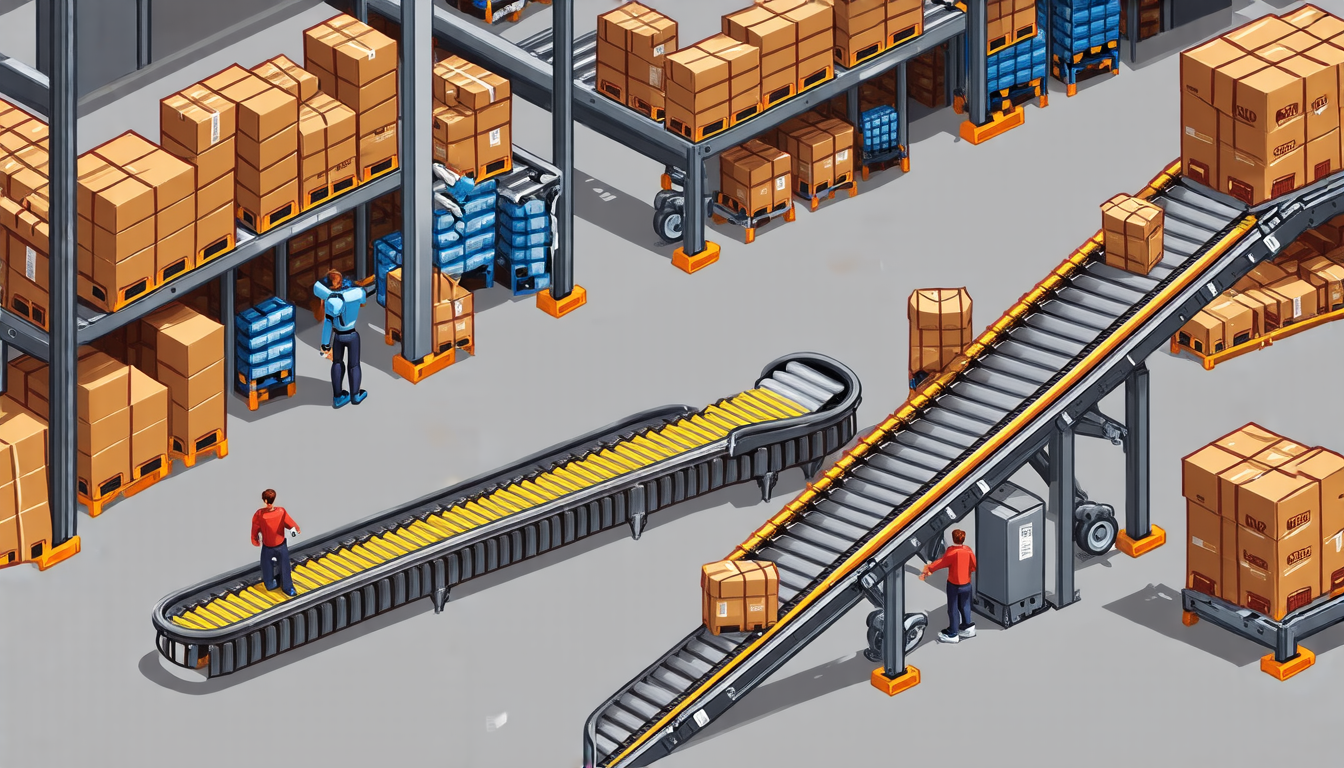
The researchers used a robotic warehouse as a testbed for their method. In this system, packages are transported from induction stations to designated eject chutes based on their destinations. The goal is to optimize the allocation of chutes to ensure efficient and reliable package sorting.
To develop DRMARL, the team combined two key components: a contextual bandit-based worst-case reward predictor (QCB) and a distributionally robust Bellman operator. QCB predicts the worst-case rewards for each state-action pair, while the distributionally robust Bellman operator incorporates this information to optimize the allocation of chutes.
The researchers tested their method using extensive simulations and compared it to traditional multi-agent reinforcement learning (MARL). The results showed that DRMARL significantly outperformed MARL in terms of package sortation efficiency and recirculation reduction. On average, DRMARL reduced recirculation by 80% while increasing throughput by 5.62%.
The team’s approach has significant implications for optimizing complex systems, particularly those involving multiple agents and uncertain environments. By incorporating robustness mechanisms, DRMARL can adapt to changing conditions and improve overall performance.
In the future, the researchers plan to apply their method to other domains, such as supply chain management and autonomous vehicles. They also aim to further improve the efficiency of QCB by incorporating more advanced machine learning algorithms.
The development of DRMARL demonstrates the potential of combining robustness mechanisms with reinforcement learning to optimize complex systems. As research continues to advance, we can expect to see even more innovative applications of this approach in various fields.
Cite this article: “Robust Multi-Agent Reinforcement Learning for Large-Scale Robotic Sortation Warehouses Under Distributional Uncertainty”, The Science Archive, 2025.
Machine Learning, Reinforcement Learning, Multi-Agent Systems, Robotic Warehouses, Distributionally Robust, Optimisation, Complex Systems, Uncertainty, Autonomous Vehicles, Supply Chain Management





