

Thursday 10 April 2025
The quest for control in chaotic systems has long been a challenge for scientists and engineers. In the complex world of autonomous vehicles, smart grids, and multi-agent systems, tiny uncertainties can quickly snowball into catastrophic outcomes. Now, researchers have developed a new approach to tame these uncertainties, ensuring that our machines and devices operate safely and efficiently.
The problem lies in the unpredictable nature of interacting agents, which can lead to a cascade of errors and failures. To address this issue, scientists have turned to signal temporal logic (STL), a mathematical framework that allows them to specify complex requirements for systems behavior. However, STL’s probabilistic nature means that it is prone to errors and uncertainties, making it difficult to guarantee the safety and performance of these systems.
To overcome this hurdle, researchers have developed a new distributionally robust control synthesis method. This approach uses concentration of measure (CoM) theory to provide a probabilistic under-approximation of the original STL constraints. By leveraging CoM’s ability to bound the probability of extreme events, the team has created a more reliable and efficient framework for controlling complex systems.
The key innovation lies in the use of Wasserstein distance, a mathematical concept that measures the similarity between two probability distributions. By incorporating this metric into the control synthesis process, researchers can better account for uncertainties and ensure that the system behaves as intended. This approach also allows them to provide probabilistic guarantees on the performance of the system, giving engineers a clearer understanding of its capabilities and limitations.
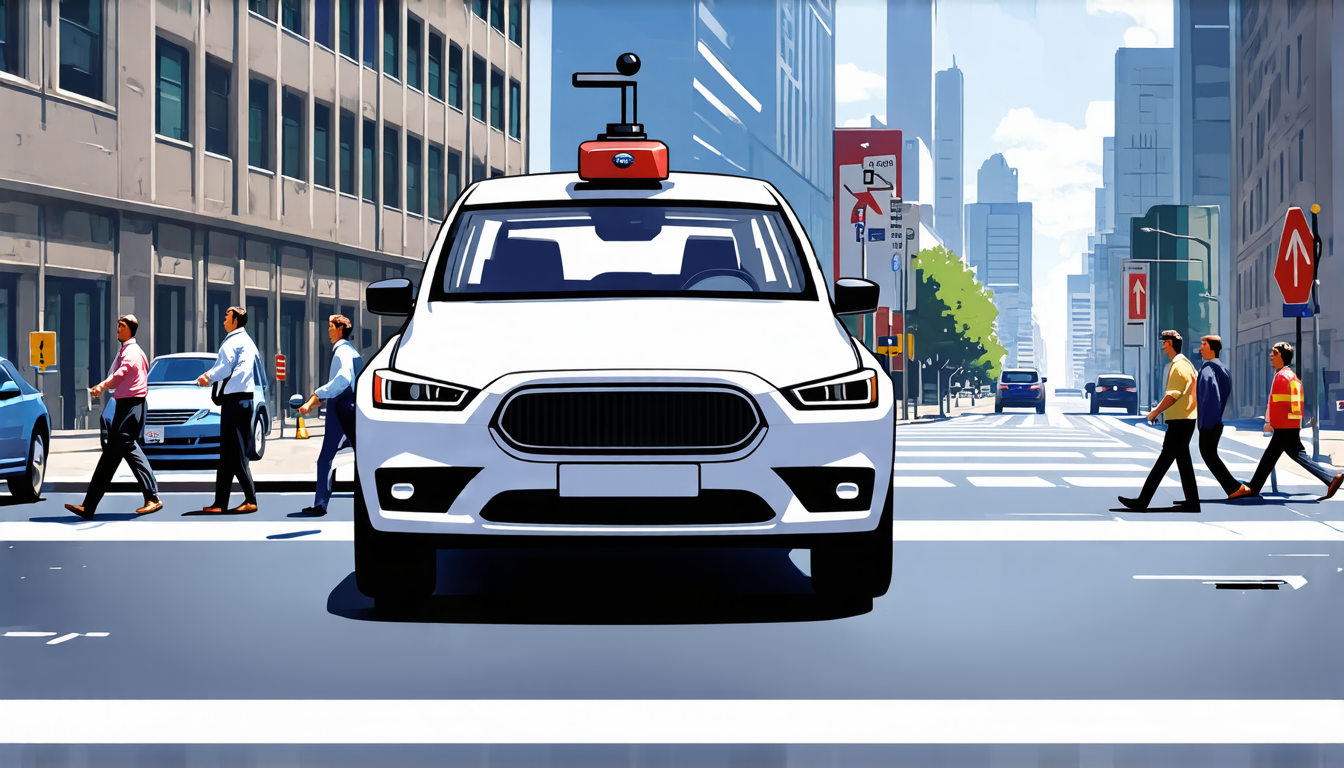
The implications of this research are far-reaching, with potential applications in fields such as autonomous vehicles, smart grids, and robotics. For instance, imagine a self-driving car navigating through a crowded city street, where pedestrians and other vehicles pose unpredictable risks. With this new control synthesis method, the car’s software can better account for these uncertainties, ensuring a safer and more efficient journey.
The team’s work has also shed light on the importance of data-driven approaches in control systems. By leveraging machine learning techniques to estimate the underlying probability distributions, researchers can create more robust and adaptive control strategies. This integration of machine learning and control theory holds significant promise for tackling complex real-world problems.
As our world becomes increasingly reliant on autonomous systems, the need for reliable and efficient control strategies has never been greater. This new distributionally robust control synthesis method offers a crucial step forward in addressing these challenges, paving the way for safer, more efficient, and more adaptive machines that can operate effectively in uncertain environments.
Cite this article: “Safe Control Synthesis for Uncertain Multi-Agent Systems: A Distributionally Robust Approach”, The Science Archive, 2025.
Autonomous Vehicles, Smart Grids, Multi-Agent Systems, Signal Temporal Logic, Distributionally Robust Control Synthesis, Concentration Of Measure Theory, Wasserstein Distance, Probabilistic Guarantees, Machine Learning, Control Theory.





